Results by title
95 books match the query 'Whites' and 3 start with o

Object Lessons
Robyn Wiegman
Duke University Press, 2012
No concept has been more central to the emergence and evolution of identity studies than social justice. In historical and theoretical accounts, it crystallizes the progressive politics that have shaped the academic study of race, gender, and sexuality. Yet few scholars have deliberated directly on the political agency that notions of justice confer on critical practice. In Object Lessons, Robyn Wiegman contemplates this lack of attention, offering the first sustained inquiry into the political desire that galvanizes identity fields. In each chapter, she examines a key debate by considering the political aspirations that shape it. Addressing Women's Studies, she traces the ways that "gender" promises to overcome the exclusions of "women." Turning to Ethnic Studies, she examines the deconstruction of "whiteness" as an antiracist methodology. As she explores American Studies, she links internationalization to the broader quest for noncomplicity in contemporary criticism. Her analysis of Queer Studies demonstrates how the commitment to antinormativity normalizes the field. In the penultimate chapter, Wiegman addresses intersectionality as the most coveted theoretical approach to political resolution in all of these fields.
[more]

Odd Tribes
Toward a Cultural Analysis of White PeopleJohn Hartigan Jr.
Duke University Press, 2005
Odd Tribes challenges theories of whiteness and critical race studies by examining the tangles of privilege, debasement, power, and stigma that constitute white identity. Considering the relation of phantasmatic cultural forms such as the racial stereotype “white trash” to the actual social conditions of poor whites, John Hartigan Jr. generates new insights into the ways that race, class, and gender are fundamentally interconnected. By tracing the historical interplay of stereotypes, popular cultural representations, and the social sciences’ objectifications of poverty, Hartigan demonstrates how constructions of whiteness continually depend on the vigilant maintenance of class and gender decorums.
Odd Tribes engages debates in history, anthropology, sociology, and cultural studies over how race matters. Hartigan tracks the spread of “white trash” from an epithet used only in the South prior to the Civil War to one invoked throughout the country by the early twentieth century. He also recounts how the cultural figure of “white trash” influenced academic and popular writings on the urban poor from the 1880s through the 1990s. Hartigan’s critical reading of the historical uses of degrading images of poor whites to ratify lines of color in this country culminates in an analysis of how contemporary performers such as Eminem and Roseanne Barr challenge stereotypical representations of “white trash” by claiming the identity as their own. Odd Tribes presents a compelling vision of what cultural studies can be when diverse research methodologies and conceptual frameworks are brought to bear on pressing social issues.
Odd Tribes engages debates in history, anthropology, sociology, and cultural studies over how race matters. Hartigan tracks the spread of “white trash” from an epithet used only in the South prior to the Civil War to one invoked throughout the country by the early twentieth century. He also recounts how the cultural figure of “white trash” influenced academic and popular writings on the urban poor from the 1880s through the 1990s. Hartigan’s critical reading of the historical uses of degrading images of poor whites to ratify lines of color in this country culminates in an analysis of how contemporary performers such as Eminem and Roseanne Barr challenge stereotypical representations of “white trash” by claiming the identity as their own. Odd Tribes presents a compelling vision of what cultural studies can be when diverse research methodologies and conceptual frameworks are brought to bear on pressing social issues.
[more]
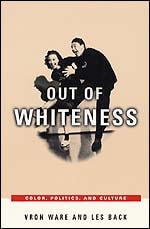
Out of Whiteness
Color, Politics, and CultureVron Ware and Les Back
University of Chicago Press, 2002
What happens when people in societies stratified by race refuse to accept the privileges inherent in whiteness? What difference does it make when whites act in a manner that contradicts their designated racial identity? Out of Whiteness considers these questions and argues passionately for an imaginative and radical politics against all forms of racism.
Vron Ware and Les Back look at key points in recent American and British culture where the "color line" has been blurred. Through probing accounts of racial masquerades in popular literature, the growth of the white power music scene on the Internet, the meteoric rise of big band jazz during the Second World War, and the pivotal role of white session players in crafting rhythm and blues classics by black artists, Ware and Back upset the idea of race as a symbol of inherent human attributes. Their book gives us a timely reckoning of the forces that continue to make people "white," and reveals to us the polyglot potential of identities and cultures.
Vron Ware and Les Back look at key points in recent American and British culture where the "color line" has been blurred. Through probing accounts of racial masquerades in popular literature, the growth of the white power music scene on the Internet, the meteoric rise of big band jazz during the Second World War, and the pivotal role of white session players in crafting rhythm and blues classics by black artists, Ware and Back upset the idea of race as a symbol of inherent human attributes. Their book gives us a timely reckoning of the forces that continue to make people "white," and reveals to us the polyglot potential of identities and cultures.
[more]