Results by title
1441 books match the query 'World' and 19 start with o
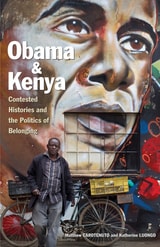
Obama and Kenya
Contested Histories and the Politics of BelongingMatthew Carotenuto
Ohio University Press, 2016
Barack Obama’s political ascendancy has focused considerable global attention on the history of Kenya generally and the history of the Luo community particularly. From politicos populating the blogosphere and bookshelves in the U.S and Kenya, to tourists traipsing through Obama’s ancestral home, a variety of groups have mobilized new readings of Kenya’s past in service of their own ends.
Through narratives placing Obama into a simplified, sweeping narrative of anticolonial barbarism and postcolonial “tribal” violence, the story of the United States president’s nuanced relationship to Kenya has been lost amid stereotypical portrayals of Africa. At the same time, Kenyan state officials have aimed to weave Obama into the contested narrative of Kenyan nationhood.
Matthew Carotenuto and Katherine Luongo argue that efforts to cast Obama as a “son of the soil” of the Lake Victoria basin invite insights into the politicized uses of Kenya’s past. Ideal for classroom use and directed at a general readership interested in global affairs, Obama and Kenya offers an important counterpoint to the many popular but inaccurate texts about Kenya’s history and Obama’s place in it as well as focused, thematic analyses of contemporary debates about ethnic politics, “tribal” identities, postcolonial governance, and U.S. African relations.

October!
The Soviet CentenaryMichael Hardt and Sandro Mezzadra, special issue editors
Duke University Press, 2017
Contributors. Giso Amendola, Martín Bergel, Kathy Ferguson, Michael Hardt, Wang Hui, Artemy Magun, John MacKay, Sandro Mezzadra, Antonio Negri, Enzo Traverso
Of Spies and Spokesmen
My Life as a Cold War CorrespondentNicholas Daniloff
University of Missouri Press, 2008
An American reporter of Russian heritage assigned to Soviet-era Moscow might seem to have an edge on his colleagues, but when he’s falsely accused of spying, any advantage quickly evaporates. . . . .
As a young UPI correspondent in Moscow during the early 1960s, Nicholas Daniloff hoped to jump-start his career in his father’s homeland, but he soon learned that the Cold War had its own rules of engagement. In this riveting memoir, he describes the reality of journalism behind the Iron Curtain: how Western reporters banded together to thwart Soviet propagandists, how their “official sources” were almost always controlled by the KGB—and how those sources would sometimes try to turn newsmen into collaborators.
Leaving Moscow for Washington in 1965, Daniloff honed his skills at the State Department, then returned to Moscow in 1981 to find a more open society. But when the FBI nabbed a Soviet agent in 1986, Daniloff was arrested in retaliation and thrown into prison as a spy—an incident that threatened to undo the Reykjavik summit until top aides to Reagan and Gorbachev worked out a solution.
In addition to recounting a career in the thick of international intrigue, Of Spies and Spokesmen is brimming with inside information about historic events. Daniloff tells how the news media played a crucial role in resolving the Cuban Missile Crisis, recalls the emotional impact of the JFK assassination on Soviet leadership, and describes the behind-the-scenes struggles that catapulted Mikhail Gorbachev to power. He even shares facts not told to the public: how the SAC would warn Moscow that its submarines were too close to American shores, why the Soviets shot down the KAL airliner without visual identification, and how American reporters in Moscow sometimes did dangerous favors for our government that could easily have been mistaken for espionage.
Daniloff sheds light not only on prominent figures such as Nikita Khrushchev and Henry Kissinger but also on suspected spies Frederick Barghoorn, John Downey, and ABC correspondent Sam Jaffe—unfairly branded a Soviet agent by the FBI. In addition, he assesses the performance of Henry Shapiro, dean of American journalists in Moscow, whose forty years in the adversary’s capital often provoke questions about his role and reputation.
In describing how the Western press functioned in the old Soviet Union—and how it still functions in Washington today—Daniloff shows that the Soviet Russia he came to know was far more complex than the “evil empire” painted by Ronald Reagan: a web of propaganda and manipulation, to be sure, but also a place of hospitality and friendship. And with Russia still finding its way toward a new social and political order, he reminds us that seventy years of Communist rule left a deep impression on its national psyche. As readable as it is eye-opening, Of Spies and Spokesmenprovides a new look at that country’s heritage—and at the practice of journalism in times of crisis.

Ohio and the World, 1753–2053
ESSAYS TOWARD A NEW HISTORY OF OHIOEdited by Geoffrey Parker, Richard Sisson, and William Russell Coil
The Ohio State University Press, 2005
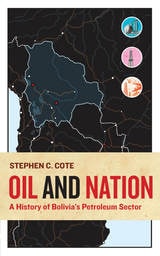
Oil and Nation
A History of Bolivia's Petroleum SectorStephen C. Cote
West Virginia University Press, 2016
The book advances chronologically from Bolivia’s earliest petroleum pioneers in the nineteenth century until the present, inserting oil into historical debates about Bolivian ethnic, racial, and environmental issues, and within development strategies by different administrations. While Bolivia is best known for its tin mining, Oil and Nation makes the case that nationalist reformers viewed hydrocarbons and the state oil company as a way to modernize the country away from the tin monoculture and its powerful backers and toward an oil-powered future.
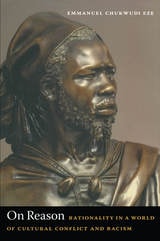
On Reason
Rationality in a World of Cultural Conflict and RacismEmmanuel Chukwudi Eze
Duke University Press, 2008
Eze draws on an extraordinary command of Western philosophical thought and a deep knowledge of African philosophy and cultural traditions. He explores models of rationality in the thought of philosophers from Aristotle, René Descartes, Francis Bacon, and Thomas Hobbes to Noam Chomsky, Richard Rorty, Hilary Putnam, and Jacques Derrida, and he considers portrayals of reason in the work of the African thinkers and novelists Chinua Achebe, Ngugi wa Thiong’o, and Wole Soyinka. Eze reflects on contemporary thought about genetics, race, and postcolonial historiography as well as on the interplay between reason and unreason in the hearings of South Africa’s Truth and Reconciliation Commission. He contends that while rationality may have a foundational formality, any understanding of its foundation and form is dynamic, always based in historical and cultural circumstances.
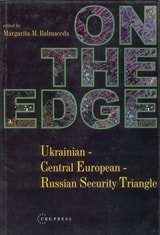
On The Edge
Ukrainian - Central European - Russian Security TriangleMargarita M. Balmaceda
Central European University Press, 2001
A new globally significant relationship arising after the break-up of the Soviet Union is the main topic of this unparalleled volume – the geopolitical link between Russia, Ukraine and the three bordering ‘Central European’ states, Hungary, Poland and Slovakia. On the Edge is a path-breaking analysis of this triangular relationship with an in-depth focus on economic, political and, more importantly, security issues.
The expansion of NATO up to Ukraine’s borders is likely to leave Ukraine in a delicate position vis-à-vis Russia. On the Edge addresses key questions, such as: how are events in Ukraine affecting the security calculations of the Central European states; Central European relations with Russia and NATO; and relations among Central European states themselves? The volume examines what Central European states can do to solidify Ukraine’s independence and help it avoid international isolation.
On the Edge gives a Central European perspective on all these issues and suggests concrete forms of co-operation.
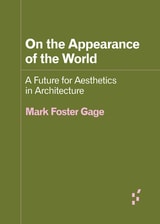
On the Appearance of the World
A Future for Aesthetics in ArchitectureMark Foster Gage
University of Minnesota Press, 2024
How can architecture develop better aesthetic directions for the twenty-first-century built environment?
Our world, increasingly defined by efficient but unconsidered architecture and cities, seems to be getting uglier. In On the Appearance of the World, Mark Foster Gage asks why. He imagines a future scenario where architectural design and ideas from aesthetic philosophy align toward the production of a built world that is more humane, habitable, beautiful, and just.
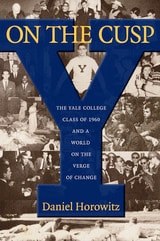
On the Cusp
The Yale College Class of 1960 and a World on the Verge of ChangeDaniel Horowitz
University of Massachusetts Press, 2015
How did the 1950s become “The Sixties”? This is the question at the heart of Daniel Horowitz's On the Cusp. Part personal memoir, part collective biography, and part cultural history, the book illuminates the dynamics of social and political change through the experiences of a small, and admittedly privileged, generational cohort.
A Jewish “townie” from New Haven when he entered Yale College in fall 1956, Horowitz reconstructs the undergraduate career of the class of 1960 and follows its story into the next decade. He begins by looking at curricular and extracurricular life on the all-male campus, then ranges beyond the confines of Yale to larger contexts, including the local drama of urban renewal, the lingering shadow of McCarthyism, and decolonization movements around the world. He ponders the role of the university in protecting the prerogatives of class while fostering social mobility, and examines the growing significance of race and gender in American politics and culture, spurred by a convergence of the personal and the political. Along the way he traces the political evolution of his classmates, left and right, as Cold War imperatives lose force and public attention shifts to the civil rights movement and the war in Vietnam.
Throughout Horowitz draws on a broad range of sources, including personal interviews, writings by classmates, reunion books, issues of the Yale Daily News, and other undergraduate publications, as well as his own letters and college papers. The end product is a work consistent with much of Horowitz's previously published scholarship on postwar America, further exposing the undercurrent of discontent and dissent that ran just beneath the surface of the so-called Cold War consensus.
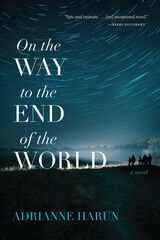
On the Way to the End of the World
A NovelAdrianne Harun
Acre Books, 2023
As the Cuban Missile Crisis eases, President Kennedy is casting around for a demonstration of American prowess when one of his Cabinet unearths an old mandate that US Marines be fit enough to walk fifty miles in twenty hours. Perfect! Kennedy decides to throw down the gauntlet to “today’s Marines,” but before he knows it, he’s sparked a wild fad. The entire country has answered the call, it seems, and for a few crazed winter weeks, masses of Americans will embark on their own arduous Big Walks—the “JFK 50-Milers.”
Yet in tiny Humtown—an isolated mill town in the Pacific Northwest—not everyone who shows up for a hastily organized Big Walk is motivated by patriotism. Not Helen Hubka, an inveterate gossip; not the suicidal Caroline, who months earlier lost her beloved husband during the Storm of the Century. Not ex-soldier/fisherman Jaspar Goode, nor the unknown man in their midst, a collared priest who seems to shift identities at will. Certainly not Avis, a battered teenager running from her terrifying brother . . . with a stolen town treasure. And when the walkers stumble upon the abandoned car of a missing young mother, they rekindle a mystery that soon reverberates among them, exposing hidden truths, talents, and alliances.
Splendidly imagined, with prose that sings on the page, On the Way to the End of the World is an adventure story riven with secrets, a national fairy tale twisted into a whodunit.
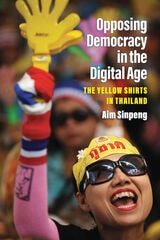
Opposing Democracy in the Digital Age
The Yellow Shirts in ThailandAim Sinpeng
University of Michigan Press, 2021
Opposing Democracy in the Digital Age is about why ordinary people in a democratizing state oppose democracy and how they leverage both traditional and social media to do so. Aim Sinpeng focuses on the people behind popular, large-scale antidemocratic movements that helped bring down democracy in 2006 and 2014 in Thailand. The yellow shirts (PAD—People’s Alliance for Democracy) that are the focus of the book are antidemocratic movements grown out of democratic periods in Thailand, but became the catalyst for the country’s democratic breakdown. Why, when, and how supporters of these movements mobilize offline and online to bring down democracy are some of the key questions that Sinpeng answers. While the book primarily uses a qualitative methodological approach, it also uses several quantitative tools to analyze social media data in the later chapters. This is one of few studies in the field of regime transition that focuses on antidemocratic mobilization and takes the role of social media seriously.
Opposing Power
Building Opposition Alliances in Electoral AutocraciesElvin Ong
University of Michigan Press, 2022
Opting Out
Women Messing with Marriage around the WorldJoanna Davidson
Rutgers University Press, 2023
Order and History, Volume 2 (CW15)
The World of the PolisEric Voegelin. Edited & Intro by Athanasios Moulakis
University of Missouri Press, 2000
This second volume of Voegelin's magisterial Order and History, The World of the Polis, explores the ancient Greek symbolization of human reality. Taking us from the origins of Greek culture in the Pre-Homeric Cretan civilizations, through the Iliad and Odyssey, Hesiod, and the rise of philosophy with the Pre-Socratics Parmenides and Heraclitus, this masterful work concludes with the historians of the classical period.
In The World of the Polis, Voegelin traces the emergence of the forms of the city-state and of philosophy from the ancient symbolism of myth. He maintains that the limits and ultimate goals of human nature are constant and that the central problem of every society is the same—"to create an order that will endow the fact of its existence with meaning in terms of ends divine and human." Thus, Voegelin shows how "the meaning of existence" achieved concrete expression in the typical political, social, and religious institutions of Greece and in the productions of its poets and thinkers. He deals with more than fifty Greek writers in the course of his analysis of the rise of myth and its representation of the divine order of the cosmos as the first great symbolic form of order, one later supplanted by the leap in being reflected in the emergence of philosophy.
The book is a tour de force, a virtuoso performance by a scholar and philosopher of great power, learning, and imagination that places its subject matter in a new light. The editor's critical introduction places The World of the Polis in the broader context of Voegelin's philosophy of history. Scholars and students of political science, philosophy, and the history of ideas will find this work invaluable.
Organizing Empire
Individualism, Collective Agency, and IndiaPurnima Bose
Duke University Press, 2003
From a historically grounded, feminist perspective, Bose offers four case studies, each of which illuminates a distinct individualizing rhetorical strategy. She looks at the parliamentary debates on the Amritsar Massacre of 1919, in which several hundred unarmed Indian protesters were killed; Margaret Cousins’s firsthand account of feminist organizing in Ireland and India; Kalpana Dutt’s memoir of the Bengali terrorist movement of the 1930s, which was modeled in part on Irish anticolonial activity; and the popular histories generated by ex-colonial officials and their wives. Bringing to the fore the constraints that colonial domination placed upon agency and activism, Organizing Empire highlights the complexity of the multiple narratives that constitute British colonial history.
Oriental Networks
Culture, Commerce, and Communication in the Long Eighteenth CenturyBärbel Czennia
Bucknell University Press, 2021
Published by Bucknell University Press. Distributed worldwide by Rutgers University Press.
Origins of African Nationalism
Continuity and Rupture in the Movements of Unity Emerging from the Struggle against Portuguese Colonial Domination, 1911–1961Mário Pinto de Andrade. Translated by Mario Pereira. Introduction by Jean-Michel Mabeko-Tali.
Tagus Press, 2022
Our Once and Future Planet
Restoring the World in the Climate Change CenturyPaddy Woodworth
University of Chicago Press, 2013
But that paints an unbalanced—and overly disheartening—picture of what’s going on with environmental stewardship today. There are success stories, and Our Once and Future Planet delivers a fascinating account of one of the most impressive areas of current environmental experimentation and innovation: ecological restoration. Veteran investigative reporter Paddy Woodworth has spent years traveling the globe and talking with people—scientists, politicians, and ordinary citizens—who are working on the front lines of the battle against environmental degradation. At sites ranging from Mexico to New Zealand and Chicago to Cape Town, Woodworth shows us the striking successes (and a few humbling failures) of groups that are attempting to use cutting-edge science to restore blighted, polluted, and otherwise troubled landscapes to states of ecological health—and, in some of the most controversial cases, to particular moments in historical time, before widespread human intervention. His firsthand field reports and interviews with participants reveal the promise, power, and limitations of restoration.
Ecological restoration alone won’t solve the myriad problems facing our environment. But Our Once and Future Planet demonstrates the role it can play, and the hope, inspiration, and new knowledge that can come from saving even one small patch of earth.
Our Own Way in This Part of the World
Biography of an African Community, Culture, and NationKwasi Konadu
Duke University Press, 2019