Results by title
66 books match the query 'Year' and 2 start with o
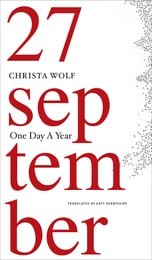
One Day a Year
2001–2011Christa Wolf
Seagull Books, 2017
During a 1960 interview, East German writer Christa Wolf was asked a curious question: would she describe in detail what she did on September 27th? Fascinated by considering the significance of a single day over many years, Wolf began keeping a detailed diary of September 27th, a practice which she carried on for more than fifty years until her death in 2011. The first volume of these notes covered 1960 through 2000 was published to great acclaim more than a decade ago. Now translator Katy Derbyshire is bringing the September 27th collection up to date with One Day a Year—a collection of Wolf’s notes from the last decade of her life.
The book is both a personal record and a unique document of our times. With her characteristic precision and transparency, Wolf examines the interplay of the private, subjective, and major contemporary historical events. She writes about Germany after 9/11, about her work on her last great book City of Angels, and also about her exhausting confrontation with old age. One Day a Year is a compelling and personal glimpse into the life of one of the world’s greatest writers.
The book is both a personal record and a unique document of our times. With her characteristic precision and transparency, Wolf examines the interplay of the private, subjective, and major contemporary historical events. She writes about Germany after 9/11, about her work on her last great book City of Angels, and also about her exhausting confrontation with old age. One Day a Year is a compelling and personal glimpse into the life of one of the world’s greatest writers.
[more]
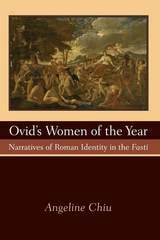
Ovid's Women of the Year
Narratives of Roman Identity in the FastiAngeline Chiu
University of Michigan Press, 2016
Roman love-poet Ovid, best known for the epic Metamorphoses, offers in his Fasti the self-proclaimed goal of exploring and explicating the Roman calendar. Published in his maturity circa 14 CE, the Fasti presents claims of aetiological, astronomical, and even antiquarian interests, but more importantly the poem highlights an extraordinary prominence of female characters at work, play, and worship in its verses. From flirtatious goddesses to talkative old women, beautiful puellae to stern prophetesses and beyond, Ovid’s “calendar girls” appear in a vast and kaleidoscopic array of guises and narratives, importing and transforming literary genre and expectation alike in a poem that already in shape and purpose is unique in Latin literature. The poet’s long-standing fascination with female figures that had first appeared in his earliest work and then accompanied him throughout his career now resurfaces in a much more complex form.
Of interest to literary scholars, antiquarians, and those studying the social and political roles of ancient women, Ovid’s Women of the Year offers an intriguing view of an Ovidian poem now coming into its own.
Of interest to literary scholars, antiquarians, and those studying the social and political roles of ancient women, Ovid’s Women of the Year offers an intriguing view of an Ovidian poem now coming into its own.
[more]