Results by title
295 books match the query 'Zoology' and 4 start with o
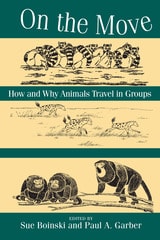
On the Move
How and Why Animals Travel in GroupsEdited by Sue Boinski and Paul A. Garber
University of Chicago Press, 2000
Getting from here to there may be simple for one individual. But as any parent, scout leader, or CEO knows, herding a whole troop in one direction is a lot more complicated. Who leads the group? Who decides where the group will travel, and using what information? How do they accomplish these tasks?
On the Move addresses these questions, examining the social, cognitive, and ecological processes that underlie patterns and strategies of group travel. Chapters discuss how factors such as group size, resource distribution and availability, the costs of travel, predation, social cohesion, and cognitive skills affect how individuals as well as social groups exploit their environment. Most chapters focus on field studies of a wide range of human and nonhuman primate groups, from squirrel monkeys to Turkana pastoralists, but chapters covering group travel in hyenas, birds, dolphins, and bees provide a broad taxonomic perspective and offer new insights into comparative questions, such as whether primates are unique in their ability to coordinate group-level activities.
On the Move addresses these questions, examining the social, cognitive, and ecological processes that underlie patterns and strategies of group travel. Chapters discuss how factors such as group size, resource distribution and availability, the costs of travel, predation, social cohesion, and cognitive skills affect how individuals as well as social groups exploit their environment. Most chapters focus on field studies of a wide range of human and nonhuman primate groups, from squirrel monkeys to Turkana pastoralists, but chapters covering group travel in hyenas, birds, dolphins, and bees provide a broad taxonomic perspective and offer new insights into comparative questions, such as whether primates are unique in their ability to coordinate group-level activities.
[more]
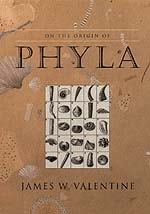
On the Origin of Phyla
James W. Valentine
University of Chicago Press, 2004
Owing its inspiration and title to On the Origin of Species, James W. Valentine's ambitious book synthesizes and applies the vast treasury of theory and research collected in the century and a half since Darwin's time. By investigating the origins of life's diversity, Valentine unlocks the mystery of the origin of phyla.
One of the twentieth century's most distinguished paleobiologists, Valentine here integrates data from molecular genetics, evolutionary developmental biology, embryology, comparative morphology, and paleontology into an analysis of interest to scholars from any of these fields. He begins by examining the sorts of evidence that can be gleaned from fossils, molecules, and morphology, then reviews and compares the basic morphology and development of animal phyla, emphasizing the important design elements found in the bodyplans of both living and extinct phyla. Finally, Valentine undertakes the monumental task of developing models to explain the origin and early diversification of animal phyla, as well as their later evolutionary patterns.
Truly a magnum opus, On the Origin of Phyla will take its place as one of the classic scientific texts of the twentieth century, affecting the work of paleontologists, morphologists, and developmental, molecular, and evolutionary biologists for decades to come.
"A magisterial compendium . . . . Valentine offers a judicious evaluation of an astonishing array of evidence."—Richard Fortey, New Scientist
"Truly a magnum opus, On the Origin of Phyla has already taken its place as one of the classic scientific texts of the twentieth century, affecting the work of paleontologists, morphologists, and developmental, molecular, and evolutionary biologists for decades to come."—Ethology, Ecology & Evolution
"Valentine is one of the Renaissance minds of our time. . . . Darwin wisely called his best-known work On the Origin of the Species; the origin of the phyla is an even stickier problem, and Valentine deserves credit for tackling it at such breadth . . . . A magnificient book."—Stefan Bengtson, Nature
[more]
Once a River
Bird Life and Habitat Changes on the Middle GilaAmadeo M. Rea
University of Arizona Press, 1983
Like many rivers of the arid Southwest, the Gila is for much of its length a dry bed except after seasonal rains. Yet a mere century ago it hosted a thriving biological community, and two centuries ago American Indians fished from its banks.
It is no mystery how the desert swallowed up the Gila. Beaver trapping, overgrazing, and woodcutting first ruined natural watersheds, then damming confined the last drops of its surface flow. Historical sources and archaeological data inform us of the Gila's past, but its bird life further testifies to the changes.
Amadeo Rea traces the decline of bird life on the Middle Gila in a book that addresses the broader issue of habitat deterioration. Bird lovers will find it a storehouse of data on avian migration patterns and on ornithological classification based on skeletal structure. Anthropologists can draw on its Piman ethnoclassification of birds, which links the Gila River tribe with various other Uto-Aztecan peoples of Mexico's west coast.
But for all concerned with protecting our environment, Once a River offers evidence of change that might be apprehended elsewhere. It is a case history of a loss that perhaps need never have occurred.
[more]
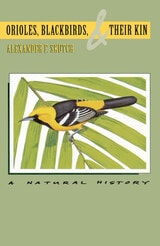
Orioles, Blackbirds, and Their Kin
A Natural HistoryAlexander F. Skutch
University of Arizona Press, 1996
From blackbirds and orioles to meadowlarks, grackles, and cowbirds, the variety and variation shown by members of the family Icteridae is legend. The family exhibits great diversity in size and coloration, mating and nest building, and habits and habitats. This group of 94 New World species once known as the troupials is well represented in backyards across America; yet most icterids are tropical or semi-tropical species that remain largely unstudied.
The least known of these species are perhaps best known to Alexander Skutch, who has studied birds in a Costa Rican tropical valley for more than half a century. In this fascinating book the first devoted exclusively to the icterids—he combines his own observations with those of other naturalists to provide a comparative natural history and biology of this remarkable family of birds. Devoting a separate chapter to each major group or genus, he delineates the outstanding characteristics of each and includes observations of little-studied tropical species such as caciques and oropendolas.
Orioles, Blackbirds, and Their Kin is an eminently readable natural history in the classic style. Enhanced by 31 scratchboard illustrations, this book will delight nature enthusiasts everywhere with its fascinating exposition of avian diversity. Because so much of the published information on the icterids is widely scattered, Skutch's painstaking compilation has created a valuable reference work that will provide students and researchers with a wealth of new insights into the tropical members of this New World family.
[more]