Results by title
3576 books match the query 'American' and 80 start with o
Opera for Everyone
The Industry's Experiments with American Opera in the Digital AgeMegan Steigerwald Ille
University of Michigan Press, 2024
Opera, Sex and Other Vital Matters
Paul Robinson
University of Chicago Press, 2002
The essays on opera gathered here explore how masterpieces like Fidelio and The Magic Flute reflect the intellectual currents of their day. Be it the work of Verdi or Mozart, Wagner or Strauss, Robinson compels us to search for meaning not just in the lyrics of opera but also in the music. In melody, not libretto, we are more likely to discern key historical complexities and appreciate the way opera transcends language and time. The essays on sexuality, meanwhile, are ruminative, funny, and even moving. At one moment, Robinson measures whether homosexuality is the result of destiny or free choice. In another, he shares a touching exchange of letters with a gay student in the process of coming out. The final essays that encompass "other vital matters" find Robinson at his most incisive. Whether defending Freud as the most influential thinker of the twentieth century, attacking the dreaded use of semicolons, reflecting on his own mortality, or even meditating on the nature of cats, Sex, Opera, and Other Vital Matters is an eclectic work that will appeal to any reader interested in the continuing relevance of ideas to life.
Operation Homecoming
Iraq, Afghanistan, and the Home Front, in the Words of U.S. Troops and Their Families, Updated Editionedited by Andrew Carroll
University of Chicago Press, 2008
“One of the chanted mantras of our time is, ‘But I support the troops.’ Terrific. Now read Operation Homecoming to find out who they are, what they think, feel, want, have learned, won and lost in Iraq and Afghanistan.”—Daniel Henninger, Wall Street Journal
“This anthology is the honest voice of war. . . . In the end, they are all one voice, a voice we must hear, and must not forget.”—Jeff Shaara
“These voices are stirring, chilling, and unforgettable.”—Bobbie Ann Mason
“[Captures] what journalists cannot, no matter how close they get—firsthand accounts from the warriors and the families they leave behind.”—Chicago Tribune
Ordinary Queerness in American Modernism
Jess Shollenberger
The Ohio State University Press, 2025
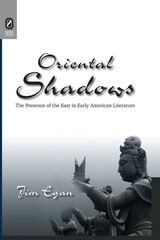
Oriental Shadows
The Presence of the East in Early American LiteratureJim Egan
The Ohio State University Press, 2011
Through the use of several iconic early American authors (Anne Bradstreet, James Kirkpatrick, Benjamin Franklin, and Edgar Allan Poe), Jim Egan’s Oriental Shadows: The Presence of the East in Early American Literature explores the presence of “the East” in American writing.
In bringing to light this largely overlooked archive of images within the American literary canon, Oriental Shadows suggests that the East played a key role in the emergence of a distinctively American literary tradition and, further, that early American identity was born as much from figures of the East as it was from the colonists’ encounters with the frontier.

Orientalism and Modernism
The Legacy of China in Pound and WilliamsZhaoming Qian
Duke University Press, 1995
Consulting rare and unpublished materials, Qian traces Pound’s and Williams’s remarkable dialogues with the great Chinese poets—Qu Yuan, Li Bo, Wang Wei, and Bo Juyi—between 1913 and 1923. His investigation reveals that these exchanges contributed more than topical and thematic ideas to the Americans’ work and suggests that their progressively modernist style is directly linked to a steadily growing contact and affinity for similar Chinese styles. He demonstrates, for example, how such influences as the ethics of pictorial representation, the style of ellipsis, allusion, and juxtaposition, and the Taoist/Zen–Buddhist notion of nonbeing/being made their way into Pound’s pre-Fenollosan Chinese adaptations, Cathay, Lustra, and the Early Cantos, as well as Williams’s Sour Grapes and Spring and All. Developing a new interpretation of important work by Pound and Williams, Orientalism and Modernism fills a significant gap in accounts of American Modernism, which can be seen here for the first time in its truly multicultural character.
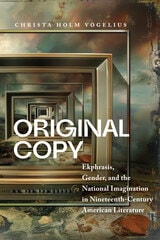
Original Copy
Ekphrasis, Gender, and the National Imagination in Nineteenth-Century American LiteratureChrista Holm Vogelius
University of Massachusetts Press, 2025
When critics of poet Phillis Wheatley, the first African American to publish a collection of poetry, dismiss her work as derivative, they fail to see her writing as part of a new creative pantheon, sitting alongside other works that, like the popular copybooks in antebellum America, are structured as a conversation between artistic allies. Different kinds of copying in this period were distinctly feminized practices, such as artistic copying, pedagogical recitation, and literary imitation. Ekphrasis, the literary description of a work of visual art, reveals a particularly interesting form of copying, as the artwork in question becomes a kind of mediated space between author and reader; this practice, then, becomes the emblematic form of literature as collective production.
Original Copy frames ekphrasis and other forms of literary and visual copy-work as key concepts for understanding the discussions of nationalism, originality, and gender that dominated US literary circles during the first half of the nineteenth century. Christa Holm Vogelius focuses on four major writers of the period—Phillis Wheatley, Margaret Fuller, Sophia Hawthorne, and Henry Longfellow—to offer a narrative of a self-consciously feminine antebellum literary culture that was equally invested in literary nationality and convention. The explicitly feminized forms of the copy between and within media, she argues, became a productive means by which writers across a variety of genres interrogated the ill-defined but ubiquitous idea of an “original” American literature. Original Copy bridges three bodies of scholarship that have remained largely distinct—studies of literary nationalism and transnationalism, scholarship on gender in nineteenth century literary culture, and aesthetic and media theory—to argue for the significance of both imitation and intimate author-reader relations to the development of an American literature.
Other People
Peter Campion
University of Chicago Press, 2005
Fast transparency that explodes the fuel and air
in the cylinder and shuts the intake valves and thrusts
down on the piston so the crankshaft spins and spins
you cut through all material that blocks your way
so fast that driving now past rushes and billboards
this pull to her could be your own impersonal presence
cloaked in the day to day of the malls and condos
all those wired sensors keeping on guard for you
except you flicker even inside the wet wall
where papillary muscle makes that sweet pulsation
in whatever room she's moving through this moment
under the cotton and the cool smoothness tinted blue
In this debut collection, Peter Campion explores both the gaps and the connections between the self and others. Like the "night blooming jasmine leaving its warm trace," these poems arise out of the dark. A man awakens in a hotel room to find the neighboring voices merging with the anguished souls of his nightmare. A woman living alone beside the ocean hears the words of the dead echo in the crashing waves. But if these poems convey a feeling of an enduring emptiness, they also offer us the most vital intimacies. In one poem, two lovers traverse the industrial sweep of strip malls and office towers to arrive at their rendezvous. In another, the seemingly simple memory of a mother playing with her sons at a park bridges a chasm of pain and loss.
With great poise, keen insight, and formal skill, Campion moves between shared experience and interior life in the shifting textures of Other People. Whether writing in rhymed couplets or free verse, he matches a deep understanding of the poetic tradition with his own imaginative feel for structure.
"The 'other people' of the title of this extraordinary book are fully alive in the life of its language; and so is the poet observing them, and observing himself, as one of them. The book is a sympathetic and unsentimental instrument of truth."—David Ferry
Other People's Troubles
Jason Sommer
University of Chicago Press, 1997
Othermindedness
The Emergence of Network CultureMichael Joyce
University of Michigan Press, 2001
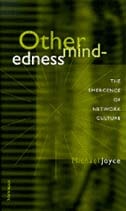
Michael Joyce's new collection continues to examine the connections between the poles of art and instruction, writing and teaching in the form of what Joyce has called theoretical narratives, pieces that are both narratives of theory and texts in which theory often takes the form of narrative. His concerns include hypertext and interactive fiction, the geography of cyberspace, and interactive film, and Joyce here searches out the emergence of network culture in spaces ranging from the shifting nature of the library to MOOs and other virtual spaces to life along a river.
While in this collection Joyce continues to be one of our most lyrical, wide-ranging, and informed cultural critics and theorists of new media, his essays exhibit an evolving distrust of unconsidered claims for newness in the midst of what Joyce calls "the blizzard of the next," as well as a recurrent insistence upon grounding our experience of the emergence of network culture in the body.
Michael Joyce is Associate Professor of English, Vassar College. He is author of a number of hypertext fictions on the web and on disk, most notably Afternoon: A Story.
His previous books are Of Two Minds: Hypertext Pedagogy and Poetics and Moral Tale and Meditations: Technological Parables and Refractions.

Otherwise
Eleanor Wilner
University of Chicago Press, 1993
"Otherwise is ambitious and patient, built on the spider's stratagem: the poet throws out a long tentative thread, then spins carefully outward until we see the new shape standing on air."—Carol Muske, The New York Times Book Review
"In a book of poems, one is happy to find half a dozen remarkable performances—poems worth rereading and even committing to memory. In Otherwise—which is splendid from the title on—it would be hard to find half a dozen which failed to equal Wilner's stratospheric standard."—David Slavit, Seven Arts
Otherwise Unseeable
Betsy Sholl
University of Wisconsin Press, 2014
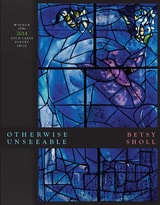
The poems in Otherwise Unseeable examine such questions. It is a poetry full of music and surprise, in voices that are personal, invented, and historical, sometimes belonging to the poet and sometimes to others. Betsy Sholl probes what there is still to learn from the devastations of the twentieth century, and she explores the roots of human envy, greed, and generosity in lively, unexpected ways, enacting the kinds of arguments we have with ourselves: between control and relinquishment, grief and ecstasy, regret and acceptance, faith and skepticism. The end result is a book of verbal wrestling, a girl-Jacob mixing it up with one kind of angel or another, limping for sure, but still blessed.
Winner, Maine Literary Award, Maine Writers and Publishers Alliance
Our Animal
Meredith Stricker
Omnidawn, 2016
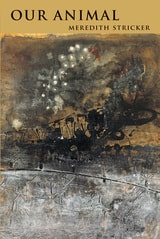
Our Animal is the winner of the 2014 Omnidawn Poetry Open Book Contest, selected by Mary Jo Bang.
Our Cancers
PoemsDan O'Brien
Acre Books, 2021
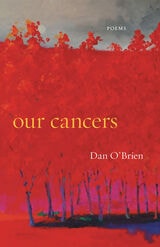
On the fourteenth anniversary of 9/11—an event that caused their downtown apartment to become “suffused with the World Trade Center’s carcinogenic dust”—Dan O’Brien’s wife discovers a lump in her breast. Surgery and chemotherapy soon follow, and on the day of his wife’s final infusion, O’Brien learns of his own diagnosis. He has colon cancer and will need to undergo his own intensive treatment over the next nine months.
Our Cancers is a compelling account of illness and commitment, of parenthood and partnership. This spare and powerful sequence creates an intimate mythology that seeks meaning in illness while also celebrating the resilience of sufferers, caregivers, and survivors.
As O’Brien explains in an introduction, “The consecutiveness of our personal disasters, with a daughter not yet two years old at the start of it, was shattering and nearly silencing. At hospital bedsides, in hospital beds myself, and at home through the cyclical assaults of our therapies, these poems came to me in fragments, as if my unconscious were attempting to reassemble our lives, our identities and memories . . . as if I were in some sense learning how to speak again.”
Our Earliest Tattoos
PoemsPeter Twal
University of Arkansas Press, 2018
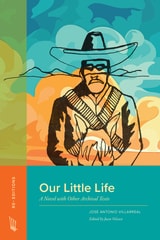
Our Little Life
A Novel with Other Archival TextsBy José Antonio Villarreal, edited by Juan Velasco
Lever Press, 2025
Our Little Life offers a much longer version of the Pocho story that extends a further 100 pages into the postwar period and follows Richard Rubio’s return from war and the changing shape of Mexican-American life in the 1940s. This newly discovered manuscript reveals Villarreal’s attention to Rubio’s struggles with PTSD and his efforts to depict a community and a family’s struggles with identity, belonging, and survival in postwar California. Our Little Life is an important work of archival recovery that sheds new light on Villarreal’s authorship and his place not only in Mexican-American literature but in the twentieth-century American literary canon.
This first publication of Our Little Life includes a scholarly introduction that places this unpublished novel in the landscape of contemporary Mexican-American literary studies and offers a brilliant examination of how novels grow and change. The volume also includes materials from the Villarreal Special Collection that recontextualize the writer’s vision, editing, and marketing of this and later novels. Our Little Life will be of interest not only to everyone in Mexican-American literary studies, but also to scholars of postwar America, women and gender studies, LGBTQ studies, ethnic studies, and migration and border studies.
Our Purpose in Speaking
William Orem
Michigan State University Press, 2018
Out There Somewhere
Simon J. Ortiz
University of Arizona Press, 2002
Simon Ortiz, one of our finest living poets, has been a witness, participant, and observer of interactions between the Euro-American cultural world and that of his Native American people for many years. In this collection of haunting new work, he confronts moments and instances of his personal past—and finds redemption in the wellspring of his culture.
A writer known for deeply personal poetry, Ortiz has produced perhaps his most personal work to date. In a collage of journal entries, free-verse poems, and renderings of poems in the Acoma language, he draws on life experiences over the past ten years—recalling time spent in academic conferences and writers' colonies, jails and detox centers—to convey something of the personal and cultural history of dislocation. As an American Indian artist living at times on the margins of mainstream culture, Ortiz has much to tell about the trials of alcoholism, poverty, displacement. But in the telling he affirms the strength of Native culture even under the most adverse conditions and confirms the sustaining power of Native beliefs and connections: "With our hands, we know the sacred earth. / With our spirits, we know the sacred sky."
Like many of his fellow Native Americans, Ortiz has been "out there somewhere"—Portland and San Francisco, Freiburg, Germany, and Martinique—away from his original homeland, culture, and community. Yet, as these works show, he continues to be absolutely connected socially and culturally to Native identity: "We insist that we as human cultural beings must always have this connection," he writes, "because it is the way we maintain a Native sense of existence." Drawing on this storehouse of places, times, and events, Out There Somewhere is a rich fusion taking readers into the heart and soul of one of today's most exciting and original American poets.
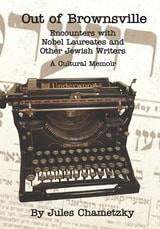
Out of Brownsville
Encounters with Nobel Laureates and Other Jewish Writers: A Cultural MemoirJules Chametzky
University of Massachusetts Press, 2012
Out of Nowhere
New and Selected PoemsMary Ann Taylor-Hall
Ohio University Press, 2017
Out of Silence
Selected PoemsMuriel Rukeyser
Northwestern University Press, 1992
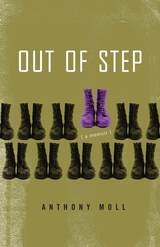
Out of Step
A MemoirAnthony Moll
The Ohio State University Press, 2018
What makes a pink-haired queer raise his hand to enlist in the military just as the nation is charging into war? In his memoir, Out of Step, Anthony Moll tells the story of a working-class bisexual boy running off to join the army in the midst of two wars and the “Don’t Ask, Don’t Tell” era. Set against the backdrop of hypermasculinity and sexual secrecy, Moll weaves a queer coming-of-age story.
Out of Step traces Moll’s development through his military service, recounting how the army both breaks and builds relationships, and what it was like to explore his queer identity while also coming to terms with his role in the nation’s ugly foreign policy. From a punk, nerdy, left-leaning, poor boy in Nevada leaving home for the first time to an adult returning to civilian life and forced to address a world more complicated than he was raised to believe, Moll’s journey isn’t a classic flag-waving memoir or war story—it’s a tale of finding one’s identity in the face of war and changing ideals.
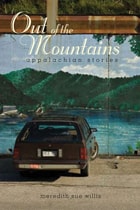
Out of the Mountains
Appalachian StoriesMeredith Sue Willis
Ohio University Press, 2010
Meredith Sue Willis’s Out of the Mountains is a collection of thirteen short stories set in contemporary Appalachia. Firmly grounded in place, the stories voyage out into the conflicting cultural identities that native Appalachians experience as they balance mainstream and mountain identities.
Willis’s stories explore the complex negotiations between longtime natives of the region and its newcomers and the rifts that develop within families over current issues such as mountaintop removal and homophobia. Always, however, the situations depicted in these stories are explored in the service of a deeper understanding of the people involved, and of the place. This is not the mythic version of Appalachia, but the Appalachia of the twenty-first century.
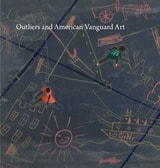
Outliers and American Vanguard Art
Lynne Cooke
University of Chicago Press, 2017
The art works in Outliers and American Vanguard Art come from three distinct periods when the intersections between mainstream and outlier artists were most dynamic and productive, ushering in exhibitions of art based on various degrees of co-existence, inclusion, and assimilation. Works by such diverse artists as Charles Sheeler, Christina Ramberg, and Matt Mullican are set in conversation with a range of works by such self-taught artists as Horace Pippin, Janet Sobel, and Henry Darger. Cooke also examines a recent increase of radically expressive work that challenges what it means to be an outlier today. She reveals how these distinctions have been freighted with a particularly American point of view as she investigates our assumptions about creativity, artistic practice, and the role of the artist in contemporary culture.
Outliers and American Vanguard Art is the most comprehensive show ever to examine outliers in dialogue with their established peers. It is sure to inspire vigorous conversation about how artists and the work they make are represented.
Outside Literary Studies
Black Criticism and the UniversityAndy Hines
University of Chicago Press, 2022
This striking contribution to Black literary studies examines the practices of Black writers in the mid-twentieth century to revise our understanding of the institutionalization of literary studies in America. Andy Hines uncovers a vibrant history of interpretive resistance to university-based New Criticism by Black writers of the American left. These include well-known figures such as Langston Hughes and Lorraine Hansberry as well as still underappreciated writers like Melvin B. Tolson and Doxey Wilkerson. In their critical practice, these and other Black writers levied their critique from “outside” venues: behind the closed doors of the Senate Permanent Subcommittee on Investigations, in the classroom at a communist labor school under FBI surveillance, and in a host of journals. From these vantages, Black writers not only called out the racist assumptions of the New Criticism, but also defined Black literary and interpretive practices to support communist and other radical world-making efforts in the mid-twentieth century. Hines’s book thus offers a number of urgent contributions to literary studies: it spotlights a canon of Black literary texts that belong to an important era of anti-racist struggle, and it fills in the pre-history of the rise of Black studies and of ongoing Black dissent against the neoliberal university.
Outside Literary Studies
Black Criticism and the UniversityAndy Hines
University of Chicago Press, 2022
This is an auto-narrated audiobook edition of this book.
A timely reconsideration of the history of the profession, Outside Literary Studies investigates how midcentury Black writers built a critical practice tuned to the struggle against racism and colonialism.
This striking contribution to Black literary studies examines the practices of Black writers in the mid-twentieth century to revise our understanding of the institutionalization of literary studies in America. Andy Hines uncovers a vibrant history of interpretive resistance to university-based New Criticism by Black writers of the American left. These include well-known figures such as Langston Hughes and Lorraine Hansberry as well as still underappreciated writers like Melvin B. Tolson and Doxey Wilkerson. In their critical practice, these and other Black writers levied their critique from “outside” venues: behind the closed doors of the Senate Permanent Subcommittee on Investigations, in the classroom at a communist labor school under FBI surveillance, and in a host of journals. From these vantages, Black writers not only called out the racist assumptions of the New Criticism, but also defined Black literary and interpretive practices to support communist and other radical world-making efforts in the mid-twentieth century. Hines’s book thus offers a number of urgent contributions to literary studies: it spotlights a canon of Black literary texts that belong to an important era of anti-racist struggle, and it fills in the pre-history of the rise of Black studies and of ongoing Black dissent against the neoliberal university.
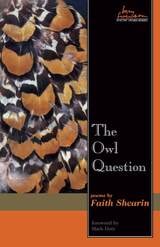
Owl Question
PoemsFaith Shearin
Utah State University Press, 2004
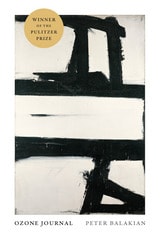
Ozone Journal
Peter Balakian
University of Chicago Press, 2015
from "Ozone Journal"
Bach’s cantata in B-flat minor in the cassette,
we lounged under the greenhouse-sky, the UVBs hacking
at the acids and oxides and then I could hear the difference
between an oboe and a bassoon
at the river’s edge under cover—
trees breathed in our respiration;
there was something on the other side of the river,
something both of us were itching toward—
radical bonds were broken, history became science.
We were never the same.
The title poem of Peter Balakian's Ozone Journal is a sequence of fifty-four short sections, each a poem in itself, recounting the speaker's memory of excavating the bones of Armenian genocide victims in the Syrian desert with a crew of television journalists in 2009. These memories spark others—the dissolution of his marriage, his life as a young single parent in Manhattan in the nineties, visits and conversations with a cousin dying of AIDS—creating a montage that has the feel of history as lived experience. Bookending this sequence are shorter lyrics that span times and locations, from Nairobi to the Native American villages of New Mexico. In the dynamic, sensual language of these poems, we are reminded that the history of atrocity, trauma, and forgetting is both global and ancient; but we are reminded, too, of the beauty and richness of culture and the resilience of love.
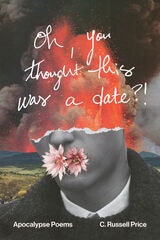
oh, you thought this was a date?!
Apocalypse PoemsC. Russell Price
Northwestern University Press, 2022
Price’s cinematic approach to language and scene is on full display, as well as their dark humor and resilience. Within these pages, the surreal is familiar and grief is a national pastime. If the end is near, who among us would not put on Fleetwood Mac? Who would not clean up their eyeliner just a smidge? This collection pulses with the beat that follows destruction (whether human or natural), the moment the jaw unhinges. These poems are not for pearl clutchers. They are for those who have already felt their private apocalypse.
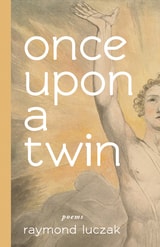
once upon a twin
poemsRaymond Luczak
Gallaudet University Press, 2021