Results by title
4917 books match the query 'Philosophy' and 131 start with o
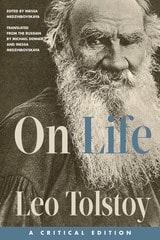
On Life
A Critical EditionLeo Tolstoy, Edited by Inessa Medzhibovskaya, Translated from the Russian by Michael Denner and Inessa Medzhibovskaya
Northwestern University Press, 2018
After its completion, On Life was suppressed by the tsars, attacked by the hierarchs of the Russian Orthodox Church, and then censored by the Stalinist regime. This critical edition is the first accurate translation of this unsung classic of Russian thought into English, based on a study of manuscript pages of Tolstoy's drafts, and the first scholarly edition of this work in any language. It includes a detailed introduction and annotations, as well as historical material, such as early drafts, documents related to the presentation of an early version at the Moscow Psychological Society, and responses to the work by philosophers, religious leaders, journalists, and ordinary readers of Tolstoy's day.

On Manly Courage
A Study of Plato's LachesWalter T. Schmid. Foreword by George Kimball Plochmann
Southern Illinois University Press, 1992
Walter T. Schmid offers the first original interpretation of the Laches since Hermann Bonitz in the nineteenth century in the only full-length commentary on the Laches available in English.
Schmid divides the book into five main discussions: the historical background of the dialogue; the relation of form and content in a Platonic dialogue and specific structural and aesthetic features of the Laches; the first half of the dialogue, which introduces the characters and considers the theme of the education of young men; the inquiry with Laches, which examines the traditional Greek conception of military courage; and the inquiry with Nicias in which two nontraditional conceptions of courage are mooted, one closely associated with the sophistic movement in Athens, the other with Socrates himself. Furnishing a detailed paragraph-by-paragraph reading that traces Socrates’ ongoing quest for virtue and wisdom—a wisdom founded in the action of a whole human life—Schmid conclusively shows how and why the Laches fills an important niche in Plato’s moral theory.
On Metaphysics
Roderick Chisholm
University of Minnesota Press, 1989
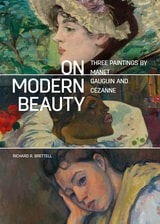
On Modern Beauty
Three Paintings by Manet, Gauguin, and CézanneRichard R. Brettell
J. Paul Getty Trust, The, 2019
Brettell shapes his manifesto around three masterworks from the collection of the J. Paul Getty Museum: Édouard Manet’s Jeanne (Spring), Paul Gauguin’s Arii Matamoe (The Royal End), and Paul Cézanne’s Young Italian Woman at a Table. The provocative discussion reveals how each of these exceptional paintings, though depicting very different subjects—a fashionable actress, a preserved head, and a weary working woman—enacts a revolutionary, yet enduring, icon of beauty.
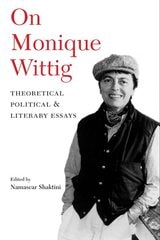
On Monique Wittig
Theoretical, Political, and Literary EssaysEdited by Namascar Shaktini
University of Illinois Press, 2004
On Monique Wittig contains twelve essays, representing French, Francophone, and U.S. critics, including three previously unpublished pieces by Wittig herself. Among the essays is Diane Griffin Crowder's discussion of the U.S. feminist movement, Linda Zerilli's consideration of gender and will, and Teresa de Lauretis's examination of the development of lesbian theory. Together, these essays situate Wittig's work in terms of the cultural contexts of its production and reception. This volume also contains the first authenticated chronology of Wittig's life and features the first translation of "For a Movement of Women's Liberation," which Wittig published with other "militantes" in May 1970.
As the first book to appear on Wittig following her death, On Monique Wittig is an indispensable tool for feminist scholars.

On Moral Personhood
Philosophy, Literature, Criticism, and Self-UnderstandingRichard Eldridge
University of Chicago Press, 1989
Eldridge presents an extensive new interpretation of Kantian ethics that is deeply informed by Kant's aesthetics. He defends a revised version of Kantian universalism and a Kantian conception of the content of morality. Eldridge then turns to literature armed not with any a priori theory but with an interpretive stance inspired by Hegel's phenomenology of self-understanding, more or less naturalized, and by Wittgenstein's work on self-understanding as ongoing narrative-interpretive activity, a stance that yields Kantian results about the universal demands our nature places on itself.
Eldridge goes on to present readings of novels by Conrad and Austen and poetry by Wordsworth and Coleridge. In each text protagonists are seen to be struggling with moral conflicts and for self-understanding as moral persons. The route toward partial resolution of their conflicts is seen to involve multiple and ongoing activities of reading and interpreting. The result of this kind of interpretation is that such literature—literature that portrays protagonists as themselves readers and interpreters of human capacities for morality—is a primary source for the development of morally significant self-understanding. We see in the careers of these protagonists that there can be genuine and fruitful moral deliberation and valuable action, while also seeing how situated and partial any understanding and achievement of value must remain.
On Moral Personhood at once delineates the moral nature of persons; shows various conditions of the ongoing, contextualized, partial acknowledgment of that nature and of the exercise of the capacities that define it; and enacts an important way of reading literature in relation to moral problems. Eldridge's work will be important reading for moral philosophers (especially those concerned with Kant, Hegel, and issues dividing moral particularists from moral universalists), literary theorists (especially those concerned with the value of literature and its relation to philosophy and to moral problems), and readers and critics of Conrad, Wordsworth, Coleridge, and Austen.
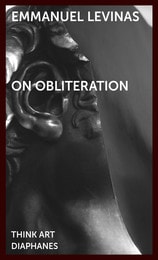
On Obliteration
An Interview with Françoise Armengaud Concerning the Work of Sacha SosnoEmmanuel Levinas
Diaphanes, 2019
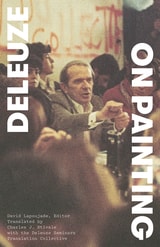
On Painting
Courses, March-June 1981Gilles Deleuze
University of Minnesota Press, 2025
Available for the first time in English: the complete and annotated transcripts of Deleuze’s 1981 seminars on painting
From 1970 until 1987, Gilles Deleuze held a weekly seminar at the Experimental University of Vincennes and, starting in 1980, at Saint-Denis. In the spring of 1981, he began a series of eight seminars on painting and its intersections with philosophy. The recorded sessions, newly transcribed and translated into English, are now available in their entirety for the first time. Extensively annotated by philosopher David Lapoujade, On Painting illuminates Deleuze’s thinking on artistic creation, significantly extending the lines of thought in his book Francis Bacon.
Through paintings and writing by Rembrandt, Delacroix, Turner, Cézanne, Van Gogh, Klee, Pollock, and Bacon, Deleuze explores the creative process, from chaos to the pictorial fact. The introduction and use of color feature prominently as Deleuze elaborates on artistic and philosophical concepts such as the diagram, modulation, code, and the digital and the analogical. Through this scrutiny, he raises a series of profound and stimulating questions for his students: How does a painter ward off grayness and attain color? What is a line without contour? Why paint at all?
Written and thought in a rhizomatic manner that is thoroughly Deleuzian—strange, powerful, and novel—On Painting traverses both the conception of art history and the possibility of color as a philosophical concept.
Retail e-book files for this title are screen-reader friendly with images accompanied by short alt text and/or extended descriptions.
On Paradox
The Claims of TheoryElizabeth S. Anker
Duke University Press, 2022
On Persistence
Rebecca Comay
Seagull Books, 2026
On Persistence is an exploration into the elusive, unruly force of endurance—not as moral virtue or capitalist work ethic, but as a temporal and affective structure that resists assimilation. In these wide-ranging philosophical and literary essays, Rebecca Comay interrogates what it means to persist when progress stalls and resolution fails to arrive. Engaging figures from Freud to Beckett, Proust to Benjamin, Hamlet to Niobe, Comay tracks the strange temporality of suspended life: interminable mourning, unfinished projects, the persistence of the past, the undead stirrings of the death drive. What emerges is a radically different model of time—neither static nor teleological, but a form of interruption that opens space for rethinking agency, grief, resistance, and repair.
On Persistence offers a profound meditation on what it means to endure—and to endure differently—in a time that demands something else of us.
On Posthuman War
Computation and Military ViolenceMike Hill
University of Minnesota Press, 2022
Tracing war’s expansion beyond the battlefield to the concept of the human being itself
As military and other forms of political violence become the planetary norm, On Posthuman War traces the expansion of war beyond traditional theaters of battle. Drawing on counterinsurgency field manuals, tactical manifestos, data-driven military theory, and asymmetrical-war archives, Mike Hill delineates new “Areas of Operation” within a concept of the human being as not only a social and biological entity but also a technical one.
Delving into three human-focused disciplines newly turned against humanity, OnPosthuman War reveals how demography, anthropology, and neuroscience have intertwined since 9/11 amid the “Revolution in Military Affairs.” Beginning with the author’s personal experience training with U.S. Marine recruits at Parris Island, Hill gleans insights from realist philosophy, the new materialism, and computational theory to show how the human being, per se, has been reconstituted from neutral citizen to unwitting combatant. As evident in the call for “bullets, beans, and data,” whatever can be parted out, counted, and reassembled can become war materiel. Hill shows how visible and invisible wars within identity, community, and cognition shift public-sphere activities, like racial identification, group organization, and even thought itself, in the direction of war. This shift has weaponized social activities against the very notion of society.
On Posthuman War delivers insights on the latest war technologies, strategies, and tactics while engaging in questions poised to overturn the foundations of modern political thought.
On Reason
Rationality in a World of Cultural Conflict and RacismEmmanuel Chukwudi Eze
Duke University Press, 2008
Eze draws on an extraordinary command of Western philosophical thought and a deep knowledge of African philosophy and cultural traditions. He explores models of rationality in the thought of philosophers from Aristotle, René Descartes, Francis Bacon, and Thomas Hobbes to Noam Chomsky, Richard Rorty, Hilary Putnam, and Jacques Derrida, and he considers portrayals of reason in the work of the African thinkers and novelists Chinua Achebe, Ngugi wa Thiong’o, and Wole Soyinka. Eze reflects on contemporary thought about genetics, race, and postcolonial historiography as well as on the interplay between reason and unreason in the hearings of South Africa’s Truth and Reconciliation Commission. He contends that while rationality may have a foundational formality, any understanding of its foundation and form is dynamic, always based in historical and cultural circumstances.
On Resurrection
Irven M. St. Albert the Great
Catholic University of America Press, 2020
On Social Structure and Science
Robert K. Merton
University of Chicago Press, 1996
This definitive compilation encompasses the breadth and brilliance of his works, from the earliest to the most recent. Merton's foundational writings on social structure and process, on the sociology of science and knowledge, and on the discipline and trajectory of sociology itself are all powerfully represented, as are his autobiographical insights in a fascinating coda. Anchored by Piotr Sztompka's contextualizing introduction, Merton's vast oeuvre emerges as a dynamic and profoundly coherent system of thought, a constant source of vitality and renewal for present and future sociology.
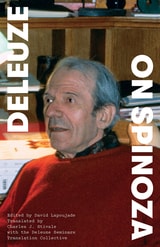
On Spinoza
Courses, November 1980–March 1981Gilles Deleuze
University of Minnesota Press, 2026
Through newly transcribed and translated lectures, Deleuze explores Spinoza’s philosophy concerning questions of good and evil and humanity’s potential for realizing a full life
Available for the first time in English, On Spinoza presents the annotated transcripts of Gilles Deleuze’s fifteen seminars on the seventeenth-century philosopher’s Ethics, delivered at Experimental University Center at Vincennes. Spinoza’s ambitious treatise was central to Deleuze’s thought, and his course provides an accessible framework for understanding the vitality of Spinoza’s philosophy.
In an informal classroom setting, Deleuze addresses fundamental aspects of Spinoza’s thought: How does one undo the negativity of harmful passions such as hate, resentment, and envy? How can a system of moral judgment based on good and evil be replaced by a more sophisticated ethics of the good and the bad? And since such questions commit Spinoza to a new theory of signs, Deleuze also delves into his thinking on how these signs should guide human existence and the differences between concepts of eternity, experienced in the here and now, and the immortality promised by philosophy and religion.
Building gradually from session to session, Deleuze shows how Spinoza rejects a hierarchical reality dominated by an authoritarian and impenetrable God, instead proposing a world ruled by light and reason in which all beings are equal. Annotated by David Lapoujade and including recorded exchanges with Deleuze’s students, On Spinoza offers a rare window into Deleuze’s teaching, offering readers a guide for linking Spinoza to other philosophers—including Deleuze himself.
Retail e-book files for this title are screen-reader friendly with image accompanied by short alt text and/or extended description.
On The Way To Diplomacy
Costas M. Constantinou
University of Minnesota Press, 1996
A deconstruction of the idea of diplomacy that explores the links between its theory and practice.
What does theory have to do with the concept-let alone the practice-of diplomacy? More than we might think, as Costas M. Constantinou amply demonstrates in this ambitious reconsideration of both the concept of diplomacy and the working of theory. Here, Constantinou focuses on the language that underwrites and directs theory and diplomacy, and shows that such a critical approach is actually a way of practicing politics.
Constantinou underscores the original intertextual association between theory and diplomacy by employing the ancient Greek term theoria. Theoria once referred to both philosophical thinking and a sacred embassy sent to discharge a religious duty. The use of the term in this book leads to a new view of theory and diplomacy. Constantinou considers the structures of diplomacy and theory together with the notion of representation that is peculiar to Western metaphysical thought. A deconstruction of diplomacy itself, this work bridges classical and contemporary philosophy, ancient and modern political practice, and, ultimately, politics and the arts in general. It will alter the study, understanding, and practice of diplomacy.
On Time and Being
Martin Heidegger
University of Chicago Press, 2002
"This collection may well vie with Vom Wesen des Grundes and Identität and Differenz as definitive statements of Heidegger's ontology."—Library Journal
"The title of the English translation is that of the lead essay, the highly celebrated lecture which Heidegger gave in 1962 and which bears the same title as the never published 'third division' of the 'first half' of Being and Time. This lecture is perhaps the most significant document to be added to the Heideggerian corpus since the Letter of Humanism. . . . Stambaugh's translation is superb."—Stanley O. Hoerr and staff, The Review of Metaphysics
On Tyranny
Leo Strauss
University of Chicago Press, 2000
"Through [Strauss's] interpretation Xenophon appears to us as no longer the somewhat dull and flat author we know, but as a brilliant and subtle writer, an original and profound thinker. What is more, in interpreting this forgotten dialogue, Strauss lays bare great moral and political problems that are still ours." —Alexandre Kojève, Critique
"On Tyranny is a complex and stimulating book with its 'parallel dialogue' made all the more striking since both participants take such unusual, highly provocative positions, and so force readers to face substantial problems in what are often wholly unfamiliar, even shocking ways." —Robert Pippin, History and Theory
"Every political scientist who tries to disentangle himself from the contemporary confusion over the problems of tyranny will be much indebted to this study and inevitably use it as a starting point."—Eric Voegelin, The Review of Politics
Leo Strauss (1899-1973) was the Robert Maynard Hutchins Distinguished Service Professor of Political Science at the University of Chicago.
On Tyranny
Corrected and Expanded Edition, Including the Strauss-Kojève CorrespondenceLeo Strauss
University of Chicago Press, 2013
On What We Know We Don't Know
Explanation, Theory, Linguistics, and How Questions Shape ThemSylvain Bromberger
University of Chicago Press, 1992
On the Animation of the Inorganic
Art, Architecture, and the Extension of LifeSpyros Papapetros
University of Chicago Press, 2012
Throughout human history, people have imagined inanimate objects to have intelligence, language, and even souls. In our secular societies today, we still willingly believe that nonliving objects have lives of their own as we find ourselves interacting with computers and other equipment. In On the Animation of the Inorganic, Spyros Papapetros examines ideas about simulated movement and inorganic life during and after the turn of the twentieth century—a period of great technical innovation whose effects continue to reverberate today.
Exploring key works of art historians such as Aby Warburg, Wilhelm Worringer, and Alois Riegl, as well as architects and artists like Fernand Léger, Mies van der Rohe, and Salvador Dalí, Papapetros tracks the evolution of the problem of animation from the fin de siècle through the twentieth century. He argues that empathy—the ability to identify with objects of the external world—was repressed by twentieth-century modernist culture, but it returned, projected onto inorganic objects such as machines, automobiles, and crystalline skyscrapers. These modern artifacts, he demonstrates, vibrated with energy, life, and desire of their own and had profound effects on people. Subtle and insightful, this book will change how we view modernist art, architecture, and their histories.
On the Appearance of the World
A Future for Aesthetics in ArchitectureMark Foster Gage
University of Minnesota Press, 2024
How can architecture develop better aesthetic directions for the twenty-first-century built environment?
Our world, increasingly defined by efficient but unconsidered architecture and cities, seems to be getting uglier. In On the Appearance of the World, Mark Foster Gage asks why. He imagines a future scenario where architectural design and ideas from aesthetic philosophy align toward the production of a built world that is more humane, habitable, beautiful, and just.

On the Border of Belonging
Luisa Capetillo, Ofelia Rodríguez Acosta, and Evangelina Rodríguez PerozoStephanie Rivera Berruz
Rutgers University Press, 2027
On the Border of Belonging: Luisa Capetillo, Ofelia Rodríguez Acosta, and Evangelina Rodríguez Perozo is a philosophical-historiographical project that spearheads the construction of an intellectual tradition of women from the Hispanophone Caribbean at the turn of the 20th century. On the Border of Belonging engages Luisa Capetillo (Puerto Rico), Ofelia Rodríguez Acosta (Cuba), Evangelina Rodríguez Perozo (Dominican Republic) as interlocutors with the landfall of Western modernity revealing a tense intersection between a desire to belong to modernity while sitting on the margins of its possibilities. The vexed relationship with belonging creates a counter-archive of contradictions that reveals a vivid philosophical patchwork that spirals and repeats across the archipelago. In this crosscurrent of ideas, Luisa Capetillo defends the possibilities of a spiritual- anarchist political life; Ofelia Rodríguez Acosta challenges the norms of love and kinship; and Evangelina Rodríguez Perozo contests the standards of maternal and infant care.

On the Communicative Turn in Philosophy
Exploring Intersubjectivity, Community and the Ethics of DialogueClaude Mangion
Intellect Books, 2025
Philosophy has long grappled with questions of meaning and human connection, yet communication itself remains an underexplored concept in the field. Claude Mangion shifts the focus by examining how communication has shaped debates on intersubjectivity and ethics.
By tracing its role across key philosophical discussions, this book offers a new outlook on how dialogue informs our understanding of self and society. Accessible and rigorously argued, it bridges the gap between philosophy and communication theory, making it a useful reference for students and scholars alike. This work provides a compelling argument for thinking about communication as a philosophical practice, whether you’re exploring community, the ethics of dialogue, or the foundations of intersubjectivity.
On the Edge of the Abyss
The Jewish Unconscious before FreudClémence Boulouque
University of Chicago Press, 2025
When Sigmund Freud published his theory of the unconscious, in 1899, he popularized an idea that had fascinated generations of Jewish philosophers before him. In this book, Clémence Boulouque charts the development of the pre-Freudian unconscious from subcultural inquiry to dominant discourse during the long nineteenth century. Although Freud’s scientific notion differed from Schelling’s mythical description of the abyss from which creation springs, its resonance with older ideas was celebrated as an opportunity to express specifically Jewish contributions to modernity. Indeed, Boulouque shows that the pre-Freudian unconscious emerged from conversations in Jewish mysticism about otherness and coexistence. In the hopeful years before World War I, Boulouque argues, such reflections offered the possibility of emancipation not only to Jews but to all.
On the Existence of Digital Objects
Yuk Hui
University of Minnesota Press, 2016
Digital objects, in their simplest form, are data. They are also a new kind of industrial object that pervades every aspect of our life today—as online videos, images, text files, e-mails, blog posts, Facebook events.Yet, despite their ubiquity, the nature of digital objects remains unclear.
On the Existence of Digital Objects conducts a philosophical examination of digital objects and their organizing schema by creating a dialogue between Martin Heidegger and Gilbert Simondon, which Yuk Hui contextualizes within the history of computing. How can digital objects be understood according to individualization and individuation? Hui pursues this question through the history of ontology and the study of markup languages and Web ontologies; he investigates the existential structure of digital objects within their systems and milieux. With this relational approach toward digital objects and technical systems, the book addresses alienation, described by Simondon as the consequence of mistakenly viewing technics in opposition to culture.
Interdisciplinary in philosophical and technical insights, with close readings of Husserl, Heidegger, and Simondon as well as the history of computing and the Web, Hui’s work develops an original, productive way of thinking about the data and metadata that increasingly define our world.
On the Form of the American Mind (CW1)
Eric Voegelin, Edited & Intro by Jurgen Gebhardt & Barry Cooper, & Translated byRuth Hein
University of Missouri Press, 0
On the Happiness of the Philosophic Life
Reflections on Rousseau's "Rêveries" in Two BooksHeinrich Meier
University of Chicago Press, 2016
On the Happiness of the Philosophic Life presents Heinrich Meier’s confrontation with Rousseau’s Rêveries, the philosopher’s most beautiful and daring work, as well as his last and least understood. Bringing to bear more than thirty years of study of Rousseau, Meier unfolds his stunningly original interpretation in two parts.
The first part of On the Happiness of the Philosophic Life approaches the Rêveries not as another autobiographical text in the tradition of the Confessions and the Dialogues, but as a reflection on the philosophic life and the distinctive happiness it provides. The second turns to a detailed analysis of a work referred to in the Rêveries, the “Profession of Faith of the Savoyard Vicar,” which triggered Rousseau’s political persecution when it was originally published as part of Émile. In his examination of this most controversial of Rousseau’s writings, which aims to lay the foundations for a successful nonphilosophic life, Meier brings to light the differences between natural religion as expressed by the Vicar and Rousseau’s natural theology. Together, the two reciprocally illuminating parts of this study provide an indispensable guide to Rousseau and to the understanding of the nature of the philosophic life.
On the Heights of Despair
E. M. Cioran
University of Chicago Press, 1992
On the Heights of Despair shows Cioran's first grappling with themes he would return to in his later, mature works: despair and decay, absurdity and alienation, futility and the irrationality of existence. It also presents Cioran as a connoisseur of apocalypse, a theoretician of despair, for whom writing and philosophy both share the "lyrical virtues" that alone lead to a metaphysical revelation.
On the Principles of Taxing Beer
and Other Brief Philosophical EssaysJames V. Schall
St. Augustine's Press, 2015
The advantage of a collection of essays is that it is free to talk about many things. It can speak of them in a learned way or in an amused and humorous way. As Chesterton said, there is no necessary conflict between what is true and what is funny. Oftentimes, the greatest things we learn are through laughter, even laughter at ourselves and our own foibles and faults.
So these essays are “brief.” And they are largely of philosophical import. At first sight, taxing beer may seem to have no serious principle, except perhaps for the brewer and the consumer. But wherever there is reality, we can find something to learn.
Each of these essays begins with the proposition “on”—this is a classical form of essay in the English language. Belloc, one the essay’s greatest masters, wrote a book simply entitled “ON”—and several other books with that introductory “ON” to begin it. The word has the advantage of focusing our attention on some idea, place, book, person, or reality that we happen to come across and notice, then notice again, then wonder about.
These essays are relatively short, often lightsome, hopefully always with a consideration that illumines the world through the mind of the reader. These essays are written in the spirit that the things we encounter provoke us, our minds. We need to come to terms, to understand what we come across in our pathways through this world. Often the best way to know what we observe or confront is to write about it, preferably briefly and with some philosophical insight. This is what we do here.
On the Psychotheology of Everyday Life
Reflections on Freud and RosenzweigEric L. Santner
University of Chicago Press, 2001
Santner's crucial innovation in this new study is to bring the theological notion of revelation into a broadly psychoanalytic field, where it can be understood as a force that opens the self to everyday life and encourages accountability within the larger world. Revelation itself becomes redefined as an openness toward what is singular, enigmatic, even uncanny about the Other, whether neighbor or stranger, thereby linking a theory of drives and desire to a critical account of sociality. Santner illuminates what it means to be genuinely open to another human being or culture and to share and take responsibility for one's implication in the dilemmas of difference.
By bringing Freud and Rosenzweig together, Santner not only clarifies in new and surprising ways the profound connections between psychoanalysis and the Judeo-Christian tradition, he makes the resources of both available to contemporary efforts to rethink concepts of community and cross-cultural communication.
On the Spirit of Rights
Dan Edelstein
University of Chicago Press, 2018
In On the Spirit of Rights, Dan Edelstein answers this question by examining the complex genealogy of the rights that regimes enshrined in the American and French Revolutions. With a lively attention to detail, he surveys a sprawling series of debates among rulers, jurists, philosophers, political reformers, writers, and others who were all engaged in laying the groundwork for our contemporary systems of constitutional governance. Every seemingly new claim about rights turns out to be a variation on a theme, as late medieval notions were subtly repeated and refined to yield the talk of “rights” we recognize today. From the Wars of Religion to the French Declaration of the Rights of Man and of the Citizen to the 1948 Universal Declaration of Human Rights, On the Spirit of Rights is a sweeping tour through centuries of European intellectual history and an essential guide to our ways of thinking about human rights today.
On the True Sense of Art
A Critical Companion to the Transfigurements of John SallisEdited by Jason M. Wirth, Michael Schwartz, and David Jones
Northwestern University Press, 2016
On the True Sense of Art collects essays by philosophers responding to John Sallis’s Transfigurements: On the True Sense of Art as well as his other works on the philosophy of art, including Force of Imagination and Logic of Imagination.
Each of the chapters, by some of the leading thinkers in Continental philosophy, engages Sallis’s work on both ancient and new senses of aesthetics—a transfiguration of aesthetics—as a beginning that is always beginning again. With a responsive essay by Sallis himself, On the True Sense of Art forms a critical introduction to the thought of this generation’s most important aesthetician.
On the Wandering Paths
Sylvain Tesson
University of Minnesota Press, 2022
A walking journey through France’s vast interior becomes a meditation on both personal recovery and the role of history in the present—more than 425,000 copies sold in France
After a free-climbing accident lands him in a coma and a hospital for four months, the French writer Sylvain Tesson makes a promise to himself: if he’s ever able to walk again, he will traverse the entire country of France on foot.
Part literary adventure, part philosophical reflection on our contemporary consumer culture, On the Wandering Paths takes us deep into the heart of what Tesson terms France’s “hyperrural” zones. Tracing the obscure paths peasants once followed throughout the countryside, Tesson embarks on a three-month journey of solitude and personal contemplation as he walks along vast stretches of mountain ranges and rivers, encountering ancient Roman stone bridges and walkways, the French Foreign Legion, pagan prayer sites, Provençal villages, and the majestic Mont-Saint-Michel. Connecting deeply with the places he visits, his experiences inspire reflection on the essential need to disengage from the digital and immerse oneself in natural beauty.
Rich with humor, historical insight, and literary power, On the Wandering Paths is both a meditation on the act of recovery and a potent recognition of the traces of our past in the present. Asking us to reassess our values and our relationship to the land, Tesson’s exquisite chronicle through landscapes that continue to resist urbanization and technology is a thoughtful—and thought-provoking—glimpse into a poet’s adventurous life. Les Chemins de Pierre, a film based on the book starring Jean Dujardin, is due to release in 2022.
On the Way to Heidegger’s Contributions to Philosophy
Parvis Emad
University of Wisconsin Press, 2007
On the Way to Theory
Lawrence Grossberg
Duke University Press, 2024
Once Out of Nature
Augustine on Time and the BodyAndrea Nightingale
University of Chicago Press, 2011
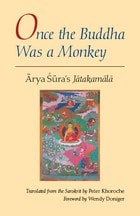
Once the Buddha Was a Monkey
Arya Sura's "Jatakamala"Arya Sùra
University of Chicago Press, 1989
Written most probably in the fourth century A.D., the Jatakamala is generally considered the masterpiece of Buddhist literature in Sanskrit. In elegant, courtly style, Arya Sura retells thirty-four traditional stories about the Buddha in his previous incarnations, human and animal. Whether as a king, a brahmin, a monkey, or a hare, the Great One is shown in assiduous pursuit of virtue and compassion. Though primarily intended as exemplary tales illustrating the Buddhist virtues, these stories also provide a vivid picture of life at a high point in ancient Indian culture—city life in ordinary households or at the royal court, and country life against a backdrop of mountain, desert, and jungle.
Fresh study of the Sanskrit manuscripts, now scattered in libraries all over the world, has enabled Peter Khoroche to make this new translation faithful to the original in both style and content. His explanatory notes will assist student and general reader alike in appreciating this classic from an ancient and exotic civilization.
“One would be a fool not to welcome the chance to read this book.”—Richard Gombrich, Journal of the Royal Asiatic Society
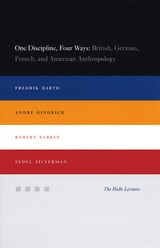
One Discipline, Four Ways
British, German, French, and American AnthropologyFredrik Barth, Robert Parkin, Andre Gingrich, and Sydel Silverman
University of Chicago Press, 2005
Moving from E. B. Taylor all the way through the development of modern fieldwork, Barth reveals the repressive tendencies that prevented Britain from developing a variety of anthropological practices until the late 1960s. Gingrich, meanwhile, articulates the development of German anthropology, paying particular attention to the Nazi period, of which surprisingly little analysis has been offered until now. Parkin then assesses the French tradition and, in particular, its separation of theory and ethnographic practice. Finally, Silverman traces the formative influence of Franz Boas, the expansion of the discipline after World War II, and the "fault lines" and promises of contemporary anthropology in the United States.
One Hour in Paris
A True Story of Rape and RecoveryKaryn L. Freedman
University of Chicago Press, 2014
At once deeply intimate and terrifyingly universal, One Hour in Paris weaves together Freedman’s personal experience with the latest philosophical, neuroscientific, and psychological insights on what it means to live in a body that has been traumatized. Using her background as a philosopher, she looks at the history of psychological trauma and draws on recent theories of posttraumatic stress disorder and neuroplasticity to show how recovery from horrific experiences is possible. Through frank discussions of sex and intimacy, she explores the consequences of sexual violence for love and relationships, and she illustrates the steep personal cost of sexual violence and the obstacles faced by individual survivors in its aftermath. Freedman’s book is an urgent call to face this fundamental social problem head-on, arguing that we cannot continue to ignore the fact that sexual violence against women is rooted in gender inequalities that exist worldwide—and must be addressed.
One Hour in Paris is essential reading for survivors of sexual violence as well as an invaluable resource for therapists, mental health professionals, and family members and friends of victims.
One Hundred Years of Philosophy
Brian Shanley
Catholic University of America Press, 2019
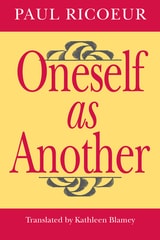
Oneself as Another
Paul Ricoeur
University of Chicago Press, 1992
Focusing on the concept of personal identity, Ricoeur develops a hermeneutics of the self that charts its epistemological path and ontological status.
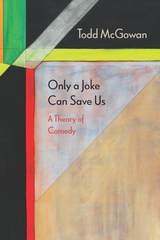
Only a Joke Can Save Us
A Theory of ComedyTodd McGowan
Northwestern University Press, 2017
Only a Joke Can Save Us presents an innovative and comprehensive theory of comedy. Using a wealth of examples from high and popular culture and with careful attention to the treatment of humor in philosophy, Todd McGowan locates the universal source of comedy in the interplay of the opposing concepts lack and excess.
After reviewing the treatment of comedy in the work of philosophers as varied as Aristotle, G. W. F. Hegel, Sigmund Freud, Henri Bergson, and Alenka Zupancic, McGowan, working in a psychoanalytic framework, demonstrates that comedy results from the deployment of lack and excess, whether in contrast, juxtaposition, or interplay.
Illustrating the power and flexibility of this framework with analyses of films ranging from Buster Keaton and Marx Brothers classics to Dr. Strangelove and Groundhog Day, McGowan shows how humor can reveal gaps in being and gaps in social order. Scholarly yet lively and readable, Only a Joke Can Save Us is a groundbreaking examination of the enigmatic yet endlessly fascinating experience of humor and comedy.

Ontological Catastrophe
Zizek and the Paradoxical Metaphysics of German IdealismJoseph Carew
Michigan Publishing Services, 2014
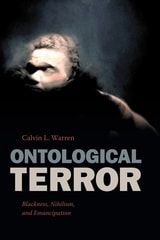
Ontological Terror
Blackness, Nihilism, and EmancipationCalvin L. Warren
Duke University Press, 2018

Ontology Of Work Of Art
Musical Work, Picture, Arch., FilmRoman Ingarden
Ohio University Press, 1989
Ingarden elaborates upon the conception of concretization which he present in The Literary Work of Art and applies it to music and visual art. He also employs the concept of aspect to clarify the ontic structure of these art works and the distinction between the concretization of the work and the work itself. The distinction between the work’s concretization — effectuated in the mental experiences of the listener or viewer — and the work itself serves to help Ingarden confirm and account for the work’s intersubjective identity.
The problem of aesthetic value, Ingarden maintains, can be fruitfully treated only after the ontic structure of art work has been clarified. His primary concern in Ontology of the Work of Art is to ascertain and describe that structure and the mode of existence of works of art. In addition, he offers several discussions of aesthetic value, showing in the m the connections between questions of aesthetic value and the structure of the work of art.
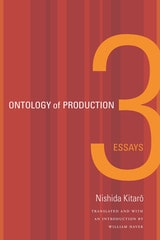
Ontology of Production
Three EssaysNishida KitarM
Duke University Press, 2012
Agreeing with Marx that ontology is production and production is ontology, Nishida in these three essays—"Expressive Activity" (1925), "The Standpoint of Active Intuition" (1935), and "Human Being" (1938)—addresses sense and reason, language and thought, intuition and appropriation, ultimately arguing that in this concept of production, ideality and materiality are neither mutually exclusive nor oppositional but, rather, coimmanent. Nishida's forceful articulation of the radical nature of Marx's theory of production is, Haver contends, particularly timely in today's speculation-driven global economy. Nishida's reading of Marx, which points to the inseparability of immaterial intellectual labor and material manual labor, provokes a reconsideration of Marxism's utility for making sense of—and resisting—the logic of contemporary capitalism.
Ontopower
War, Powers, and the State of PerceptionBrian Massumi
Duke University Press, 2015
Open Society Unresolved
The Contemporary Relevance of a Contested IdeaChristof Royer
Central European University Press, 2023
Is the concept of open society still relevant in the 21st century? Do the current social, moral, and political realities call for a drastic revision of this concept? Here fifteen essays address real-world contemporary challenges to open society from a variety of perspectives. What unites the individual authors and chapters is an interest in open society’s continuing usefulness and relevance to address current problems. And what distinguishes them is a rich variety of geographical and cultural backgrounds, and a wide range of academic disciplines and traditions.
While focusing on probing the contemporary relevance of the concept, several chapters approach it historically. The book features a comprehensive introduction to the history and current ‘uses’ of the theory of open society. The authors link the concept to contemporary themes including education, Artificial Intelligence, cognitive science, African cosmology, colonialism, and feminism. The diversity of viewpoints in the analysis reflects a commitment to plurality that is at the heart of this book and of the idea of open society itself.
Operation Valhalla
Writings on War, Weapons, and MediaFriedrich Kittler. Edited and translated by Ilinca Iurascu, Geoffrey Winthrop-Young, and Michael Wutz
Duke University Press, 2021