Results by title
2916 books match the query 'Politics and government' and 54 start with o
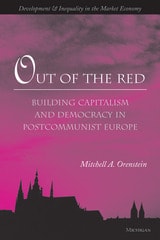
Out of the Red
Building Capitalism and Democracy in Postcommunist EuropeMitchell A. Orenstein
University of Michigan Press, 2001
A detailed analysis of Poland and the Czech Republic suggests that alternation between strategies has been the secret to the success of East-Central European countries.
This comparative case analysis identifies the significance of reform mistakes during transition and the corrective benefits of policy alternation, its claims illustrated with an in-depth study of privatization policy in the two countries.
Mitchell A. Orenstein delves into the historic struggle to build capitalism and democracy during a decade of post- communist transition in East-Central Europe and develops a model that explains why democratic policy alternation may accelerate policy learning under conditions of uncertainty and constraint.
Out of the Red is accessible to a general audience and as such is suitable for both graduate and undergraduate courses on political economy. It will be of particular interest to economists, political scientists, sociologists, students of postcommunism, and anyone interested in the relations between capitalism and democracy in the contemporary world.
Mitchell A. Orenstein is Assistant Professor of Political Science, Syracuse University.
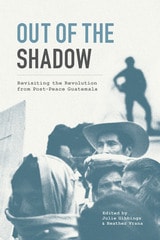
Out of the Shadow
Revisiting the Revolution from Post-Peace GuatemalaEdited by Julie Gibbings and Heather Vrana
University of Texas Press, 2020
Guatemala’s “Ten Years of Spring” (1944–1954) began when citizens overthrew a military dictatorship and ushered in a remarkable period of social reform. This decade of progressive policies ended abruptly when a coup d’état, backed by the United States at the urging of the United Fruit Company, deposed a democratically elected president and set the stage for a period of systematic human rights abuses that endured for generations. Presenting the research of diverse anthropologists and historians, Out of the Shadow offers a new examination of this pivotal chapter in Latin American history.
Marshaling information on regions that have been neglected by other scholars, such as coastlines dominated by people of African descent, the contributors describe an era when Guatemalan peasants, Maya and non-Maya alike, embraced change, became landowners themselves, diversified agricultural production, and fully engaged in electoral democracy. Yet this volume also sheds light on the period’s atrocities, such as the US Public Health Service’s medical experimentation on Guatemalans between 1946 and 1948. Rethinking institutional memories of the Cold War, the book concludes by considering the process of translating memory into possibility among present-day urban activists.

Overcoming Zionism
Creating a Single Democratic State in Israel/PalestineJoel Kovel
Pluto Press, 2007
Joel Kovel argues that the inner contradictions of Zionism have led Israel to a ‘state-sponsored racism’ fully as incorrigible as that of apartheid South Africa and deserving of the same resolution. Only a path toward a single-state secular democracy can provide the justice essential to healing the wounds of the Middle East.
Kovel is well-known writer on the Middle East conflict. This book draws on his detailed knowledge to show that Zionism and democracy are essentially incompatible. He offers a thoughtful account of the emergence and disintegration of Zionism that integrates psychological, political, cultural, economic, and ideological levels.
Ultimately, Kovel argues, a two-state solution is essentially hopeless as it concedes too much to the regressive forces of nationalism, wherein lie the roots of continued conflict.
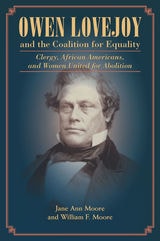
Owen Lovejoy and the Coalition for Equality
Clergy, African Americans, and Women United for AbolitionJane Ann Moore and William F. Moore
University of Illinois Press, 2019
Owen Lovejoy and the Coalition for Equality examines how these three distinct groups merged their agendas into a single antislavery, religious, political campaign for equality with Lovejoy at the helm. Combining scholarly biography, historiography, and primary source material, Jane Ann Moore and William F. Moore demonstrate Lovejoy's crucial role in nineteenth-century politics, the rise of antislavery sentiment in religious spaces, and the emerging congressional commitment to end slavery. Their compelling account explores how the immorality of slavery became a touchstone of political and religious action in the United States through the efforts of a synergetic coalition led by an essential abolitionist figure.