Results by title
4038 books match the query 'Social aspects' and 92 start with o
Operation Valhalla
Writings on War, Weapons, and MediaFriedrich Kittler. Edited and translated by Ilinca Iurascu, Geoffrey Winthrop-Young, and Michael Wutz
Duke University Press, 2021
Operational Images
From the Visual to the InvisualJussi Parikka
University of Minnesota Press, 2023
An in-depth look into the transformation of visual culture and digital aesthetics
First introduced by the German filmmaker Harun Farocki, the term operational images defines the expanding field of machine vision. In this study, media theorist Jussi Parikka develops Farocki’s initial concept by considering the extent to which operational images have pervaded today’s visual culture, outlining how data technologies continue to develop and disrupt our understanding of images beyond representation.
Charting the ways that operational images have been employed throughout a variety of fields and historical epochs, Parikka details their many roles as technologies of analysis, capture, measurement, diagramming, laboring, (machine) learning, identification, tracking, and destruction. He demonstrates how, though inextricable from issues of power and control, operational images extend their reach far beyond militaristic and colonial violence and into the realms of artificial intelligence, data, and numerous aspects of art, media, and everyday visual culture.
Serving as an extensive guide to a key concept in contemporary art, design, and media theory, Operational Images explores the implications of machine vision and the limits of human agency. Through a wealth of case studies highlighting the areas where imagery and data intersect, this book gives us unprecedented insight into the ever-evolving world of posthuman visuality.
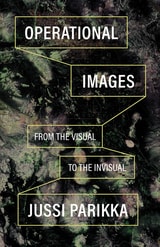
Cover alt text: Satellite photo on which white title words appear in yellow boxes. Yellow lines connect the boxes.
Oppenheimer Is Watching Me
A MemoirJeff Porter
University of Iowa Press, 2007
Optical Play
Glass, Vision, and Spectacle in Russian CultureJulia Bekman Chadaga
Northwestern University Press, 2014
Longlist finalist, 2015 Historia Nova Prize for Best Book on Russian Intellectual and Cultural History
Julia Bekman Chadaga’s ambitious study posits that glass—in its uses as a material and as captured in culture—is a key to understanding the evolution of Russian identity from the eighteenth century onward. From the contemporary perspective, it is easy to overlook how glass has profoundly transformed vision. Chadaga shows the far-reaching effects of this phenomenon.
Her book examines the similarities between glass and language, the ideological uses of glass, and the material’s associations with modernity, while illuminating the work of Lomonosov, Dostoevsky, Zamyatin, and Eisenstein, among others. In particular, Chadaga explores the prominent role of glass in the discourse around Russia’s contentious relationship with the West—by turns admiring and antagonistic—as the nation crafted a vision for its own future. Chadaga returns throughout to the spectacular aspect of glass and shows how both the tendentious capacity and the playfulness of this material have shaped Russian culture.
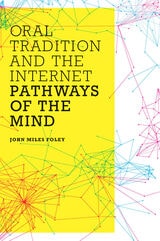
Oral Tradition and the Internet
Pathways of the MindJohn Miles Foley
University of Illinois Press, 2012
challenging the default medium of the linear book and page and all that they entail, Oral Tradition and the Internet shows readers that there are large, complex, wholly viable, alternative
worlds of media-technology out there--if only they are willing to explore, to think outside the usual, culturally constructed categories. This "brick-and-mortar" book exists as an extension of
The Pathways Project (http://pathwaysproject.org), an open-access online suite of chapter-nodes, linked websites, and multimedia all dedicated to exploring and demonstrating the
dynamic relationship between oral tradition and Internet technology
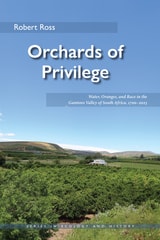
Orchards of Privilege
Water, Oranges, and Race in the Gamtoos Valley of South Africa, 1700–2023Robert Ross
Ohio University Press, 2025
This study of the Gamtoos River floodplain in South Africa’s Eastern Cape Province traces its transformation from an eighteenth-century natural landscape of thick bush into an agricultural zone now threatened by climate change. The first half of the book explains how missionaries from the London Missionary Society and residents of the Hankey Mission Station introduced irrigation, turning the area into a community of small-scale farmers. Despite early failures, by 1849 they had constructed South Africa’s first major irrigation tunnel and aqueduct. However, conflicts between the missionaries and residents led to the loss of communal lands to privatization, which ultimately impoverished the local farmers. The second half explores efforts to develop the valley for large-scale agriculture, addressing challenges like drought, flash floods, and saline water. By the mid-twentieth century, Afrikaners dominated the area, benefiting from the construction in 1970 of the Kouga Dam, which provided fresh water for the floodplain. This led to the rise of a wealthy white farming community, sustained by apartheid policies and labor from the “Coloured” and African populations. In the early twenty-first century, however, this prosperity has become threatened by severe droughts linked to global climate change. In view of these historical transformations, the Gamtoos River floodplain exemplifies the complex interplay between human ambition, environmental challenges, and sociopolitical forces.
Ordinary Abortion
Reproductive Choice in Twenty-First-Century Women’s WritingMary Thompson
The Ohio State University Press, 2026
The Supreme Court’s Dobbs v. Jackson (2022) decision, which erased the constitutional right to abortion, abruptly redramatized access in the United States. Yet twenty-first-century literature written before Dobbs reflects a landscape in which abortion appears as an undramatic, routine part of women’s lives. In Ordinary Abortion, Mary Thompson argues that many contemporary women writers depict abortion as a commonplace decision intertwined with health, education, career, sexuality, relationships, family-making, and motherhood.
Drawing on American poetry, fiction, nonfiction, memoir, and dystopian writing, Ordinary Abortion examines how ideas about abortion circulate through literature and how literary forms, in turn, shape readers’ understandings of reproduction and politics. Thompson traces new plots, characters, narrative strategies, and genres emerging around birth control, unplanned pregnancy, termination, and family formation. These works reveal renewed thematic attention to abortion’s relationship with motherhood and mother-loss, neoliberal pressures, stratified reproduction, masculinity, violence, care work, and disability.
Ultimately, Ordinary Abortion shows that abortion literature extends far beyond stories centered on crisis or choice. Instead, twenty-first-century women’s writing reveals a quiet, pervasive truth: Abortion has long been woven into everyday American life, normalized in ways that public discourse has often failed to acknowledge.
Ordinary Genomes
Science, Citizenship, and Genetic IdentitiesKaren-Sue Taussig
Duke University Press, 2009

Ordinary Reactions to Extraordinary Events
Edited by Ray B. Browne and Arthur B. Neal
University of Wisconsin Press, 2001

Orgasmology
Annamarie Jagose
Duke University Press, 2013
Along the way, she examines marriage manuals of the 1920s and 1930s, designed to teach heterosexual couples how to achieve simultaneous orgasms; provides a queer reading of behavioral modification practices of the 1960s and 1970s, aimed at transforming gay men into heterosexuals; and demonstrates how representations of orgasm have shaped ideas about sexuality and sexual identity.
A confident and often counterintuitive engagement with feminist and queer traditions of critical thought, Orgasmology affords fresh perspectives on not just sex, sexual orientation, and histories of sexuality, but also agency, ethics, intimacy, modernity, selfhood, and sociality. As modern subjects, we presume we already know everything there is to know about orgasm. This elegantly argued book suggests that orgasm still has plenty to teach us.
Orientalism's Interlocutors
Painting, Architecture, PhotographyJill Beaulieu and Mary Roberts, eds.
Duke University Press, 2002
Looking at the political significance of cross-cultural encounters refracted through the visual languages of Orientalism, the contributors engage with pressing recent debates about indigenous agency, postcolonial identity, and gendered subjectivities. The very range of artists, styles, and forms discussed in this collection broadens contemporary understandings of Orientalist art. Among the artists considered are the Algerian painters Azouaou Mammeri and Mohammed Racim; Turkish painter Osman Hamdi; British landscape painter Barbara Bodichon; and the French painter Henri Regnault. From the liminal "Third Space" created by mosques in postcolonial Britain to the ways nineteenth-century harem women negotiated their portraits by British artists, the essays in this collection force a rethinking of the Orientalist canon.
This innovative volume will appeal to those interested in art history, theories of gender, and postcolonial studies.
Contributors. Jill Beaulieu, Roger Benjamin, Zeynep Çelik, Deborah Cherry, Hollis Clayson, Mark Crinson, Mary Roberts
Orienting to Chance
Probabilism and the Future of Social TheoryMichael Strand and Omar Lizardo
University of Chicago Press, 2025
Since the founding of the discipline, sociologists have endeavored to understand the structures of groups, organizations, and societies, and how these entities condition our behavior. While some of the foundational theorists saw these processes as largely deterministic, sociological theory has increasingly insisted on the importance of culture in shaping our position in and responses to social groups. In Orienting to Chance, sociologists Michael Strand and Omar Lizardo aim to show that the social order bears an unmistakable link to chance and urge us to think about how it conditions our actions.
Strand and Lizardo provide a sweeping overview of a new social theory framework that they call probabilism. Using examples of probabilism in sociology, particularly in the work of Max Weber, W. E. B. Du Bois, and Pierre Bourdieu, they describe probabilism’s place in multiple fields of science. As the authors argue, their effort at redefinition and recovery helps position sociology as a field of the future, while also keeping it grounded in core issues of action, structure, culture, inequality, and inequity. By sharing these groundbreaking insights and revealing wider theoretical claims about mortality, fate, and technology in the contemporary era, Strand and Lizardo demonstrate how probabilism is an essential intervention for understanding the inevitable role of uncertainty in social life.
Origins and Destinations
The Making of the Second GenerationRenee Luthra
Russell Sage Foundation, 2018
Using surveys of second generation immigrant adults in New York and Los Angeles, Origins and Destinations explains why second generation experiences differ across national origin groups and why immigrant offspring with the same national background often follow different trajectories. Inter-group disparities stem from contexts of both emigration and immigration. Origin countries differ in value orientations: immigrant parents transmit lessons learned in varying contexts of emigration to children raised in the U.S. A system of migration control sifts immigrants by legal status, generating a context of immigration that favors some groups over others. Both contexts matter: schooling is higher among immigrant children from more secular societies (South Korea) than among those from more religious countries (the Philippines). When immigrant groups enter the U.S. migration system through a welcoming door, as opposed to one that makes authorized status difficult to achieve, education propels immigrant children to better jobs.
Diversity is also evident among immigrant offspring whose parents stem from the same place. Immigrant children grow up with homeland connections, which can both hurt and harm: immigrant offspring get less schooling when a parent lives abroad, but more schooling if parents in the U.S. send money to relatives living abroad. Though all immigrants enter the U.S. as non-citizens, some instantly enjoy legal status, while others spend years in the shadows. Children born abroad, but raised in the U.S. are all everyday Americans, but only some have become de jure Americans, a difference yielding across-the-board positive effects, even among those who started out in the same country.
Disentangling the sources of diversity among today’s population of immigrant offspring, Origins and Destinations provides a compelling new framework for understanding the second generation that is transforming America.
Origins of Psychopathology
The Phylogenetic and Cultural Basis of Mental IllnessFábrega Jr., Horacio
Rutgers University Press, 2002
In Origins of Psychopathology, Horacio Fárega Jr. employs principles of evolutionary biology to better understand the significance of mental illness. He explores whether what psychiatry has categorized as mental disorders could have existed during earlier phases of human evolution. Fábrega approaches the prominent features of mental disorders as adaptive responses to the environment and life’s circumstances, which in turn can only be understood in the context of our evolutionary past. Taking his cue from theoretical issues raised by research into primate behavior and early hominid evolution, he poses the question: What, if any, aspects of mental illness are rooted in our evolution? Does mental illness occur in primates and other animals, and if so, what does this tell us about mental illness in human evolution? How has mental illness played an adaptive role? How has the development of language and higher cognitive functions affected characteristics of psychopathology? Fábrega synthesizes insights from both the clinical and the evolutionary points of view. This facet of psychopathology, which involves its origins and manifestations viewed across the expanse of human evolution, has, until now, been largely neglected in psychiatric education, theory, and practice.
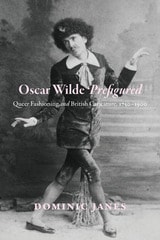
Oscar Wilde Prefigured
Queer Fashioning and British Caricature, 1750-1900Dominic Janes
University of Chicago Press, 2016
Oscar Wilde Prefigured is a study of the prehistory of this “queer moment” in 1895. Janes explores the complex ways in which men who desired sex with men in Britain had expressed such interests through clothing, style, and deportment since the mid-eighteenth century. He supplements the well-established narrative of the inscription of sodomitical acts into a homosexual label and identity at the end of the nineteenth century by teasing out the means by which same-sex desires could be signaled through visual display in Georgian and Victorian Britain. Wilde, it turns out, is not the starting point for public queer figuration. He is the pivot by which Georgian figures and twentieth-century camp stereotypes meet. Drawing on the mutually reinforcing phenomena of dandyism and caricature of alleged effeminates, Janes examines a wide range of images drawn from theater, fashion, and the popular press to reveal new dimensions of identity politics, gender performance, and queer culture.
Other Cities, Other Worlds
Urban Imaginaries in a Globalizing AgeAndreas Huyssen, ed.
Duke University Press, 2008
The effects of global processes such as the growth of transnational corporations and investment, the weakening of state sovereignty, increasing poverty, and the privatization of previously public services are described and analyzed in essays by Teresa P. R. Caldeira (São Paulo), Beatriz Sarlo (Buenos Aires), Néstor García Canclini (Mexico City), Farha Ghannam (Cairo), Gyan Prakash (Mumbai), and Yingjin Zhang (Beijing). Considering Johannesburg, the architect Hilton Judin takes on themes addressed by other contributors as well: the relation between the country and the city, and between racial imaginaries and the fear of urban violence. Rahul Mehrotra writes of the transitory, improvisational nature of the Indian bazaar city, while AbdouMaliq Simone sees a new urbanism of fragmentation and risk emerging in Douala, Cameroon. In a broader comparative frame, Okwui Enwezor reflects on the proliferation of biennales of contemporary art in African, Asian, and Latin American cities, and Ackbar Abbas considers the rise of fake commodity production in China. The volume closes with the novelist Orhan Pamuk’s meditation on his native city of Istanbul.
Contributors: Ackbar Abbas, Teresa P. R. Caldeira, Néstor García Canclini, Okwui Enwezor, Farha Ghannam, Andreas Huyssen, Hilton Judin, Rahul Mehrotra, Orhan Pamuk, Gyan Prakash, Beatriz Sarlo, AbdouMaliq Simone, Yingjin Zhang
Other Mothers
Beyond the Maternal IdealEdited by Ellen Bayuk Rosenman and Claudia C. Klaver
The Ohio State University Press, 2008
This collection addresses this void, revealing the extraordinary diversity of Victorian motherhood. Exploring diaries, novels, and court cases, with contexts ranging from London to Egypt to Australia, these varied accounts take the collection “beyond the maternal ideal” to consider the multiple, unpredictable ways in which motherhood was experienced and imagined in this formative historical period.
Other Mothers joins revisionist approaches to femininity that now characterize Victorian studies. Its contents trace intersections among gender, race, and class; question the power of separate spheres ideology; and insist on the context-specific nature of social roles. The fifteen essays in this volume contribute to the fields of literary criticism, history, cultural studies, and history.
Othermindedness
The Emergence of Network CultureMichael Joyce
University of Michigan Press, 2001
Michael Joyce's new collection continues to examine the connections between the poles of art and instruction, writing and teaching in the form of what Joyce has called theoretical narratives, pieces that are both narratives of theory and texts in which theory often takes the form of narrative. His concerns include hypertext and interactive fiction, the geography of cyberspace, and interactive film, and Joyce here searches out the emergence of network culture in spaces ranging from the shifting nature of the library to MOOs and other virtual spaces to life along a river.
While in this collection Joyce continues to be one of our most lyrical, wide-ranging, and informed cultural critics and theorists of new media, his essays exhibit an evolving distrust of unconsidered claims for newness in the midst of what Joyce calls "the blizzard of the next," as well as a recurrent insistence upon grounding our experience of the emergence of network culture in the body.
Michael Joyce is Associate Professor of English, Vassar College. He is author of a number of hypertext fictions on the web and on disk, most notably Afternoon: A Story.
His previous books are Of Two Minds: Hypertext Pedagogy and Poetics and Moral Tale and Meditations: Technological Parables and Refractions.
Others' Milk
The Potential of Exceptional BreastfeedingWilson, Kristin J.
Rutgers University Press, 2018
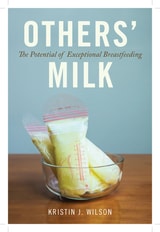
Exceptional breastfeeders find creative ways to feed and care for their children—such as by inducing lactation, sharing milk, or exclusively pumping. They want to adhere to the societal ideal of giving them “the best” but sometimes have to face off with dogmatic authorities in order to do so. Kristin J. Wilson argues that while breastfeeding is never going to be the feasible choice for everyone, it should be accessible to anyone.
Our Blood
The Social Experience of HeritasMichael M. Bell, Loka Ashwood and Jay Orne
University of Chicago Press, 2026
From whom do I come? Our Blood describes the central importance of our sense not just of our heritage, but our embodied heritage: that our past is in our bodies and runs in our blood, and that our embodied past is central to our futures. Deeply felt heritas, as Michael M. Bell, Loka Ashwood, and Jay Orne call it, can be a source of great love and kindness for one another. But it can also be a beautiful horror, the source of some of our greatest hate and meanness towards one another. We think of our embodied heritage as natural and historical facts, beyond our choice, and therefore free of manipulation for social gain. We think of it as spirited presences in our bodies that we did not choose. We think of its origins as external to us, whether we are talking about family, class, caste, places, things, ethnoraciality, or our professions. We think of it as legitimate and rightful, therefore. But we do choose. We do select. Bell, Ashwood, and Orne argue that greater awareness of heritas’s social origins and social selectivity can help us cultivate a wider sense of mutual care and ease the divisiveness of our time. Ultimately, Our Blood asks us all to consider heritas, and in doing so, to perhaps even reconsider our very selves.
Our Body of Work
Embodied Administration and Teachingedited by Melissa Nicolas & Anna Sicari
Utah State University Press, 2022
Open exchanges enable complex and nuanced conversations about intersectionality and how racism, sexism, classism, and ableism (among other “isms”) create systems of power. Contributors examine how these conversations are framed around work, practices, policies, and research and identify ways to create inclusive, embodied practices in writing programs and classrooms. The collection is organized to maximize representation in the areas of race, gender, identity, ability, and class by featuring scholarly chapters followed by narratively focused interchapters that respond to and engage with the scholarly work.
The honest and emotionally powerful stories in Our Body of Work expose problematic and normalizing policies, practices, and procedures and offer diverse theories and methodologies that provide multiple paths for individuals to follow to make the academy more inclusive and welcoming for all bodies. It will be an important resource for researchers, as well a valuable addition to graduate and undergraduate syllabi on embodiment, writing instruction/pedagogy, and WPA work.
Contributors: Dena Arendall, Janel Atlas, Hayat Bedaiwi, Elizabeth Boquet, Lauren Brentnell, Triauna Carey, Denise Comer, Joshua Daniel, Michael Faris, Rebecca Gerdes-McClain, Morgan Gross, Nabila Hijazi, Jacquelyn Hoermann-Elliott, Maureen Johnson, Jasmine Kar Tang, Elitza Kotzeva, Michelle LaFrance, Jasmine Lee, Lynn C. Lewis, Mary Lourdes Silva, Rita Malenczyk, Anna Rita Napoleone, Julie Prebel, Rebecca Rodriguez Carey, Ryan Skinnell, Trixie Smith, Stacey Waite, Kelsey Walker, Shannon Walters, Isaac Wang, Jennie Young
Our Charge to Keep
Writing Center and Writing Program Administration at Historically Black Colleges and UniversitiesWonderful Faison
Utah State University Press, 2026
The first book to explore writing center (WC) and writing program (WP) administration in HBCUs, Our Charge to Keep nuances ideas of ethical tutoring, explores Black college students’ beliefs about using Black Language in academic writing, provides new theories about tutoring, and gives insights into infrastructure and challenges facing WC and WP administrators in HBCU settings.
Many writing center directors have taken up the challenge to interrogate the impact of systemic racism on writing center theory, research, pedagogy, praxes, and daily operations, but the focus has largely been on predominantly white institutions (PWIs). As a result, writing center theory and research has unintentionally excluded the practices of everyday HBCU writing centers—their pedagogies, praxes, theories, and research. This edited volume rectifies this marginality by centering the epistemologies, practices, and wisdom of HBCU writing administrators, theorists, and practitioners. Chapters examine antiracist pedagogy, first-year writing challenges, the role of the larger HBCU community, and more.
Our Charge to Keep is a collection of writings that ultimately demystifies the administration of HBCU writing centers and inspires critical curiosity about them. Dr. Wonderful and Kendra Mitchell frame and showcase the resilience of HBCU writing center directors in combating the residual impact of systemic oppression and point the way forward for PWIs to shift toward new HBCU-centered perspectives on how to institute true antiracist policies and initiatives.
Our Common Bonds
Using What Americans Share to Help Bridge the Partisan DivideMatthew Levendusky
University of Chicago Press, 2023
One of the defining features of twenty-first-century American politics is the rise of affective polarization: Americans increasingly not only disagree with those from the other party but distrust and dislike them as well. This has toxic downstream consequences for both politics and social relationships. Is there any solution?
Our Common Bonds shows that—although there is no silver bullet that will eradicate partisan animosity—there are concrete interventions that can reduce it. Matthew Levendusky argues that partisan animosity stems in part from partisans’ misperceptions of one another. Democrats and Republicans think they have nothing in common, but this is not true. Drawing on survey and experimental evidence, the book shows that it is possible to help partisans reframe the lens through which they evaluate the out-party by priming commonalities—specifically, shared identities outside of politics, cross-party friendships, and common issue positions and values identified through civil cross-party dialogue. Doing so lessons partisan animosity, and it can even reduce ideological polarization. The book discusses what these findings mean for real-world efforts to bridge the partisan divide.
Our Grateful Dead
Stories of Those Left BehindVinciane Despret
University of Minnesota Press, 2021
An award-winning exploration of the presence of the dead in the lives of the living
A common remedy after suffering the loss of a loved one is to progress through the “stages of grief,” with “acceptance” as the final stage in the process. But is it necessary to leave death behind, to stop dwelling on the dead, to get over the pain? Vinciane Despret thinks not. In her fascinating, elegantly translated book, this influential thinker argues that, in practice, people in all cultures continue to enjoy a lively, inventive, positive relationship with their dead.
Through her unique storytelling woven from ethnographic sources and her own family history, Despret assembles accounts of those who have found ways to live their daily lives with their dead. She rejects the idea that one must either subscribe to “complete mourning” (in a sense, to get rid of the dead) or else fall into fantasy and superstition. She explores instead how the dead still play an active, tangible role through those who are living, who might assume their place in a family or in society; continue their labor or art; or thrive from a shared inheritance or an organ donation. This is supported by dreams and voices, novels, television and popular culture, the work of clairvoyants, and the everyday stories and activities of the living. For decades now, in the West, the dead have been discreet and invisible. Today, especially as a result of the Covid-19 pandemic, Despret suggests that perhaps we will be willing to engage with the dead in ways that bring us happiness despite our loss.
Despret’s unique method of inquiry makes her book both entertaining and instructive. Our Grateful Dead offers a new, pragmatic approach to social and cultural research and may indeed provide compassionate therapy for those of us coping with death.
Our Musicals, Ourselves
A Social History of the American Musical TheatreJohn Bush Jones
Brandeis University Press, 2004
Our New Husbands Are Here
Households, Gender, and Politics in a West African State from the Slave Trade to Colonial RuleEmily Lynn Osborn
Ohio University Press, 2011
In Our New Husbands Are Here, Emily Lynn Osborn investigates a central puzzle of power and politics in West African history: Why do women figure frequently in the political narratives of the precolonial period, and then vanish altogether with colonization? Osborn addresses this question by exploring the relationship of the household to the state. By analyzing the history of statecraft in the interior savannas of West Africa (in present-day Guinea-Conakry), Osborn shows that the household, and women within it, played a critical role in the pacifist Islamic state of Kankan-Baté, enabling it to endure the predations of the transatlantic slave trade and become a major trading center in the nineteenth century. But French colonization introduced a radical new method of statecraft to the region, one that separated the household from the state and depoliticized women’s domestic roles. This book will be of interest to scholars of politics, gender, the household, slavery, and Islam in African history.

Our Precious Corn
YukwanénsteRebecca M. Webster
Michigan State University Press, 2023
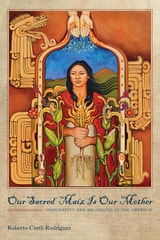
Our Sacred Maíz Is Our Mother
Indigeneity and Belonging in the AmericasRoberto Cintli Rodríguez
University of Arizona Press, 2014
Follow it he did, and his book Our Sacred Maíz Is Our Mother changes the way we look at Mexican Americans. Not so much peoples created as a result of war or invasion, they are people of the corn, connected through a seven-thousand-year old maíz culture to other Indigenous inhabitants of the continent. Using corn as the framework for discussing broader issues of knowledge production and history of belonging, the author looks at how corn was included in codices and Mayan texts, how it was discussed by elders, and how it is represented in theater and stories as a way of illustrating that Mexicans and Mexican Americans share a common culture.
Rodriguez brings together scholarly and traditional (elder) knowledge about the long history of maíz/corn cultivation and culture, its roots in Mesoamerica, and its living relationship to Indigenous peoples throughout the continent, including Mexicans and Central Americans now living in the United States. The author argues that, given the restrictive immigration policies and popular resentment toward migrants, a continued connection to maíz culture challenges the social exclusion and discrimination that frames migrants as outsiders and gives them a sense of belonging not encapsulated in the idea of citizenship. The “hidden transcripts” of corn in everyday culture—art, song, stories, dance, and cuisine (maíz-based foods like the tortilla)—have nurtured, even across centuries of colonialism, the living maíz culture of ancient knowledge.
Ours to Lose
When Squatters Became Homeowners in New York CityAmy Starecheski
University of Chicago Press, 2016
Those decades of strife, however, also gave the Lower East Side something unusual: a radical movement that blended urban homesteading and European-style squatting in a way never before seen in the United States. Ours to Lose tells the oral history of that movement through a close look at a diverse group of Lower East Side squatters who occupied abandoned city-owned buildings in the 1980s, fought to keep them for decades, and eventually began a long, complicated process to turn their illegal occupancy into legal cooperative ownership. Amy Starecheski here not only tells a little-known New York story, she also shows how property shapes our sense of ourselves as social beings and explores the ethics of homeownership and debt in post-recession America.
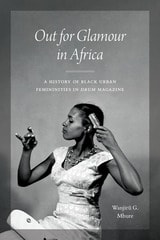
Out for Glamour in Africa
A History of Black Urban Femininities in Drum MagazineWanjiru G. Mbure
University of Michigan Press, 2026
Out for Glamour in Africa critically reflects on how Black women utilized Drum magazine, a leading publication in Africa during the era of independence, for political empowerment and constructing notions of Black femininity. Wanjirũ G. Mbure terms the concept of femme urbAfricana, a model of Black femininity depicted as urban, political, fashionable, paradoxically Afrocentric, heteronormative, and transnational. Foregrounding stories of the women who embodied these traits and the social, political, and economic forces that shaped their presence in Drum, Mbure argues that these representations of Black women from Africa, the Caribbean, Europe, and the United States produced a novel form of Black urban femininity. Utilizing a breadth of archival materials from cover girl photographs, advertisements, and columns, to readers’ comments, Mbure reveals the complex relationship between the Black urban woman and the era’s contested ideals within a transnational matrix.
Out in the Center
Public Controversies and Private StrugglesHarry C. Denny
Utah State University Press, 2018
A diverse group of contributors interweaves personal experience with writing center theory and critical race theory, as well as theories on the politics and performance of identity. In doing so, Out in the Center extends upon the writing center corpus to disrupt and reimagine conventional approaches to writing center theory and practice. Out in the Center proposes that practitioners benefit from engaging in dialogue about identity to better navigate writing center work—work that informs the local and carries forth a social and cultural impact that stretches well beyond academic institutions.
Contributors:
Allia Abdullah-Matta, Nancy Alvarez, Hadi Banat, Tammy S. Conard-Salvo, Michele Eodice, Rochell Isaac, Sami Korgan, Ella Leviyeva, Alexandria Lockett, Talisha Haltiwanger Morrison, Anna Rita Napoleone, Beth A. Towle, Elizabeth Weaver, Tim Zmudka
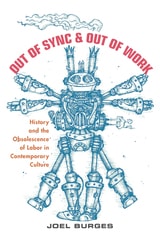
Out of Sync & Out of Work
History and the Obsolescence of Labor in Contemporary CultureBurges, Joel
Rutgers University Press, 2018
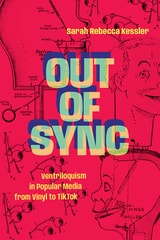
Out of Sync
Ventriloquism in Popular Media from Vinyl to TikTokSarah Rebecca Kessler
Duke University Press, 2026
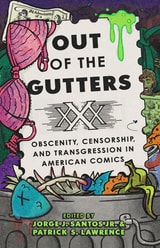
Out of the Gutters
Obscenity, Censorship, and Transgression in American ComicsEdited by Jorge J. Santos Jr. and Patrick S. Lawrence
University of Texas Press, 2025
Comics have long been a subject of moral panics, no doubt thanks to their in-your-face illustrations and their association with young readers. Indeed, the politicians and parents behind today’s book-banning campaigns reserve special ire for graphic novels. What makes today’s controversies different is the content of the alleged obscenity. Instead of targeting sex as such, censors now focus on affirmations of nonheteronormative identity, as in Maia Kobabe’s Gender Queer. And while violence is a constant in comics, stories that acknowledge nationalist oppression and violence, such as Art Spiegelman’s Maus, are also being blacklisted.
Out of the Gutters assembles scholars from diverse disciplines to examine US comics, graphic novels, and cartooning that have been challenged as obscene or transgressive. Covering well-known underground figures like Robert Crumb and Charles Burns, newcomers such as C. Spike Trotman and Emil Ferris, and mainstream creators including Chris Claremont and Archie Goodwin, the collection explores the market economics of transgression, historical representations of graphic violence, the ever-changing meaning of pornography, sex-positive comics by BIPOC authors, and queerness in pop-culture mega-properties like X-Men and The Walking Dead.
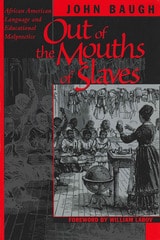
Out of the Mouths of Slaves
African American Language and Educational MalpracticeBy John Baugh
University of Texas Press, 1999
Winner, A Choice Outstanding Academic Book
When the Oakland, California, school board called African American English "Ebonics" and claimed that it "is not a black dialect or any dialect of English," they reignited a debate over language, race, and culture that reaches back to the era of slavery in the United States. In this book, John Baugh, an authority on African American English, sets new parameters for the debate by dissecting and challenging many of the prevailing myths about African American language and its place in American society.
Baugh's inquiry ranges from the origins of African American English among slaves and their descendants to its recent adoption by standard English speakers of various races. Some of the topics he considers include practices and malpractices for educating language minority students, linguistic discrimination in the administration of justice, cross-cultural communication between Blacks and whites, and specific linguistic aspects of African American English. This detailed overview of the main points of debate about African American language will be important reading for both scholars and the concerned public.
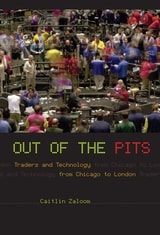
Out of the Pits
Traders and Technology from Chicago to LondonCaitlin Zaloom
University of Chicago Press, 2006
From New York to Singapore, from Chicago to London, the trading floors of the world’s financial markets are icons of global capitalism. Images of them are used on the news all the time—traders burying their heads in their hands when the market is down, their arms flailing in a frenzy when fortunes are rising—to convey the current state of the economy. But these marketplaces, and the cultural life that sustains them, are dissolving into the ether of the digital age: powerful financial institutions are shutting down the trading pits, replacing face-to-face exchanges with an electronic network where traders sit, face to screen, finger to mouse, and compete in a global arena made up of digits and charts.
Out of the Pits considers the implications of this sea change for everyone involved, from the traders and brokers to the market as a whole. Caitlin Zaloom takes us down to the floor at the Chicago Board of Trade and into a digital dealing room in the City of London. Drawing on her own firsthand experiences as a clerk and a trader and on her unusual access to these key sites of global finance, she explainshow changes at the world’s leading financial exchanges have transformed economic cultures and the craft of speculation; how people and places are responding to the digital transition; how traders are remaking themselves to compete in the contemporary marketplace; and how brokers, business managers, and software designers are collaborating to build new financial markets.
A penetrating and richly detailed account of how cities, culture, and technology shape everyday life in the new global economy, Out of the Pits will be must reading for business buffs or anyone who has ever wondered how financial markets work.
Outlaw Music in Russia
The Rise of an Unlikely GenreAnastasia Gordienko
University of Wisconsin Press, 2023
The Russian shanson can be heard across the country today, on radio and television shows, at mass events like political rallies, and even at the Kremlin. Yet despite its ubiquity, it has attracted almost no scholarly attention. Anastasia Gordienko provides the first full history of the shanson, from its tenuous ties to early modern criminals’ and robbers’ folk songs, through its immediate generic predecessors in the Soviet Union, to its current incarnation as the soundtrack for daily life in Russia. It is difficult to firmly define the shanson or its family of song genres, but they all have some connection, whether explicit or implicit, to the criminal underworld or to groups or activities otherwise considered subversive. Traditionally produced by and popular among criminals and other marginalized groups, and often marked by characters and themes valorizing illegal activities, the songs have undergone censorship since the early nineteenth century. Technically legal only since the collapse of the Soviet Union, the shanson is today not only broadly popular but also legitimized by Vladimir Putin’s open endorsement of the genre.
With careful research and incisive analysis, Gordienko deftly details the shanson’s history, development, and social meanings. Attempts by imperial rulers, and later by Soviet leaders, to repress the songs and the lifestyles they romanticized not only did little to discourage their popularity but occasionally helped the genre flourish. Criminals and liberal intelligentsia mingled in the Gulag system, for instance, and this contact introduced censored songs to an educated, disaffected populace that inscribed its own interpretations and became a major point of wider dissemination after the Gulag camps were closed. Gordienko also investigates the shanson as it exists in popular culture today: not divorced from its criminal undertones (or overtones) but celebrated for them. She argues that the shanson expresses fundamental themes of Russian culture, allowing for the articulation of anxieties, hopes, and dissatisfactions that are discouraged or explicitly forbidden otherwise.
Over Here, Over There
Transatlantic Conversations on the Music of World War IEdited by William Brooks, Christina Bashford, and Gayle Magee
University of Illinois Press, 2019
Over There
Living with the U.S. Military Empire from World War Two to the PresentMaria Höhn and Seungsook Moon, eds.
Duke University Press, 2010
Contributors
Donna Alvah
Chris Ames
Jeff Bennett
Maria Höhn
Seungsook Moon
Christopher Nelson
Robin Riley
Michiko Takeuchi
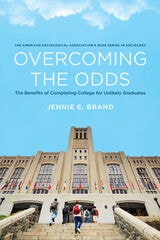
Overcoming the Odds
The Benefits of Completing College for Unlikely GraduatesJennie E. Brand
Russell Sage Foundation, 2023
Drawing on two cohorts of nationally representative data from the Bureau of Labor Statistics National Longitudinal Surveys program, Brand uses matching and machine learning methods to estimate the effects of college completion across students with varying likelihoods of completing four-year degrees. To illustrate her findings, Brand describes outcomes using matched vignettes of college and non-college graduates. Brand shows that four-year college completion enables graduates to increase wages and household income, while also circumventing unemployment, low-wage work, job instability, poverty, and social assistance. Completing college also increases civic engagement. Most of these benefits are larger for disadvantaged than for more advantaged students, rendering arguments that college has limited benefits for unlikely graduates as flawed. Brand concludes that greater long-term earnings, and less job instability and unemployment, and thus more tax revenue, less reliance on public assistance, and high levels of volunteering indicate that public investment in higher education for students from disadvantaged backgrounds yields far-reaching collective benefits. She asserts that it is better for our society when more people complete college.
Overcoming the Odds is an innovative and enlightening exploration of how college can transform lives.
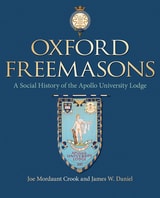
Oxford Freemasons
A Social History of Apollo University LodgeJoe Mordaunt Crook and James W. Daniel
Bodleian Library Publishing, 2018

Oye Como Va!
Hybridity and Identity in Latino Popular MusicDeborah Pacini Hernandez
Temple University Press, 2009
Listen Up! When the New York-born Tito Puente composed "Oye Como Va!" in the 1960s, his popular song was called "Latin" even though it was a fusion of Afro-Cuban and New York Latino musical influences. A decade later, Carlos Santana, a Mexican immigrant, blended Puente’s tune with rock and roll, which brought it to the attention of national audiences. Like Puente and Santana, Latino/a musicians have always blended musics from their homelands with other sounds in our multicultural society, challenging ideas of what "Latin" music is or ought to be. Waves of immigrants further complicate the picture as they continue to bring their distinctive musical styles to the U.S.—from merengue and bachata to cumbia and reggaeton.
In Oye Como Va!, Deborah Pacini Hernandez traces the trajectories of various U.S. Latino musical forms in a globalizing world, examining how the blending of Latin music reflects Latino/a American lives connecting across nations. Exploring the simultaneously powerful, vexing, and stimulating relationship between hybridity, music, and identity, Oye Como Va! asserts that this potent combination is a signature of the U.S. Latino/a experience.