Results by title
8642 books match the query '20th Century' and 170 start with o
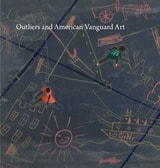
Outliers and American Vanguard Art
Lynne Cooke
University of Chicago Press, 2017
The art works in Outliers and American Vanguard Art come from three distinct periods when the intersections between mainstream and outlier artists were most dynamic and productive, ushering in exhibitions of art based on various degrees of co-existence, inclusion, and assimilation. Works by such diverse artists as Charles Sheeler, Christina Ramberg, and Matt Mullican are set in conversation with a range of works by such self-taught artists as Horace Pippin, Janet Sobel, and Henry Darger. Cooke also examines a recent increase of radically expressive work that challenges what it means to be an outlier today. She reveals how these distinctions have been freighted with a particularly American point of view as she investigates our assumptions about creativity, artistic practice, and the role of the artist in contemporary culture.
Outliers and American Vanguard Art is the most comprehensive show ever to examine outliers in dialogue with their established peers. It is sure to inspire vigorous conversation about how artists and the work they make are represented.
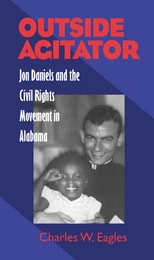
Outside Agitator
Jon Daniels and the Civil Rights Movement in AlabamaCharles Eagles
University of Alabama Press, 2000
WINNER OF THE LILLIAN SMITH BOOK AWARD
The story of faith, sacrifice, and moral courage in Alabama's fight for civil rights.
Outside Agitator tells the powerful, largely forgotten story of Jonathan Daniels—a white Episcopal seminarian from New England who answered the call of the civil rights movement and paid for that commitment with his life. In 1965, Daniels left the safety of Harvard and Cambridge for Selma and Alabama’s Black Belt, where he worked alongside Black activists to challenge segregation, register voters, and confront the moral failures of church and state. His murder by a white segregationist shocked the nation and exposed the deadly cost of racial injustice—and of moral courage.
More than a biography, this book asks urgent questions that still resonate: What does it mean to act on conscience in a society structured by inequality? What responsibilities do faith, citizenship, and privilege impose? Historian Charles W. Eagles places Daniels’s life within the turbulent final phase of the southern civil rights movement, revealing the everyday fears, ethical dilemmas, and racial tensions behind the iconic events of Selma and Lowndes County.
Outside Agitator will appeal to readers interested in civil rights history, religious activism, Southern history, and the moral dimensions of political struggle. It is essential reading for students, scholars, clergy, and general readers seeking to understand how individual lives can illuminate—and challenge—the ongoing fight for justice and equality.
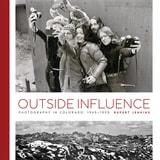
Outside Influence
Photography in Colorado, 1945–1995Rupert Jenkins
University Press of Colorado, 2025
Outside Influence: Photography in Colorado, 1945–1995 is the first detailed account of the state’s history of post–World War II expressive photography. The title “Outside Influence” alludes to the historic presence of the natural landscape as subject and to the transformative impact of out-of-state artists and educators. Their arrival in Colorado beginning in the 1960s galvanized interpretive photography by introducing innovative concepts, nontraditional materials, and emergent digital technologies to students, peers, and their audience-at-large.
Throughout the book’s nine chapters, Rupert Jenkins contextualizes Colorado photography’s postwar development with a social, political, and cultural abstract that encompasses national events and trends, the emerging presence of women and photographers of color, and institutional leadership. Drawing from more than 120 personal interviews, he identifies the medium’s principal in-state creators, mentors, and advocates from the modernist era of film processing to the emergence of interdisciplinary digital practice. Jenkins answers fundamental questions about the people and work of this era: Who generated this significant body of innovative, noncommercial photographic work? Where did they come from? Who inspired them, and who in turn did they inspire?
As Eric Paddock, curator of photography at the Denver Art Museum, discusses in his foreword, by looking at the schools, workshops, galleries, and museums that supported these artists, Jenkins stresses the importance of collaboration and community to any successful venture. Crucially, in examining the lives and careers of photographers like Robert Adams, Walter Chappell, Albert Chong, Cherie Hiser, Barbara Houghton, Winter Prather, Mark Sink, Melanie Walker, Myron Wood, and numerous others, Outside Influence seeks to affirm the medium’s legacy within Colorado’s fine arts canon.
Outside Literary Studies
Black Criticism and the UniversityAndy Hines
University of Chicago Press, 2022
This striking contribution to Black literary studies examines the practices of Black writers in the mid-twentieth century to revise our understanding of the institutionalization of literary studies in America. Andy Hines uncovers a vibrant history of interpretive resistance to university-based New Criticism by Black writers of the American left. These include well-known figures such as Langston Hughes and Lorraine Hansberry as well as still underappreciated writers like Melvin B. Tolson and Doxey Wilkerson. In their critical practice, these and other Black writers levied their critique from “outside” venues: behind the closed doors of the Senate Permanent Subcommittee on Investigations, in the classroom at a communist labor school under FBI surveillance, and in a host of journals. From these vantages, Black writers not only called out the racist assumptions of the New Criticism, but also defined Black literary and interpretive practices to support communist and other radical world-making efforts in the mid-twentieth century. Hines’s book thus offers a number of urgent contributions to literary studies: it spotlights a canon of Black literary texts that belong to an important era of anti-racist struggle, and it fills in the pre-history of the rise of Black studies and of ongoing Black dissent against the neoliberal university.
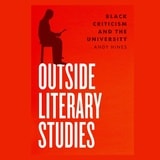
Outside Literary Studies
Black Criticism and the UniversityAndy Hines
University of Chicago Press, 2022
This is an auto-narrated audiobook edition of this book.
A timely reconsideration of the history of the profession, Outside Literary Studies investigates how midcentury Black writers built a critical practice tuned to the struggle against racism and colonialism.
This striking contribution to Black literary studies examines the practices of Black writers in the mid-twentieth century to revise our understanding of the institutionalization of literary studies in America. Andy Hines uncovers a vibrant history of interpretive resistance to university-based New Criticism by Black writers of the American left. These include well-known figures such as Langston Hughes and Lorraine Hansberry as well as still underappreciated writers like Melvin B. Tolson and Doxey Wilkerson. In their critical practice, these and other Black writers levied their critique from “outside” venues: behind the closed doors of the Senate Permanent Subcommittee on Investigations, in the classroom at a communist labor school under FBI surveillance, and in a host of journals. From these vantages, Black writers not only called out the racist assumptions of the New Criticism, but also defined Black literary and interpretive practices to support communist and other radical world-making efforts in the mid-twentieth century. Hines’s book thus offers a number of urgent contributions to literary studies: it spotlights a canon of Black literary texts that belong to an important era of anti-racist struggle, and it fills in the pre-history of the rise of Black studies and of ongoing Black dissent against the neoliberal university.
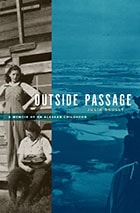
Outside Passage
A Memoir of an Alaskan ChildhoodJulia Scully
University of Alaska Press, 2010
Outside Passage is a lyrical and affecting memoir of those years, simultaneously an emotional account of a young girl’s first steps into adulthood and a unique portrait of a vanished frontier life.
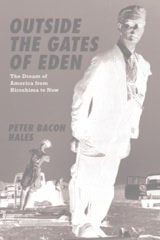
Outside the Gates of Eden
The Dream of America from Hiroshima to NowPeter Bacon Hales
University of Chicago Press, 2014
Born under the shadow of the bomb, with little security but the cold comfort of duck-and-cover, the postwar generations lived through—and led—some of the most momentous changes in all of American history. Hales explores those decades through perceptive accounts of a succession of resonant moments, spaces, and artifacts of everyday life—drawing unexpected connections and tracing the intertwined undercurrents of promise and peril. From sharp analyses of newsreels of the first atomic bomb tests and the invention of a new ideal American life in Levittown; from the music emerging from the Brill Building and the Beach Boys, and a brilliant account of Bob Dylan’s transformations; from the painful failures of communes and the breathtaking utopian potential of the early days of the digital age, Hales reveals a nation, and a dream, in transition, as a new generation began to make its mark on the world it was inheriting.
Full of richly drawn set-pieces and countless stories of unforgettable moments, Outside the Gates of Eden is the most comprehensive account yet of the baby boomers, their parents, and their children, as seen through the places they built, the music and movies and shows they loved, and the battles they fought to define their nation, their culture, and their place in what remains a fragile and dangerous world.
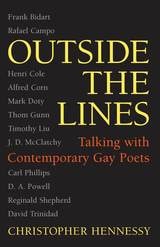
Outside the Lines
Talking with Contemporary Gay PoetsChristopher Hennessy, Editor
University of Michigan Press, 2005
---Bernard Cooper, author of Maps to Anywhere
Editor Christopher Hennessy gathers interviews with some of the most significant figures in contemporary American poetry. While each poet is gay, these encompassing, craft-centered interviews reflect the diversity of their respective arts and serve as a testament to the impact gay poets have had and will continue to have on contemporary poetics.
The book includes twelve frank, intense interviews with some of America's best-known and loved poets, who have not only enjoyed wide critical acclaim but who have had lasting impact on both the gay tradition and the contemporary canon writ large, for example, Frank Bidart, the late Thom Gunn, and J. D. McClatchy. Some of the most honored and respected poets, still in the middle of their careers, are also included, for example, Mark Doty, Carl Phillips, and Reginald Shepherd. Each interview explores the poet's complete work to date, often illuminating the poet's technical evolution and emotional growth, probing shifts in theme, and even investigating links between verse and sexuality.
In addition to a selected bibliography of works by established poets, the book also includes a list of works by newer and emerging poets who are well on their way to becoming important voices of the new millennium.
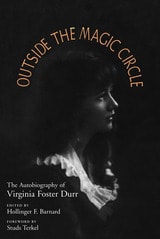
Outside the Magic Circle
The Autobiography of Virginia Foster DurrHollinger F. Barnard
University of Alabama Press, 1990
Winner of the Alabama Library Author Award
Outside the Magic Circle tells the remarkable story of Virginia Foster Durr, a southern white woman born into privilige who (along with her husband Clifford Durr, a lawyer best known for defending Rosa Parks), nonetheless devoted her life to Civil Rights activism.
Outside the Magic Circle is the powerful and deeply personal autobiography of Virginia Foster Durr, a Southern woman who defied the expectations of her privileged upbringing to become one of the most courageous voices for civil rights and social justice in 20th-century America. Born into a wealthy, white Alabama family, Durr was raised in a world steeped in segregation and conservative values. Yet through a journey marked by moral reckoning, intellectual awakening, and political activism, she stepped outside the “magic circle” of Southern gentility to confront the injustices that shaped her world.
With a foreword by renowned oral historian Studs Terkel, this memoir captures Durr’s transformation from reluctant conformist to outspoken advocate. Her story spans decades of American history—from the Great Depression and New Deal politics to the McCarthy era and the Civil Rights Movement. Alongside her husband, attorney Clifford Durr, Virginia became a key figure in progressive circles, working to abolish the poll tax, defend civil liberties, and support Black activists in the segregated South.
Told in Durr’s own voice, the narrative is rich with anecdotes, reflections, and encounters with historical figures such as Eleanor Roosevelt, Rosa Parks, and Martin Luther King Jr. It is both a personal reckoning and a political document, offering rare insight into the inner conflicts of white Southern liberals and the cost of dissent in a deeply divided society.
Outside the Magic Circle is more than a memoir—it is a testament to the power of conscience, the courage of transformation, and the enduring fight for justice. It remains a vital resource for readers interested in civil rights history, feminist thought, and the complexities of Southern identity.
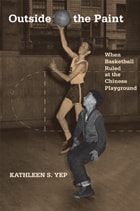
Outside the Paint
When Basketball Ruled at the Chinese PlaygroundKathleen S. Yep
Temple University Press, 2009
Outside the Paint takes readers back to the Chinese Playground of San Francisco in the 1930s and 1940s, the only public outdoor space in Chinatown. It was a place where young Chinese American men and women developed a new approach to the game of basketbal—with fast breaks, intricate passing and aggressive defense—that was ahead of its time.
Drawing on interviews with players and coaches, Kathleen Yep recounts some surprising stories. From the success of the Hong Wah Kues, a professional barnstorming men's basketball team and the Mei Wahs, a championship women’s amateur team, to Woo Wong, the first Chinese athlete to play in Madison Square Garden, and his extraordinarily talented sister Helen Wong, who is compared to Babe Didrikson.
Outside the Paint chronicles the efforts of these highly accomplished athletes who developed a unique playing style that capitalized on their physical attributes, challenged the prevailing racial hierarchy, and enabled them, for a time, to leave the confines of their segregated world. As they learned to dribble, shoot, and steal, they made basketball a source of individual achievement and Chinese American community pride.
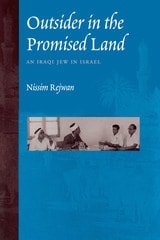
Outsider in the Promised Land
An Iraqi Jew in IsraelBy Nissim Rejwan
University of Texas Press, 2006
In 1951, Israel was a young nation surrounded by hostile neighbors. Its tenuous grip on nationhood was made slipperier still by internal tensions among the various communities that had immigrated to the new Jewish state, particularly those between the politically and socially dominant Jewish leadership hailing from Eastern Europe and the more numerous Oriental Jews from the Middle East and North Africa. Into this volatile mix came Nissim Rejwan, a young Iraqi Jewish intellectual who was to become one of the country's leading public intellectuals and authors.
Beginning with Rejwan's arrival in 1951 and climaxing with the tensions preceding Israel's victory in the Six-Day War of 1967, this book colorfully chronicles Israel's internal and external struggles to become a nation, as well as the author's integration into a complex culture. Rejwan documents how the powerful East European leadership, acting as advocates of Western norms and ideals, failed to integrate Israel into the region and let the country take its place as a part of the Middle East. Rejwan's essays and occasional articles are an illuminating example of how minority groups use journalism to gain influence in a society. Finally, the letters and diary entries reproduced in Outsider in the Promised Land are full of lively, witty meditations on history, literature, philosophy, education, and art, as well as one man's personal struggle to find his place in a new nation.
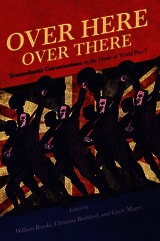
Over Here, Over There
Transatlantic Conversations on the Music of World War IEdited by William Brooks, Christina Bashford, and Gayle Magee
University of Illinois Press, 2019
Over There
Living with the U.S. Military Empire from World War Two to the PresentMaria Höhn and Seungsook Moon, eds.
Duke University Press, 2010
Contributors
Donna Alvah
Chris Ames
Jeff Bennett
Maria Höhn
Seungsook Moon
Christopher Nelson
Robin Riley
Michiko Takeuchi
Over the Wire and on TV
CBS and UPI in Campaign '80Michael J. Robinson
Russell Sage Foundation, 1983
Overcoming All Obstacles
The Women of the Académie JulianBecker, Jane R
Rutgers University Press, 1999
Overcoming All Obstacles: The Women of the Académie Julian is the first book to examine late nineteenth-century Paris's most famous training ground for the leading women artists of the period. The Académie Julian was founded in Paris in 1868, initially to prepare students for entry to the Ecole des Beaux-Arts, the nineteenth-century's preeminent art school. Because women could not study at the Ecole des Beaux-Arts until 1897, Julian itself became an international equivalent for many of the late nineteenth- and early twentieth-century's most important women artists.
Not only does Overcoming All Obstacles introduce the reader to many works by women artists-both famous and lesser known-but the essays offer a cultural and historical context in which to appreciate their art. Gabriel Weisberg's essay concentrates on the rigorous training methods enforced by Rodolphe Julian and the teachers at the Academy. Jane Becker explores the competitive environment of the Julian Academy as it affected the Ukrainian painter Marie Bashkirtseff and the Swiss painter Louise-Catherine Breslau. Essays by Catherine Fehrer, the leading scholar of the Académie Julian, and Tamar Garb, an art historian who focuses on the training of women artists, give us a richer understanding of the Académie Julian's place in the sphere of art education in late nineteenth-century Paris.
Generously illustrated with both color and black-and-white images, this volume includes documentary photographs and caricatures that have never before been reproduced. The core of the book draws on the large collection of the Académie Julian Del Debbio, the Académie Julian's successor institution in Paris. This publication accompanied an exhibition organized by the Dahesh Museum in New York that opened after its exhibition at the Sterling and Francine Clark Art Institute in Williamstown. The exhibition subsequently continued to the Dixon Gallery and Gardens, Memphis.
Overweight Sensation
The Life and Comedy of Allan ShermanMark Cohen
Brandeis University Press, 2013
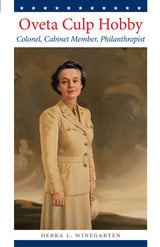
Oveta Culp Hobby
Colonel, Cabinet Member, PhilanthropistBy Debra L. Winegarten
University of Texas Press, 2014
This young adult biography introduces middle school readers to a remarkable woman who founded the Women’s Army Corps, served as Secretary of Health, Education, and Welfare, and ran a media empire that included the Houston Post newspaper and radio and TV stations.
Winner, Gold Medal for Biography, Military Writers Society of America, 2015
Oveta Culp Hobby (1905–1995) had a lifetime of stellar achievement. During World War II, she was asked to build a women’s army from scratch—and did. Hobby became Director of the Women’s Army Corps and the first Army woman to earn the rank of colonel. President Eisenhower chose her as Secretary of Health, Education, and Welfare, making her the second woman in history to be appointed to a president’s cabinet. When she wasn’t serving in the government, Hobby worked with her husband, former Texas governor William P. Hobby, to lead a media empire that included the Houston Post newspaper and radio and TV stations. She also supported the Houston community in many ways, from advocating for civil rights for African Americans to donating generously to the Houston Symphony and the Museum of Fine Arts.
Oveta Culp Hobby is the first biography of this important woman. Written for middle school readers, it traces her life from her childhood in Killeen to her remarkable achievements in Washington, DC, and Houston. Debra Winegarten provides the background to help young adult readers understand the times in which Hobby lived and the challenges she faced as a woman in nontraditional jobs. She shows how Hobby opened doors for women to serve in the military and in other professions that still benefit women today. Most of all, Oveta Culp Hobby will inspire young adults to follow their own dreams and turn them into tangible reality.
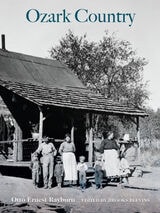
Ozark Country
Otto Ernest Rayburn
University of Arkansas Press, 2021
Published just days before America’s entry into World War II, Ozark Country is Otto Ernest Rayburn’s love letter to his adopted region. One of several chronicles of the Ozarks that garnered national attention during the Depression and war years, when many Americans craved stories about people and places seemingly untouched by the difficulties of the times, Rayburn’s colorful tour takes readers from the fictional village of Woodville into the backcountry of a region teeming with storytellers, ballad singers, superstitions, and home remedies.
Rayburn’s tales—fantastical, fun, and unapologetically romantic—portray a world that had already nearly disappeared by the time they were written. Yet Rayburn’s depiction of the Ozarks resonates with notions of the region that have persisted in the American consciousness ever since.
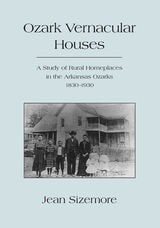
Ozark Vernacular Houses
A Study of Rural Homeplaces in the Arkansas Ozarks, 1830-1930Jean Sizemore
University of Arkansas Press, 1991
Ozu and the Ethics of Indeterminacy
Daisuke Miyao
Duke University Press, 2026