Results by title
28164 books match the query 'History' and 581 start with o
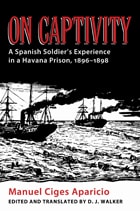
On Captivity
A Spanish Soldier's Experience in a Havana Prison, 1896-1898Manuel Ciges Aparicio
University of Alabama Press, 2012
A rare and unfiltered witness to Spain’s colonial collapse—Ciges Aparicio’s prison memoir exposes the political, human, and moral stakes of the Cuban War of Independence.
Ciges enlisted in the Spanish army in 1893 at the age of twenty. He served in Africa and then in Cuba, where he opposed Spanish General Valeriano Weyler’s policies in Cuba as well as the war itself. Ciges soon found himself imprisoned and facing execution for treason as punishment for an article critical of Weyler’s conducting of the war that was intercepted by Spanish authorities before it could be published in the pro-Cuban Parisian paper L’Intransigeant.
First published in book form in 1903, Ciges’s account includes detailed observations concerning prison organization, perceptions of political events and personalities of the time, as well as graphic descriptions of the daily life of the men confined in the infamous prison. Ciges is the only one of the so-called Generation of 1898—writers considered to have been deeply marked by el desastre (the loss of the colonies)—who was in Cuba during the war years. His witness to events there, colored by his stance as a freethinker and political skeptic, constitutes a significant historical document. Following his release from prison, Ciges returned to Spain where he resumed his career as an activist journalist and also earned acclaim as a translator and novelist. In time, his political allegiances shifted from socialism to liberal republicanism. He was acting as provincial governor of Avila when he was killed by unidentified assassins on August 4, 1936—eighteen days after the Falangist uprising against the Second Republic.
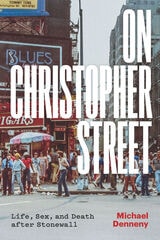
On Christopher Street
Life, Sex, and Death after StonewallMichael Denneny
University of Chicago Press, 2023
The Stonewall Riots of 1969 and the AIDS crisis of the 1980s have been captured in minute detail, and rightly memorialized in books, on tv, and in film as pivotal and powerful moments in queer history. Yet what about the moments in between—the tumultuous decade post-Stonewall when the queer community’s vitality and creativity exploded across the country, even as the AIDS crisis emerged?
Michael Denneny was there for it all. As a founder and editor of the wildly influential magazine Christopher Street and later as the first openly gay editor at a major publishing house, Denneny critically shaped publishing around gay subjects in the 1970s and beyond. At St. Martin’s Press, he acquired a slew of landmark titles by gay authors—many for his groundbreaking Stonewall Inn Editions—propelling queer voices into the mainstream cultural conversation. On Christopher Street is Denneny’s time machine, going back to that heady period to lay out the unfolding geographies and storylines of gay lives and capturing the raw immediacy of his and his contemporaries’ daily lives as gay people in America. Through forty-one micro-chapters, he uses his journal writings, articles, interviews, and more from the 1970s and ‘80s to illuminate the twists and turns of a period of incomparable cultural ferment.
One of the few surviving voices of his generation, Denneny transports us back in time to share those vibrant in-between moments in gay lives—the joy, sorrow, ecstasy, and energy—across three decades of queer history.
On Civilization, Power, and Knowledge
Selected WritingsNorbert Elias
University of Chicago Press, 1997
This volume is a carefully chosen collection of Elias's most important writings and includes many of his most brilliant ideas. The development of Elias's thinking during the course of his long career is traced along with a discussion of how his work relates to other major sociologists and how the various selections are interconnected. The result is a consistent and stimulating look at one of sociology's founding thinkers.
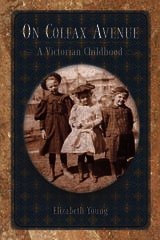
On Colfax Avenue
A Victorian ChildhoodElizabeth Young
University Press of Colorado, 2004
On Dark and Bloody Ground
An Oral History of the West Virginia Mine WarsAnne T. Lawrence
West Virginia University Press, 2021
In 1972 Anne Lawrence came to West Virginia at the invitation of the Miners for Democracy movement to conduct interviews with participants in, and observers of, the Battle of Blair Mountain and other Appalachian mine wars of the 1920s and ’30s. The set of oral histories she collected—the only document of its kind—circulated for many years as an informal typescript volume, acquiring an almost legendary status among those intrigued by the subject. Key selections from it appear here for the first time as a published book, supplemented with introductory material, maps, and photographs. The volume’s vivid, conversational mode invites readers into miners’ lived experiences and helps us understand why they took up arms to fight anti-union forces in some of the nation’s largest labor uprisings.
Published to coincide with the celebration of the Blair Mountain centennial in 2021, On Dark and Bloody Ground includes a preface by public historian Catherine Venable Moore and an afterword by Cecil E. Roberts of the United Mine Workers of America.
On Decoloniality
Concepts, Analytics, PraxisWalter D. Mignolo and Catherine E. Walsh
Duke University Press, 2018
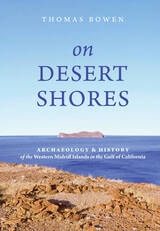
On Desert Shores
Archaeology and History of the Western Midriff Islands in the Gulf of CaliforniaThomas Bowen
University of Utah Press, 2022
Bowen draws on a wide range of sources, including the first archaeological field work ever conducted on the islands, written accounts dating back to the sixteenth century, oral histories of native people, contemporary interviews, and his own firsthand experiences. Among those cast in the islands’ historical drama are the Seri (Comcaac) people of Sonora, the extinct Cochimís of Baja California, Spanish explorers, Jesuit missionaries, pearl fishers, egg collectors, guano miners, hydrographers, cartographers, small-scale Mexican fishermen, recreational anglers, writers, photographers, ecotourists, shipwreck victims, and, most importantly, scientists. The final chapter documents the impact of this human activity on the islands’ ecosystems and examines conservation efforts now underway. Compelling and richly illustrated, this broadly based work provides a unique picture of these extraordinary islands.
On Duty
Power, Politics, and the History of Nursing in New JerseyWard, Frances
Rutgers University Press, 2009
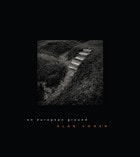
On European Ground
Alan Cohen
University of Chicago Press, 2001
Cohen's images achieve a solemn beauty even as they engage history at its most topical. Pictures of trenches and bunkers at the battlefields of Somme and Verdun explore the tension between the violence of the past and the inscrutability of its remnants. Photographs from the grounds of Dachau and Auschwitz solicit a provocative dialogue between the ordinariness of these sites today and their haunting memory. They teach us, as the New Art Examiner notes, "that the living perceptual connection to the Holocaust is vanishing." Images of the Berlin Wall show only the footprint of the barricade that once separated two hostile ideologies. They record the physical erosion and looming disappearance of the Wall while capturing its reappearance as a memorialized abstraction.
Accompanying the photographs in On European Ground are essays by Sander Gilman and Jonathan Bordo, as well as an interview with Cohen by critic Roberta Smith of the New York Times. The essays present both an introduction to and aesthetic analysis of Cohen's work, while the interview discusses the intractable problems of history and memory that his photographs so uniquely capture.
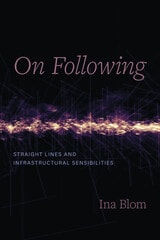
On Following
Straight Lines and Infrastructural SensibilitiesIna Blom
University of Chicago Press, 2027
A cross-disciplinary examination of the relation between straight lines and sensory capacities in modern art, architecture, and music.
The human hand cannot draw a straight line, claimed nineteenth-century polymath John Ruskin. Straight lines are typically seen as incompatible with human bodies, and this is one of the reasons why their proliferation in modern art and architecture has been associated with the rational, universalist perspectives of a new industrial culture. With On Following, art historian Ina Blom traces a different genealogy of straight lines through modern and contemporary art, offering a perspective on straight-line works that addresses the close connections between the sensory capacities and experiences of human bodies and new media infrastructures. She considers what happens to aesthetic expression when bodies are surrounded by technologies that are themselves sensing systems.
Taking an expansive look at visual art, architecture, film, and music from the late nineteenth century to the present day, Blom considers practitioners including Walter De Maria, Marcel Duchamp, August Endell, Liam Gillick, Raoul Hausmann, Florian Hecker, Jenny Holzer, Ryoji Ikeda, Piero Manzoni, László Moholy-Nagy, Krzysztof Penderecki, Superstudio, Mies van der Rohe, and La Monte Young.
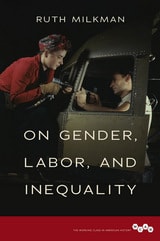
On Gender, Labor, and Inequality
Ruth Milkman
University of Illinois Press, 2016
Milkman's introduction frames a career-spanning scholarly project: her interrogation of historical and contemporary intersections of class and gender inequalities in the workplace, and the efforts to challenge those inequalities. Early chapters focus on her pioneering work on women's labor during the Great Depression and the World War II years. In the book's second half, Milkman turns to the past fifty years, a period that saw a dramatic decline in gender inequality even as growing class imbalances created greater-than-ever class disparity among women. She concludes with a previously unpublished essay comparing the impact of the Great Depression and the Great Recession on women workers.
A first-of-its-kind collection, On Gender, Labor, and Inequality is an indispensable text by one of the world's top scholars of gender, equality, and work.

On Guerrilla Warfare
Mao Tse-tung
University of Illinois Press, 1961
One of the most influential documents of our time, Mao Tse-tung's pamphlet on guerrilla warfare has become the basic textbook for waging revolution in underdeveloped and emergent areas throughout the world.
Recognizing the fundamental disparity between agrarian and urban societies, Mao advocated unorthodox strategies that converted deficits into advantages: using intelligence provided by the sympathetic peasant population; substituting deception, mobility, and surprise for superior firepower; using retreat as an offensive move; and educating the inhabitants on the ideological basis of the struggle. This radical new approach to warfare, waged in jungles and mountains by mobile guerrilla bands closely supported by local inhabitants, has been adopted by other revolutionary leaders from Ho Chi Minh to Che Guevara.
Mao wrote On Guerrilla Warfare in 1937 while in retreat after ten years of battling the Nationalist army of Chiang Kai-shek. Twelve years later, the Nationalist Chinese were rousted from the mainland, and Mao consolidated his control of a new nation, having put his theories of revolutionary guerrilla warfare to the test.
Established governments have slowly come to recognize the need to understand and devise means to counter this new method of warfare. Samuel B. Griffith's classic translation makes Mao's treatise widely available and includes a comprehensive introduction that profiles Mao, analyzes the nature and conduct of guerrilla warfare, and considers its implications for American policy.
On History
Fernand Braudel
University of Chicago Press, 1980
A wide-ranging collection of essays on the subject of history from a legendary historian
The first English translation of Ecrits sur l’histoire—a collection of essays written over a twenty-year period following publication of Braudel’s masterwork, The Mediterranean—On History sets forth Fernand Braudel’s reflections on the intellectual framework of his historical studies. Braudel calls on the historian to penetrate beneath the surface of political events to uncover and measure the forces shaping collective existence. Cycles of production, wages and prices, grids of communication and trade, fluctuations of climate, demographic trends, popular beliefs—all of these phenomena are proper subjects, Braudel argues of the historian’s investigations. It is only through study of the longue durée, Braudel argues, that one can discern structure, the supports and obstacles, the limits man and his experience cannot escape.
On Homesickness
A PleaJesse Donaldson
West Virginia University Press, 2017
One day, Jesse Donaldson wakes up in Portland, Oregon, and asks his wife to uproot their life together and move to his native Kentucky. As he searches for the reason behind this sudden urge, Donaldson examines both the place where he was born and the life he’s building.
The result is a hybrid—part memoir, part meditation on nostalgia, part catalog of Kentucky history and myth. Organized according to Kentucky geography, with one passage for each of the commonwealth’s 120 counties, On Homesickness examines whether we can ever return to the places we’ve called home.
On Hysteria
The Invention of a Medical Category between 1670 and 1820Sabine Arnaud
University of Chicago Press, 2015
In On Hysteria, Sabine Arnaud traces the creation and rise of hysteria, from its invention in the eighteenth century through nineteenth-century therapeutic practice. Hysteria took shape, she shows, as a predominantly aristocratic malady, only beginning to cross class boundaries (and be limited to women) during the French Revolution. Unlike most studies of the role and status of medicine and its categories in this period, On Hysteria focuses not on institutions but on narrative strategies and writing—the ways that texts in a wide range of genres helped to build knowledge through misinterpretation and recontextualized citation.
Powerfully interdisciplinary, and offering access to rare historical material for the first time in English, On Hysteria will speak to scholars in a wide range of fields, including the history of science, French studies, and comparative literature.
On Illustrious Men
Saint Jerome
Catholic University of America Press, 1999

On Internal War
American and Soviet Approaches to Third World Clients and InsurgentsWilliam E. Odom
Duke University Press, 1992
On Internal War reviews the contrasting theory and practice in Soviet and American approaches to their competition in the Third World and relates them to indigenous causes of internal wars. Odom also integrates the military dimensions of insurgencies with external influences and internal politics. Drawing on political development theory, he underscores the sources of instability in Third World states that make insurgencies more likely and offers ways to assess the prospects for democracy in specific cases.
The centerpiece of the study is a practical application of the author’s analysis to three case studies—El Salvador, Guatemala, and the Philippines—and a regional assessment of the Middle East. Odom provides no panaceas but suggests that more promising strategies can be devised.

On Interpretation
Sociology for Interpreters of Natural and CulturalGary E. Machlis
Oregon State University Press, 1992

On Job
Blind Didymus the Blind
Catholic University of America Press, 0
On Job, Volume 2
Franklin T. St. Albert the Great
Catholic University of America Press, 2025
On Knowing--The Natural Sciences
Richard P. McKeon
University of Chicago Press, 1994
In his lectures, McKeon outlines the entire history of Western thinking on the sciences. Treating the central concepts of motion, space, time, and cause, he traces modern intellectual debates back to the ancient Greeks, notably Plato, Aristotle, Democritus, and the Sophists. As he brings the story of Western science up to the twentieth century, he uses his fabled semantic schema (reproduced here for the first time) to uncover new ideas and observations about cosmology, mechanics, dynamics, and other aspects of physical science.
Illustrating the broad historical sweep of the lectures are a series of discussions which give detail to the course's intellectual framework. These discussions of Plato, Aristotle, Galileo, Newton, and Maxwell are perhaps the first published rendition of a philosopher in literal dialogue with his students. Led by McKeon's pointed questioning, the discussions reveal the difficulties and possibilities of learning to engage in serious intellectual communication.
On Knowing--The Social Sciences
Richard P. McKeon
University of Chicago Press, 2017
This volume—the second in a series—leaves behind natural science themes to embrace freedom, power, and history, which, McKeon argues, lay out the whole field of human action. The authors McKeon considers—Hobbes, Machiavelli, Spinoza, Kant, and J. S. Mill—show brilliantly how philosophic methods work in action, via analyses that do not merely reduce or deconstruct meaning, but enhance those texts by reconnecting them to the active history of philosophy and to problems of ethics, politics, and history. The waves of modernism and post-modernism are receding. Philosophic pluralism is now available, fully formulated, in McKeon’s work, spreading from the humanities to the social sciences.
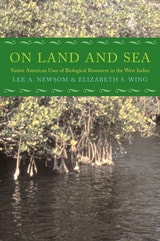
On Land and Sea
Native American Uses of Biological Resources in the West IndiesLee A. Newsom and Elizabeth S. Wing
University of Alabama Press, 2003
During the vast stretches of early geologic time, the islands of the Caribbean archipelago separated from continental land masses, rose and sank many times, merged with and broke from other land masses, and then by the mid-Cenozoic period settled into the current pattern known today. By the time Native Americans arrived, the islands had developed complex, stable ecosystems. The actions these first colonists took on the landscape—timber clearing, cultivation, animal hunting and domestication, fishing and exploitation of reef species—affected fragile land and sea biotic communities in both beneficial and harmful ways.
On Land and Sea examines the condition of biosystems on Caribbean islands at the time of colonization, human interactions with those systems through time, and the current state of biological resources in the West Indies. Drawing on a massive data set collected from long-term archaeological research, the study reconstructs past lifeways on these small tropical islands. The work presents a wide range of information, including types of fuel and construction timber used by inhabitants, cooking techniques for various shellfish, availability and use of medicinal and ritual plants, the effects on native plants and animals of cultivation and domestication, and diet and nutrition of native populations.
The islands of the Caribbean basin continue to be actively excavated and studied in the quest to understand the earliest human inhabitants of the New World. This comprehensive work will ground current and future studies and will be valuable to archaeologists, anthropologists, botanists, ecologists, Caribbeanists, Latin American historians, and anyone studying similar island environments.
On Laws
Seán William of Auvergne
Catholic University of America Press, 2027
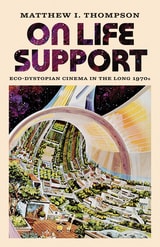
On Life Support
Eco-Dystopian Cinema in the Long 1970sMatthew I Thompson
University of Minnesota Press, 2026
Finding strategies for today’s environmental movement in classic science fiction films
What can science fiction film tell us about the course of the modern ecological movement? On Life Support traces how the environmental concerns of the 1970s were embedded in the eco-dystopian cinema of the era—and considers its implications for ecological thought and activism today.
Illuminating the patterns that shape our thinking about nonhuman nature, Matthew I. Thompson pairs iconic films such as Soylent Green and Silent Running with the transformational environmentalist texts that inspired them and kick-started the modern environmental movement, including Rachel Carson’s Silent Spring and Buckminster Fuller’s Operating Manual for Spaceship Earth. Thompson examines this confluence of literature and cinema to show how, as they translated environmentalism for Hollywood’s audiences, these movies distilled the movement’s concepts into a form that revealed their inherent contradictions.
A sensitive analysis of the tensions that complicate environmentalist praxis—especially between desire and fear in the activist impulse—On Life Support offers a timely critique of the politics of environmental containment and control, calling instead for a politics of interconnection and contamination. It is, after all, by inviting complexity and chaos that we begin to undermine the myth of human mastery, letting nature flourish on its own terms.
Retail e-book files for this title are screen-reader friendly with images accompanied by short alt text and/or extended descriptions.
On Louise Gluck
Change What You SeeJoanne Feit Diehl, Editor
University of Michigan Press, 2005
Glück, author of nine books of poetry, including the Pulitzer Prize-winning The Wild Iris, is noted for her searing honesty and compelling first-person personae. Though compared to world-famous verse by Sappho and Dickinson, Glück's poetry has remained curiously undigested among readers of contemporary poetry for some time. On Louise Glück gathers for the first time a diverse array of essays by the leading critics of this preeminent poet. Featuring a probing, extended interview with Glück, On Louise Glück traces the critical reception of her work and offers new insights into her imaginative, mysterious poetry.
On Love and Charity
Readings from the Commentary on the Sentences of Peter Lombard (Thomas Aquinas in Translation)Saint Thomas Aquinas
Catholic University of America Press, 2008
On Monsters and Marvels
Ambroise Pare
University of Chicago Press, 1983
On Niebuhr
A Theological StudyLangdon Gilkey
University of Chicago Press, 2001
On Our Own Ground
The Complete Writings of William Apess, a PequotWilliam Apess
University of Massachusetts Press, 1992
William Apess was the first Native American to fully, and publicly, speak out regarding the racism and unfair treatment that he and others endured. The author's writing is eloquently delivered, instilling the reader with a realistic framework of a political, historical, and personal mindset.
On Our Way Home from the Revolution
Reflections on UkraineSonya Bilocerkowycz
The Ohio State University Press, 2019
In 2014 Sonya Bilocerkowycz is a tourist at a deadly revolution. At first she is enamored with the Ukrainians’ idealism, which reminds her of her own patriotic family. But when the romantic revolution melts into a war with Russia, she becomes disillusioned, prompting a return home to the US and the diaspora community that raised her. As the daughter of a man who studies Ukrainian dissidents for a living, the granddaughter of war refugees, and the great-granddaughter of a gulag victim, Bilocerkowycz has inherited a legacy of political oppression. But what does it mean when she discovers a missing page from her family’s survival story—one that raises questions about her own guilt?
In these linked essays, Bilocerkowycz invites readers to meet a swirling cast of post-Soviet characters, including a Russian intelligence officer who finds Osama bin Laden a few weeks after 9/11; a Ukrainian poet whose nose gets broken by Russian separatists; and a long-lost relative who drives a bus into the heart of Chernobyl. On Our Way Home from the Revolution muddles our easy distinctions between innocence and culpability, agency and fate.

On Parliamentary War
Partisan Conflict and Procedural Change in the U.S. SenateJames I. Wallner
University of Michigan Press, 2017
On Reason
Rationality in a World of Cultural Conflict and RacismEmmanuel Chukwudi Eze
Duke University Press, 2008
Eze draws on an extraordinary command of Western philosophical thought and a deep knowledge of African philosophy and cultural traditions. He explores models of rationality in the thought of philosophers from Aristotle, René Descartes, Francis Bacon, and Thomas Hobbes to Noam Chomsky, Richard Rorty, Hilary Putnam, and Jacques Derrida, and he considers portrayals of reason in the work of the African thinkers and novelists Chinua Achebe, Ngugi wa Thiong’o, and Wole Soyinka. Eze reflects on contemporary thought about genetics, race, and postcolonial historiography as well as on the interplay between reason and unreason in the hearings of South Africa’s Truth and Reconciliation Commission. He contends that while rationality may have a foundational formality, any understanding of its foundation and form is dynamic, always based in historical and cultural circumstances.
On Robert Antelme's The Human Race
Essays and CommentaryRobert Antelme
Northwestern University Press, 2003
In this volume, the extraordinary nature and extent of Robert Antelme's accomplishment, and of the reverberations he set in motion in French life and literature, finds eloquent expression. The pieces Antelme wrote for journals—including essays on "principles put to the test," man as the "basis of right," and the question of revenge—appear here alongside appreciations of The Human Race by authors from Perec to Maurice Blanchot to Sarah Kofman. Also included are Antelme's personal recollections and interviews with, among others, Dionys Mascolo (who brought Antelme back from Dachau), Marguerite Duras (Antelme's wife, who tells of his return from Germany), and Mitterand.
Also available: Antelme's The Human Race
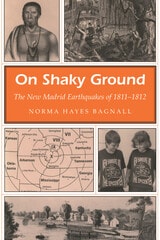
On Shaky Ground
The New Madrid Earthquakes of 1811-1812Norma Hayes Bagnall
University of Missouri Press, 1996
Although most Americans associate earthquakes with California, the tremors that shook the Mississippi valley in southeast Missouri from December 16, 1811, through February 7, 1812, are among the most violent quakes to hit the North American continent in recorded history. Collectively known as the New Madrid earthquakes, these quakes affected more than 1 million square miles. By comparison, the 1906 San Francisco earthquake affected only 60,000 square miles, less than one-sixteenth the area of the New Madrid earthquakes.
Scientists believe that each of the three greatest tremors would have measured more than 8.0 on the Richter scale, had that measuring device been in place in 1811. Vibrations were felt from the Rocky Mountains to the Atlantic coast and from Mexico to Canada. The quake zone was in constant movement during this period. Five towns in three states disappeared, islands vanished in the Mississippi River, lakes formed where there had been none before, and the river flowed backward for a brief period.
Providing eyewitness accounts from people both on the land and on the river, Bagnall captures the fears of the residents through their tales about the smells and dark vapors that filled the air, the cries of the people, the bawling of animals, and the constant roar of the river and its collapsing banks. On Shaky Ground also traces the history of the founding of New Madrid and considers the impact of the earthquakes on population and land in southeast Missouri. Predictions for future earthquakes along the New Madrid fault, as well as instructions on preparing for and surviving a quake, are also included.
Informative, clearly written, and well illustrated, On Shaky Ground will be of interest to all general readers, especially those interested in earthquakes or Missouri history.
On Slavery and the Slave Trade
<i>De Iustitia et lure</i>, Book 1, Treatise 2, Disputations 32-40Luis De Molina
Catholic University of America Press, 2023
On Story—The Golden Ages of Television
Edited by Maya Perez and Barbara Morgan; foreword by Noah Hawley
University of Texas Press, 2018
“On Story is film school in a box, a lifetime’s worth of filmmaking knowledge squeezed into half-hour packages.”
—Kenneth Turan, film critic for the Los Angeles Times
Austin Film Festival (AFF) is the first organization to focus on writers’ creative contributions to film and television. Its annual Film Festival and Conference offers screenings, panels, workshops, and roundtable discussions that help new writers and filmmakers connect with mentors and gain advice and insight from masters, as well as reinvigorate veterans with new ideas. To extend the Festival’s reach, AFF produces On Story, a television series currently airing on PBS-affiliated stations and streaming online that presents high-caliber artists talking candidly and provocatively about the art and craft of screenwriting and filmmaking, often using examples from their own work.
On Story—The Golden Ages of Television explores the transformation of television’s narrative content over the past several decades through interviews with some of TV’s best creators and writers, including Garry Shandling (The Larry Sanders Show), Carl Reiner (The Dick Van Dyke Show), Issa Rae (Insecure), Vince Gilligan (Breaking Bad), Greg Daniels (The Office), Paula Pell (Saturday Night Live), Noah Hawley (Fargo), Liz Meriwether (New Girl), David Chase (The Sopranos), Alan Yang (Master of None), Marta Kauffman (Friends), Jenji Kohan (Orange Is the New Black), and many more. Their insights, behind-the-scenes looks at the creative process, production tales, responses to audiences’ reactions, and observations on how both TV narratives and the industry have changed make this book ideal for TV lovers, pop culture fans, students taking screenwriting courses, and filmmakers and writers seeking information and inspiration.
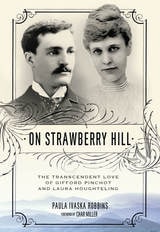
On Strawberry Hill
The Transcendent Love of Gifford Pinchot and Laura HoughtelingPaula Ivaska Robbins
University of Alabama Press, 2017
At its core, Paula Ivaska Robbins’s On Strawberry Hill: The Transcendent Love of Gifford Pinchot and Laura Houghteling is a human interest story that cuts a neat slice across nineteenth-century America by bringing into juxtaposition a wide array of topics germane to the period—the national fascination with spiritualism, the death scourge that was tuberculosis, the rise of sanitariums and tourism in the southern highlands, the expansion of railroad travel, the rage for public parklands and playgrounds, and the development of professional forestry and green preservation―all through the very personal love story of two young blue bloods.
Born into a wealthy New York family, Gifford Pinchot (1865–1946) served two terms as Pennsylvania’s governor and was the first chief of the US Forest Service, which today manages 192 million acres across the country. Pinchot also created the Society of American Foresters, the organization that oversees his chosen profession, and the Yale School of Forestry and Environmental Studies, the oldest forestry school in America. Ultimately, he and his friend President Theodore Roosevelt made forestry the focus of a national land conservation movement.
But before these accomplishments, Gifford Pinchot fell in love with Laura Houghteling, daughter of the head of the Chicago Board of Trade, while she recuperated from “consumption” at Strawberry Hill, the family retreat in Asheville, North Carolina. In his twenties at the time and still a budding forester, Pinchot was working just across the French Broad River at George Vanderbilt’s great undertaking, the Biltmore Estate, when the young couple’s relationship blossomed. Although Laura would eventually succumb to the disease, their brief romance left an indelible mark on Gifford, who recorded his ongoing relationship, and mental conversations, with Laura in his daily diary entries long after her death. He steadfastly remained a bachelor for twenty years while accomplishing the major highlights of his career.
This poignant book focuses on that phenomenon of devotion and inspiration, providing a unique window into the private practice of spiritualism in the context of Victorian mores, while offering new perspectives on Pinchot and early American forestry. In addition, preeminent Pinchot biographer Char Miller contributes an excellent foreword.
On Sunspots
Galileo Galilei and Christoph Scheiner
University of Chicago Press, 2010
Galileo’s telescopic discoveries, and especially his observation of sunspots, caused great debate in an age when the heavens were thought to be perfect and unchanging. Christoph Scheiner, a Jesuit mathematician, argued that sunspots were planets or moons crossing in front of the Sun. Galileo, on the other hand, countered that the spots were on or near the surface of the Sun itself, and he supported his position with a series of meticulous observations and mathematical demonstrations that eventually convinced even his rival.
On Sunspots collects the correspondence that constituted the public debate, including the first English translation of Scheiner’s two tracts as well as Galileo’s three letters, which have previously appeared only in abridged form. In addition, Albert Van Helden and Eileen Reeves have supplemented the correspondence with lengthy introductions, extensive notes, and a bibliography. The result will become the standard work on the subject, essential for students and historians of astronomy, the telescope, and early modern Catholicism.
On The Edge
Ukrainian - Central European - Russian Security TriangleMargarita M. Balmaceda
Central European University Press, 2001
A new globally significant relationship arising after the break-up of the Soviet Union is the main topic of this unparalleled volume – the geopolitical link between Russia, Ukraine and the three bordering ‘Central European’ states, Hungary, Poland and Slovakia. On the Edge is a path-breaking analysis of this triangular relationship with an in-depth focus on economic, political and, more importantly, security issues.
The expansion of NATO up to Ukraine’s borders is likely to leave Ukraine in a delicate position vis-à-vis Russia. On the Edge addresses key questions, such as: how are events in Ukraine affecting the security calculations of the Central European states; Central European relations with Russia and NATO; and relations among Central European states themselves? The volume examines what Central European states can do to solidify Ukraine’s independence and help it avoid international isolation.
On the Edge gives a Central European perspective on all these issues and suggests concrete forms of co-operation.
On The Ho Chi Minh Trail
The Blood Road, The Women Who Defended It, The LegacySherry Buchanan
Asia Ink, 2020
Offering both a personal and historical exploration of the Ho Chi Minh Trail, this book highlights the critical role the Trail and the young women soldiers who helped build and defend it played in the Vietnam War. Accompanied by two traveling companions, Sherry Buchanan winds her way from Hanoi in the north to Ho Chi Minh City, formerly Saigon, in the south. Driving through the spectacular scenery of Vietnam and Laos, she encounters locations from the Truong Son mountains, the Phong Nha Caves, ancient citadels, and Confucian temples to the Khmer Temple of Wat Phu at the western-most point of the Trail in Laos.
Buchanan records her interactions—both scheduled and spontaneous—with those who experienced the Vietnam War firsthand. She listens to the women who defended the Trail roads against the greatest bombing campaign in modern times, walks through minefields with the demolition teams hunting for unexploded ordnance, and meets American veterans who have returned to Vietnam with an urge to “do something.” Buchanan weaves informative, and often humorous, tales from her journey with excerpts from the accounts of others, situating the locations she visits in their historical and political context. On the Ho Chi Minh Trail brings together geography, history, and personal accounts to reveal the scale of the tragedy, its harmful legacies, and our memory of it. Buchanan challenges American exceptionalism and calls for redress for those harmed by US military actions during the Vietnam War and America’s subsequent wars.
On The Way To Diplomacy
Costas M. Constantinou
University of Minnesota Press, 1996
A deconstruction of the idea of diplomacy that explores the links between its theory and practice.
What does theory have to do with the concept-let alone the practice-of diplomacy? More than we might think, as Costas M. Constantinou amply demonstrates in this ambitious reconsideration of both the concept of diplomacy and the working of theory. Here, Constantinou focuses on the language that underwrites and directs theory and diplomacy, and shows that such a critical approach is actually a way of practicing politics.
Constantinou underscores the original intertextual association between theory and diplomacy by employing the ancient Greek term theoria. Theoria once referred to both philosophical thinking and a sacred embassy sent to discharge a religious duty. The use of the term in this book leads to a new view of theory and diplomacy. Constantinou considers the structures of diplomacy and theory together with the notion of representation that is peculiar to Western metaphysical thought. A deconstruction of diplomacy itself, this work bridges classical and contemporary philosophy, ancient and modern political practice, and, ultimately, politics and the arts in general. It will alter the study, understanding, and practice of diplomacy.
On Time Delivery
The Dog Team Mail CarriersWilliam S. Schneider
University of Alaska Press, 2012
On War and Writing
Samuel Hynes
University of Chicago Press, 2018
Samuel Hynes knows war personally: he served as a Marine Corps pilot in the Pacific Theater during World War II, receiving the Distinguished Flying Cross. He has spent his life balancing two careers: pilot and professor of literature. Hynes has written a number of major works of literary criticism, as well as a war-memoir, Flights of Passage, and several books about the World Wars. His writing is sharp, lucid, and has provided some of the most expert, detailed, and empathetic accounts of a disappearing generation of fighters and writers.
On War and Writing offers for the first time a selection of Hynes’s essays and introductions that explore the traditions of war writing from the twentieth century to the present. Hynes takes as a given that war itself—the battlefield uproar of actual combat—is unimaginable for those who weren’t there, yet we have never been able to turn away from it. We want to know what war is really like: for a soldier on the Somme; a submariner in the Pacific; a bomber pilot over Germany; a tank commander in the Libyan desert. To learn, we turn again and again to the memories of those who were there, and to the imaginations of those who weren’t, but are poets, or filmmakers, or painters, who give us a sense of these experiences that we can’t possibly know.
The essays in this book range from the personal (Hynes’s experience working with documentary master Ken Burns, his recollections of his own days as a combat pilot) to the critical (explorations of the works of writers and artists such as Thomas Hardy, E. E. Cummings, and Cecil Day-Lewis). What we ultimately see in On War and Writing is not military history, not the plans of generals, but the feelings of war, as young men expressed them in journals and poems, and old men remembered them in later years—men like Samuel Hynes.
On Wide Seas
The US Navy in the Jacksonian EraClaude Berube
University of Alabama Press, 2022
An analytical study of naval policy, expansion, and maritime strategy in the formative Jacksonian era.
The 1830s is an overlooked period in American naval history and is usually overshadowed by the more dramatic War of 1812 and the Civil War. Nevertheless, the personnel, operations, technologies, policies, and vision of the Navy of that era, which was emerging from the “Age of Sail,” are important components of its evolution, setting it on the long path to its status as a global maritime power. On Wide Seas: The US Navy in the Jacksonian Era details the ways in which the US Navy transformed from an antiquated arm of the nation’s military infrastructure into a more dynamic and effective force that was soon to play a pivotal role in a number of national and international conflicts.
By Andrew Jackson’s inauguration in 1829, the Navy had engaged with two major powers, defended American shipping, conducted antipiracy operations, and provided a substantive, long-term overseas presence. The Navy began to transform during Jackson’s administration due in part to the policies of the administration and to the emerging officer corps, which sought to professionalize its own ranks, modernize the platforms on which it sailed, and define its own role within national affairs and in the broader global maritime commons. Jackson had built his reputation as a soldier, but he quickly recognized as president the necessity for a navy that could foster his policies. To expand American commerce, he needed a navy that could defend shipping as well as conduct punitive raids or deterrence missions.
Jackson developed a clear, concise naval strategy that policymakers and officers alike could seize and execute. He also provided a vision for the Navy, interceded to resolve naval disciplinary challenges, and directed naval operations. Also, given Jackson’s own politics, junior officers were emboldened by the populist era to challenge traditional, conservative thinking. They carried out a collective vision that coincided with the national literary movement that recognized America’s future would rely upon the Navy.
On Wisconsin Women
Working for Their Rights from Settlement to SuffrageGenevieve C. McBride
University of Wisconsin Press, 1993
In On Wisconsin Women, Genevieve McBride traces women’s work in reform movements in the state’s politics and especially in its press. Even before Wisconsin became a state in 1848, women’s news and opinions appeared in abolitionist journals and “temperance sheets,” if often anonymously. But the first paper in Wisconsin published under a woman’s name, however, was boycotted by Milwaukee printers and failed in 1853.
From the passage of the Fourteenth Amendment in 1866 to the state’s historic ratification of the Nineteenth Amendment in 1919, Wisconsin women were never at a loss for words nor a newspaper to print them. Among women who would be heard were Mathilde Fransziska Anneke, Emma Brown, Lavinia Goodell, Emma Bascom, Olympia Brown, Belle Case La Follette, Ada L. James, and Theodora Winton Youmans. McBride brings their voices vividly to life, in their own words on their lifelong work for woman’s rights.
Nowhere was “the struggle” fought for so long and so hard as in Wisconsin. While women elsewhere sang suffrage hymns, women in the Badger State marched to a “fight song” with a familiar tune but sung in their own words—lyrics too long forgotten until now.
On a Trail of Southwest Discovery
The Expedition Diaries of Frederick W. Hodge and Margaret W. Magill, 1886–1888Curtis M. Hinsley and David R. Wilcox
University of Arizona Press, 2024
The Hemenway Southwestern Archaeological Expedition (1886–1889), directed by Frank Hamilton Cushing, was the first privately funded expedition to the American Southwest. This volume examines the expedition through the diaries of two participants who fell in love on the expedition: the field secretary, Fred Hodge, and the expedition artist, Margaret Magill—who was also Cushing’s sister-in-law. It also presents the first biographical treatment of Hodge, who became a major figure in early twentieth-century anthropology. The book’s first two sections chronicle the field operations of the expedition, while the third describes the long anthropological career of Hodge after the end of the expedition. Through deep research in primary and secondary sources and archival materials, the book details both the daily operations of the expedition and the growing romantic relationship between Hodge and Magill.
For those interested in settlements in early Arizona and Zuni Pueblo, the book provides rare insights into the lives of both men and women, offering an intimate view of an enterprise that is now considered a foundation of Hohokam archaeology—even as it reveals deep love and persistent personal conflicts.
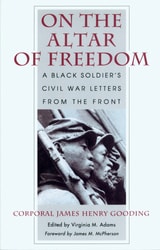
On the Altar of Freedom
A Black Soldier’s Civil War Letters from the FrontJames Henry Gooding
University of Massachusetts Press, 1991
From basic training at Camp Meigs in Readville, Massachusetts, through campaigns in Georgia, South Carolina, and Florida, Gooding faithfully records the activities of the 54th, including the legendary storming of Fort Wagner. He also voices the injustice felt by soldiers of his regiment over the issue of unequal pay, the refusal to promote deserving black enlistees to officer rank, and the deeply ingrained racism of whites in both the North and South.
Wounded and captured during the battle of Olustee, Florida, in February 1864, Gooding died later that year in Andersonville Prison.
In her introduction, Virginia M. Adams provides biographical details on Gooding's life and examines the antebellum history of New Bedford's large and articulate community of free blacks.

On the Animation of the Inorganic
Art, Architecture, and the Extension of LifeSpyros Papapetros
University of Chicago Press, 2012
Throughout human history, people have imagined inanimate objects to have intelligence, language, and even souls. In our secular societies today, we still willingly believe that nonliving objects have lives of their own as we find ourselves interacting with computers and other equipment. In On the Animation of the Inorganic, Spyros Papapetros examines ideas about simulated movement and inorganic life during and after the turn of the twentieth century—a period of great technical innovation whose effects continue to reverberate today.
Exploring key works of art historians such as Aby Warburg, Wilhelm Worringer, and Alois Riegl, as well as architects and artists like Fernand Léger, Mies van der Rohe, and Salvador Dalí, Papapetros tracks the evolution of the problem of animation from the fin de siècle through the twentieth century. He argues that empathy—the ability to identify with objects of the external world—was repressed by twentieth-century modernist culture, but it returned, projected onto inorganic objects such as machines, automobiles, and crystalline skyscrapers. These modern artifacts, he demonstrates, vibrated with energy, life, and desire of their own and had profound effects on people. Subtle and insightful, this book will change how we view modernist art, architecture, and their histories.

On the Arab-Jew, Palestine, and Other Displacements
Selected Writings of Ella ShohatElla Shohat
Pluto Press, 2017
Spanning several decades, Ella Shohat's work has introduced conceptual frameworks that fundamentally challenged conventional understandings of Palestine, Zionism and the Middle East, focusing on the pivotal figure of the Arab-Jew. This book gathers together her most influential political essays, interviews, speeches, testimonies and memoirs, as well as previously unpublished material.
Defying the binarist and Eurocentric Arab-versus-Jew rendering of the Israeli/Palestinian conflict, Shohat's work has dared to engage with the deeper historical and cultural questions swirling around colonialism, Orientalism and nationalism. Shohat's paradigm-shifting work unpacks such fraught issues as the anomalies of the national/colonial in Zionist discourse; the narrating of Jewish pasts in Muslim spaces; the links and distinctions between the dispossession of the Nakba and the dislocation of Arab-Jews; the traumatic memories triggered by partition and border-crossing; the echoes within Islamophobia of the anti-Semitic figure of 'the Jew'; and the efforts to imagine a possible future inter-communal 'convivencia'.
Shohat's transdisciplinary perspective illuminates the cultural politics in and around the Middle East. Juxtaposing texts of various genres written in divergent contexts, the book offers a vivid sense of the author's intellectual journey.