Results by title
28164 books match the query 'History' and 581 start with o
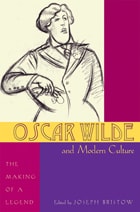
Oscar Wilde and Modern Culture
The Making of a LegendJoseph Bristow
Ohio University Press, 2009
Oscar Wilde and Modern Culture: The Making of a Legend explores the meteoric rise, sudden fall, and legendary resurgence of an immensely influential writer’s reputation from his hectic 1881 American lecture tour to recent Hollywood adaptations of his dramas. Always renowned—if not notorious—for his fashionable persona, Wilde courted celebrity at an early age. Later, he came to prominence as one of the most talented essayists and fiction writers of his time.
In the years leading up to his two-year imprisonment, Wilde stood among the foremost dramatists in London. But after he was sent down for committing acts of “gross indecency” it seemed likely that social embarrassment would inflict irreparable damage to his legacy. As this volume shows, Wilde died in comparative obscurity. Little could he have realized that in five years his name would come back into popular circulation thanks to the success of Richard Strauss’s opera Salome and Robert Ross’s edition of De Profundi. With each succeeding decade, the twentieth century continued to honor Wilde’s name by keeping his plays in repertory, producing dramas about his life, adapting his works for film, and devising countless biographical and critical studies of his writings.
This volume reveals why, more than a hundred years after his demise, Wilde’s value in the academic world, the auction house, and the entertainment industry stands higher than that of any modern writer.

Oscar Wilde's Decorated Books
Nicholas Frankel
University of Michigan Press, 2000
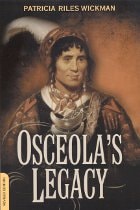
Osceola's Legacy
Patricia Riles Wickman
University of Alabama Press, 2006
A bestselling, re-evaluation of a major Native American resistance leader. Named an Outstanding Book by the Gustavus Myers Center for the Study of Human Rights.
Born in Alabama to a Muscogee/Creek Indian mother and an English father, Osceola, born Billy Powell, came to prominence in the 1830s for resisting the U. S. government's sweep into Florida. He protested the government's Florida Indian removal, killed a pro-emigration Indian leader and then made war on the US government.
Osceola's Legacy draws on a wealth of sources, including letters, diaries, and artifacts to bring this fascinating figure and the central role he played in the Second Seminole War into vivid focus. Of particular interest is a chapter on the forensic report on Osceola's grave as well as descriptions and the illustrations of his personal property at the time of his death.
Osceola's Legacy is significant for its genealogy and archaeological study of this Native American and his interaction with the federal government during the 1800s. The catalog of photographs of Osceola portraits and his personal possessions makes this a worthwhile reference book as well.

Osiris, Volume 10
Constructing Knowledge in the History of ScienceEdited by Arnold Thackray
University of Chicago Press, 1995
Osiris, Volume 11
Science in the FieldEdited by Henrika Kuklick and Robert E. Kohler
University of Chicago Press, 1996
Included are "Gender, Culture, and Astrophysical Fieldwork: Elizabeth Campbell and the Lick Observatory-Crocker Eclipse Expeditions," by Alex Soo-jung-Kim Pang; "Wallace in Other Lands," by Jane Camerini; "The Heroic Science of Glacier Motion," by Bruce Hevly; "Objectivity or Heroism: Invisibility of Women in Science," by Naomi Oreskes; "When Nature is the Zoo: Vision and Power in the Art and Science of Natural History," by Gregg Mitman; "Manly Men in Scientific Balloons: Meteorology and the Victorian Scientist as Romantic Hero," by Jennifer Tucker; "Paul du Chaillu and Construction of Authority," by Stuart McCook; "Of Sangfroid and Sphinx Moths: Cruelty, Public Relations, and Entomology, 1800-1840," by Anne Larsen Hollerbach; "The Ship as a Scientific Instrument in the 18th Century," by Richard Sorrenson; and "'A Tent with a View:' Colonial Officers, Anthropologists, and the Making of the Field in Northern Rhodesia, 1937-1960," by Lynette Schumaker.
Osiris, Volume 15
Nature and Empire: Science and the Colonial EnterpriseEdited by Roy MacLeod
University of Chicago Press, 2001
Osiris, Volume 16
Science in Theistic Contexts: Cognitive DimensionsEdited by John Hedley Brooke, Margaret J. Osler, and Jitse M. van der Meer
University of Chicago Press, 2001
Reflecting the fecundity of contemporary scholarship, the current volume should be of extraordinary interest to historians of science, scientists, as well as anyone intrigued by the many ways in which relations between religion and science have been constructed.
Contributors include:
Peter Barker,
John Hedley Brooke,
Geoffrey Cantor,
Margaret G. Cook,
Michael J. Crowe,
Thomas Dixon,
Noah J. Efron,
Richard England,
Martin Fichman,
Maurice A. Finocchiaro,
Menachem Fish,
Bernard R. Goldstein,
Bernard Lightman,
Margaret J. Osler
F. Jamil Ragep,
Phillip R. Sloan,
Stephen Snobelen,
Jitse M. van der Meer,
Stephen J. Wykstra,
Osiris, Volume 17
Science and Civil SocietyEdited by Lynn K. Nyhart and Thomas Broman
University of Chicago Press, 2002
Osiris, Volume 18
Science and the CityEdited by Sven Dierig, Jens Lachmund, and Andrew Mendelsohn
University of Chicago Press, 2003
Osiris, Volume 19
Landscapes of Exposure: Knowledge and Illness in Modern EnvironmentsEdited by Gregg Mitman, Michelle Murphy, and Christopher Sellers
University of Chicago Press, 2004
Osiris, Volume 20
Politics and Science in Wartime: Comparative International Perspectives on the Kaiser Wilhelm InstituteEdited by Carola Sachse and Mark Walker
University of Chicago Press, 2005
Osiris, Volume 21
Global Power Knowledge: Science and Technology in International AffairsEdited by John Krige and Kai-Henrik Barth
University of Chicago Press, 2006
Osiris, Volume 22
The Self as Project: Politics and the Human SciencesEdited by Greg Eghigian, Andreas Killen, and Christine Leuenberger
University of Chicago Press, 2007
Osiris annually examines a particular topic in the history of science, bringing together experts in the field to consider multiple aspects of the time period, episode, or theme. Volume 22 explores the ways that twentieth-century political institutions and the human sciences in the western world attempted to understand and shape the attitudes and behaviors of individuals.
Osiris, Volume 23
Intelligentsia Science: The Russian Century, 1860-1960Edited by Michael Gordin, Karl Hall, and Alexei Kojevnikov
University of Chicago Press, 2008
The contributors argue that it was the generation of the 1860s that transformed “intelligentsia” into a central notion of Russian popular discourse, cementing its association with revolutionary politics—and with science. Science became the cornerstone of the intelligentsia’s ideological and political projects, either as an alternative to socialism, or more often as its nominal raison d’être. The Russian century may in fact be over, but the interrelation of the intelligentsia and science to form “intelligentsia science” proves enduring.
Osiris, Volume 24
National Identity: The Role of Science and TechnologyEdited by Carol E. Harrison and Ann Johnson
University of Chicago Press, 2009
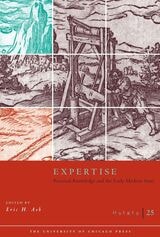
Osiris, Volume 25
Expertise: Practical Knowledge and the Early Modern StateEdited by Eric H. Ash
University of Chicago Press, 2010
This newest annual edition of Osiris brings together a variety of scholars to consider a topic of increasing interest in the history of science: expertise. Focusing specifically on the role expertise has played in the support, legitimation, and growth of the state since early modern times, Expertise and the Early Modern State reveals how scientific expertise and practical knowledge were crucial to the construction of early modern empires and economies. The state, on the other hand, performed a similar function for scientists, giving them much of the status and resources they needed to further their work. A penetrating, multifaceted investigation, Osiris 25 will be required reading for historians of science and early modern political development.
Osiris, Volume 26
KlimaEdited by James Rodger Fleming and Vladimir Jankovic
University of Chicago Press, 2011
“Climate is a rather elusive entity,” wrote Helmut Landsberg in 1950 as he sorted out some twenty or so competing definitions. This volume of Osiris explores the complexities in understanding what climate means from a historical perspective. The title of this volume, Klima, evokes its Greek origins, κλίμα, meaning an extended period encompassing vast layers of different kinds of meteorological information. The volume thus seeks not only to decouple Klima from its current exclusive association with atmospheric sciences, but also to re-visit the implications of an ancient vocabulary for medical, geographical, agricultural, economic, racial, and other “endemic” concerns. If climate is not just about the weather, what is it? The essays in this volume treat climate discourse as a framing device that makes explicit all social concerns arising from the anxiety over the sensible and latent experiences of living in an atmosphere of hunger and satiation, disease and health, poverty and wealth, isolation and community, angst and hope.
James Fleming is a historian of science and technology and Professor of Science, Technology and Society at Colby College, Maine. Vladimir Jankovic is a faculty member, at the Centre for the History of Science, Technology and Medicine, University of Manchester. He is a historian of atmospheric sciences, and has published in the history of meteorology, geography of environmental knowledge, and medical climatology.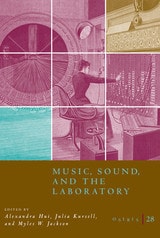
Osiris, Volume 28
Music, Sound, and the Laboratory from 1750-1980Edited by Alexandra Hui, Julia Kursell, and Myles W. Jackson
University of Chicago Press Journals, 2013
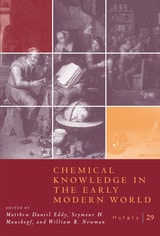
Osiris, Volume 29
Chemical Knowledge in the Early Modern WorldEdited by Matthew D. Eddy, Seymour H. Mauskopf, and William R. Newman
University of Chicago Press Journals, 2014
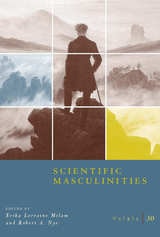
Osiris, Volume 30
Scientific MasculinitiesEdited by Erika Lorraine Milam and Robert A. Nye
University of Chicago Press Journals, 2015

Osiris, Volume 31
History of Science and the EmotionsEdited by Otniel E. Dror, Bettina Hitzer, Anja Laukötter, and Pilar León-Sanz
University of Chicago Press Journals, 2016
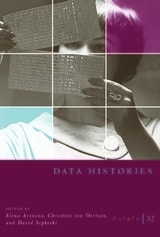
Osiris, Volume 32
Data HistoriesEdited by Elena Aronova, Christine von Oertzen, and David Sepkoski
University of Chicago Press Journals, 2017
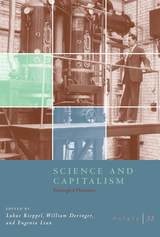
Osiris, Volume 33
Science and Capitalism: Entangled HistoriesEdited by Lukas Rieppel, William Deringer, and Eugenia Lean
University of Chicago Press Journals, 2018
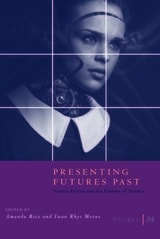
Osiris, Volume 34
Presenting Futures Past: Science Fiction and the History of ScienceEdited by Amanda Rees and Iwan Rhys Morus
University of Chicago Press Journals, 2019
The protagonists of these two enterprises have a lot in common. Both SF and the history of science are oriented towards the (re)construction of unfamiliar worlds; both are fascinated by the ways in which natural and social systems interact; both are critically aware of the different ways in which the social (class, gender, race, sex, species) has inflected the experience of the scientific. Taking a global approach, Presenting Futures Past examines the ways in which SF can be used to investigate the cultural status and authority afforded to science at different times and in different places. The essays consider the role played by SF in the history of specific scientific disciplines, topics, or cultures, as well as the ways in which it has helped to move scientific concepts, methodologies, and practices between wider cultural areas. Ultimately, Presenting Futures Past explores what SF can tell us about the histories of the future, how different communities have envisaged their futures, and how SF conveys the socioscientific claims of past presents.

Osiris, Volume 35
Food Matters: Critical Histories of Food and the SciencesEdited by E. C. Spary and Anya Zilberstein
University of Chicago Press Journals, 2020
The essays delve into a range of topics, from early modern dietetics and debates about cannibalism to modern ready-to-eat rations and Ayurvedic recipes, from analyses of hungry model organisms to the dining rituals of Silicon Valley entrepreneurs and their patrons. As Food Matters shows, the history of knowledge about food has always raised debates about the shifting definition and boundaries of expertise: between traditional recipes and experimental protocols; between domestic craft skill and laboratory procedure; between the management and redistribution of resources for the social body on the one hand, and the subjective experiences of individual bodies on the other. At a moment when the authority of science is being questioned by a variety of publics, Food Matters is a timely reminder that such tensions, always present in food-related domains, reflect broader historical developments through which science became a prevalent force in shaping all aspects of public and private life.
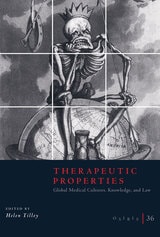
Osiris, Volume 36
Therapeutic Properties: Global Medical Cultures, Knowledge, and LawEdited by Helen Tilley
University of Chicago Press Journals, 2021
The contributions draw upon source material from the Americas, Africa, Western Europe, the Caribbean, and Asia to trace the influence of penal and civil codes, courts and constitutions, and patents and intellectual properties on not only health practices but also the very foundations of state-sanctioned medicine. The authors explore, too, how institutions of global governance, including those underpinning empires and trade, have historically created feedback loops that enabled laws and regulatory regimes to spread, amplifying their effects and standardizing approaches to diseases, drugs, professions, personhood, and well-being along the way. Highlighting the payoff of interdisciplinary and transnational analyses, this volume adroitly teases apart how different actors fought to write the rules of global health, rendering certain approaches to life and death irrelevant and invisible, others pathological and punishable by law, and others still, normal and natural.
Osiris, Volume 37
Translating Medicine across Premodern WorldsEdited by Tara Alberts, Sietske Fransen, and Elaine Leong
University of Chicago Press Journals, 2022
This volume of Osiris turns the analytical lens of translation onto medical knowledge and practices across the premodern world. Understandings of the human body, and of diseases and their cures, were influenced by a range of religious, cultural, environmental, and intellectual factors. As a result, complex systems of translation emerged as people crossed linguistic and territorial boundaries to share not only theories and concepts, but also materials, such as drugs, amulets, and surgical tools. The studies here reveal how instances of translation helped to shape and, in some cases, reimagine these ideas and objects to fit within local frameworks of medical belief.
Translating Medicine across Premodern Worlds features case studies located in geographically and temporally diverse contexts, including ninth-century Baghdad, sixteenth-century Seville, seventeenth-century Cartagena, and nineteenth-century Bengal. Throughout, the contributors explore common themes and divergent experiences associated with a variety of historical endeavors to “translate” knowledge about health and the body across languages, practices, and media. By deconstructing traditional narratives and de-emphasizing well-worn dichotomies, this volume ultimately offers a fresh and innovative approach to histories of knowledge.
Osiris, Volume 38
Beyond Craft and Code: Human and Algorithmic Cultures, Past and PresentEdited by James Evans and Adrian Johns
University of Chicago Press Journals, 2023
Perceptively explores the shifting intersections between algorithmic systems and human practices in the modern era.
How have algorithmic systems and human practices developed in tandem since 1800? This volume of Osiris deftly addresses the question, dispelling along the way the traditional notion of algorithmic “code” and human “craft” as natural opposites. Instead, algorithms and humans have always acted in concert, depending on each other to advance new knowledge and produce social consequences. By shining light on alternative computational imaginaries, Beyond Craft and Code opens fresh space in which to understand algorithmic diversity, its governance, and even its conservation.
The volume contains essays by experts in fields extending from early modern arithmetic to contemporary robotics. Traversing a range of cases and arguments that connect politics, historical epistemology, aesthetics, and artificial intelligence, the contributors collectively propose a novel vocabulary of concepts with which to think about how the history of science can contribute to understanding today’s world. Ultimately, Beyond Craft and Code reconfigures the historiography of science and technology to suggest a new way to approach the questions posed by an algorithmic culture—not only improving our understanding of algorithmic pasts and futures but also unlocking our ability to better govern our present.
Osiris, Volume 39
Disability and the History of ScienceEdited by Jaipreet Virdi, Mara Mills, and Sarah F. Rose
University of Chicago Press Journals, 2024
Disability has been a central—if unacknowledged—force in the history of science, as in the scientific disciplines. Across historical epistemology and laboratory research, disability has been “good to think with”: an object of investigation made to yield generalizable truths. Yet disability is rarely imagined to be the source of expertise, especially the kind of expertise that produces (rational, neutral, universal) scientific knowledge.
This volume of Osiris places disability history and the history of science in conversation to foreground disability epistemologies, disabled scientists, and disability sciencing (engagement with scientific tools and processes). Looking beyond paradigms of medicalization and industrialization, the volume authors also examine knowledge production about disability from the ancient world to the present in fields ranging from mathematics to the social sciences, resulting in groundbreaking histories of taken-for-granted terms such as impairment, infirmity, epidemics, and shōgai.
Some contributors trace the disabling impacts of scientific theories and practices in the contexts of war, factory labor, insurance, and colonialism; others excavate racial and settler ableism in the history of scientific facts, protocols, and collections; still others query the boundaries between scientific, lay, and disability expertise. Contending that disability alters method, authors bring new sources and interpretation techniques to the history of science, overturn familiar narratives, apply disability analyses to established terms and archives, and discuss accessibility issues for disabled historians. The resulting volume announces a disability history of science.
Osiris, Volume 40
Animal MobilitiesEdited by Tamar Novick, Lisa Onaga, and Gabriel N. Rosenberg
University of Chicago Press Journals, 2025
Human societies often come to know the natural world by examining animals, even as animals, frequently both willful and animate, can elude human grasp and challenge human aims. Animals and their movements have underpinned many methodological, moral, and epistemic dilemmas that generatively trouble the field. Featuring a range of geographies, species, languages, and cultures, the contributions in this volume broaden the view of the historical roles animals play in knowledge production processes. Organized according to three scales of animal movement (individuals, groups, systems), the twelve richly illustrated inquiries are situated in different time periods, from the sixteenth-century Ottoman Empire to the recent globalized past, and introduce varied forms, capacities, and politics of movement associated with animals. The analytic attention to animal mobility deepens comprehension of animal agency and human–animal interactions in unexpected spaces, including airports, entertainment venues, living rooms, dirt roads, and waterways. Taken together, the case studies in this volume reconsider how, where, and by whom science is done.
Osiris, Volume 41
Histories of Science and ChildhoodsEdited by Andrea Graus, Violeta Ruiz, and Elisabeth M. Yang
University of Chicago Press Journals, 2026
Converges the fields of childhood studies and the histories of science, medicine, and technology, foregrounding and investigating the entangled histories of the "child" and childhood and science.
Building on the premise that neither childhood nor science are natural, essential, or universalizable entities, this Osiris volume examines the interrelation of these two categories, tracing back to the Middle Ages and up until the present. Organized around three major themes—theorizing and historicizing the category of childhood and child agency, the technologies and politics of child health, and the co-constitutive relationship between the concept of the child and childhood and the realm of science—the issue traverses time, space, cultures, bodies, and disciplines. The contributions explore the role that science, technology, and medicine played in constructing how the ideology of childhood shaped ideas about scientific thinking and practices, e.g., the psy-sciences, sexology, filmology, medicine, health technology; and how the entanglement between the “child” and science influenced the formation of national identity, selfhood, colonial rule, resistance, and the notions of “progress” and the “future.” Using the “child” as an analytical category and considering children as fully-fledged historical actors allows us to retell and re-present (the history of) science through a wide range of sources, and in turn, reimagine our understandings of agency, governance, subjectivity, human nature, and what science owes the “child” and children.
Osiris, Volume 7
Science after '40Edited by Arnold Thackray
University of Chicago Press, 1992
Osiris, Volume 9
InstrumentsEdited by Albert Van Helden and Thomas L. Hankins
University of Chicago Press, 1994
Contributors include Albert Van Helden on telescopes and authority, Jan Golinski on the demonstrative order of proof in Lavoisier's chemistry, Bruce J. Hunt on the development of electrical standards, Deborah Warner on terrestrial magnetism, Bruce Hevly on Stanford's supervoltage X-ray tube, Robert W. Smith and Jose h N. Tatarewicz on devices and black boxes, Thatcher Deane on the imperial astronomical bureau in the Ming dynasty, Thomas L. Hankins on Louis-Bertrand Castel's ocular harpsichord, Simon Schaffer on demonstration devices in Georgian mechanics, Timothy Lenoir on Helmholtz and the materialities of communication, and Robert Frank on instruments, biological techniques, and the "all-or-none" principle.
Ossium Carnes Multae e Marci Tullii Ciceronis Epistulis / The Bones’ Meats Abundant from the Epistles of Marcus Tullius Cicero
Reginaldus Thomas Foster
Catholic University of America Press, 2021
Ostraka and Other Inscribed Material from Bir Shawish, Small Oasis
Excavation Seasons 2005 and 2007Marek Dospel
University of Michigan Press, 2020
Informal documents and remains of material culture, when analyzed properly, offer a unique window into the daily lives and workings of ancient civilizations. Published here in their archaeological context and with any relevant artifacts, the documents and inscriptions excavated recently in Egypt’s Western Desert represent a valuable addition to our meager documentation of the Bahriya Oasis in the first centuries CE.
This is the first comprehensive treatment of an archaeological dataset from the archaeological exploration of Bīr Shawīsh. Dating to around 400 CE, these primary historical sources include documentary texts written on ostraka, informal inscriptions on various ceramic objects, plus a group of incised lids. The core of the volume consists of an annotated edition and analytical indices. This is prefaced by the historical and archaeological context and is followed by a synthesis of selected issues inherent to the published material. The book includes appendices and pictures of all published objects. Doubling the number of texts and inscriptions published to date from the Small Oasis, this new corpus furthers our understanding of the economic, administrative, and social history of Late Antique Egypt.

Otaku
Japan's Database AnimalsHiroki Azuma
University of Minnesota Press, 2009
Hiroki Azuma’s Otaku offers a critical, philosophical, and historical inquiry into the characteristics and consequences of this consumer subculture. For Azuma, one of Japan’s leading public intellectuals, otaku culture mirrors the transformations of postwar Japanese society and the nature of human behavior in the postmodern era. He traces otaku’s ascendancy to the distorted conditions created in Japan by the country’s phenomenal postwar modernization, its inability to come to terms with its defeat in the Second World War, and America’s subsequent cultural invasion. More broadly, Azuma argues that the consumption behavior of otaku is representative of the postmodern consumption of culture in general, which sacrifices the search for greater significance to almost animalistic instant gratification. In this context, culture becomes simply a database of plots and characters and its consumers mere “database animals.”
A vital non-Western intervention in postmodern culture and theory, Otaku is also an appealing and perceptive account of Japanese popular culture.
Othello and Interpretive Traditions
Edward Pechter
University of Iowa Press, 1999

Other 1898s
Working-Class Politics in the Postemancipation CaribbeanAnne Eller
Duke University Press, 2027
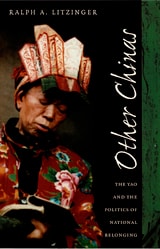
Other Chinas
The Yao and the Politics of National BelongingRalph A. Litzinger
Duke University Press, 2000
Litzinger begins by describing how during the Republican period the Yao were considered a dangerous people who preferred to consort with beasts and goblins rather than join in the making of a modern nation. He then compares this to the communist revolutionaries’ view of the Yao as impressive rebels and positive examples of subaltern agency. Litzinger shows how scholars, government workers, communist party officials, and Taoist ritual specialists have influenced the varied depictions of the Yao and, in doing so, he advances a new understanding of both the Yao and the effects of official discourse, written histories, state policy, and practices of minority empowerment. In addition to analyzing issues of ritual practice, social order, morality, and the governance of ethnic populations, Litzinger considers the Yao’s role in the cultural reforms of the 1980s. By distancing his study from romanticized depictions of minorities Litzinger is able to focus on how minority representation, struggle, and agency have influenced the history of the People’s Republic, cultural debates within contemporary Chinese society, and China’s rapidly changing role in the global order.
This book will be of interest to Asianists in both anthropology and cultural studies and should appeal more generally to scholars invested in issues of ethnic identity, minority politics, and transnationalism.
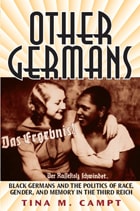
Other Germans
Black Germans and the Politics of Race, Gender, and Memory in the Third ReichTina M. Campt
University of Michigan Press, 2005
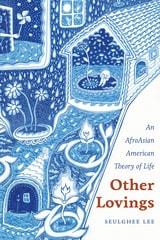
Other Lovings
An AfroAsian American Theory of LifeSeulghee Lee
The Ohio State University Press, 2025
In Other Lovings, Seulghee Lee traces the presence and plenitude of love embedded in Black and Asian American literatures and cultures to reveal their irreducible power to cohere minoritarian social life. Bringing together Black studies, Asian American studies, affect theory, critical theory, and queer of color critique, Lee examines the bonds of love in works by Amiri Baraka, Audre Lorde, David Henry Hwang, Gayl Jones, Fred Moten, Adrian Tomine, and Charles Yu. He attends to the ontological force of love in popular culture, investigating Asian American hip-hop and sport through readings of G Yamazawa, Year of the Ox, and Jeremy Lin, as well as in Black public culture through bell hooks, Martin Luther King Jr., and Cornel West.
By assessing love’s positive function in these works, Lee argues against critical regimes, such as Afropessimism and racial melancholia, that center negativity. In revealing what Black and Asian American traditions share in their positive configurations of being and collectivity, and in their responses to the overarching logic of white supremacy, Other Lovings suggests possibilities for thinking beyond sociological opposition and historical difference and toward political coalition and cultural affinity. Ultimately, Other Lovings argues for a counter-ontology of love—its felt presence, its relational possibilities, and its lived practices.
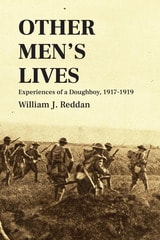
Other Men's Lives
Experiences of a Doughboy, 1917–1919William J. Reddan
Westholme Publishing, 2017
“Who can explain the feelings or thoughts of a soldier during the last few minutes before a battle? He fixes his bayonet, sees that his rifle is working properly, loads it, turns the safety lock, doing a dozen things, automatically from force of training. Just a faint trace of nervousness. . . . A few of us were thinking of a wife and children hoping if it was our turn to ‘Go West,’ that the folks back home would not feel too badly.”—from Other Men’s Lives
Receiving orders in March 1917 to report for active service in the European war, Capt. William J. Reddan and his New Jersey National Guard unit joined the 29th Infantry Division of the U.S. Army. Following training for “Over There,” which included maneuvering under live machine gun and grenade fire and constant bayonet drills, Reddan assumed command of Company B, 114th Infantry—two hundred officers and men. Arriving in France in June 1918, Reddan and his company entered the frontline trenches along the Alsace front in August. Fighting side by side with the French, the 114th conducted patrols in “no man’s land,” repulsed attacks, and endured artillery and chemical barrages. Toward the end of September, the regiment was moved by truck to a new sector: the Argonne Forest. Here, Reddan and his company would be part of the Meuse-Argonne offensive, the largest in the history of the U.S. Army. This final Allied assault would last until the Armistice, November 11, 1918, and claim the most American lives of the war. On October 12, Reddan and the rest of the 114th Infantry were ordered to take a German position that was supposed to offer little resistance; instead, Reddan watched in horror as his company was destroyed: of his two hundred officers and men, only thirteen survived the ordeal. Wounded by both shrapnel and gas, Reddan was evacuated to a field hospital and did not return to his unit until after peace was declared.
Written in 1936, Other Men’s Lives: Experiences of a Doughboy, 1917–1919 recounts the complete story of Reddan’s company in the World War, including the true story of what happened in that tragic October battle as well as the political aftermath that sought to exonerate the upper command who had bungled the operation.
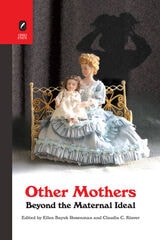
Other Mothers
Beyond the Maternal IdealEdited by Ellen Bayuk Rosenman and Claudia C. Klaver
The Ohio State University Press, 2008
This collection addresses this void, revealing the extraordinary diversity of Victorian motherhood. Exploring diaries, novels, and court cases, with contexts ranging from London to Egypt to Australia, these varied accounts take the collection “beyond the maternal ideal” to consider the multiple, unpredictable ways in which motherhood was experienced and imagined in this formative historical period.
Other Mothers joins revisionist approaches to femininity that now characterize Victorian studies. Its contents trace intersections among gender, race, and class; question the power of separate spheres ideology; and insist on the context-specific nature of social roles. The fifteen essays in this volume contribute to the fields of literary criticism, history, cultural studies, and history.
Other People's Colleges
The Origins of American Higher Education ReformEthan W. Ris
University of Chicago Press, 2022
For well over one hundred years, people have been attempting to make American colleges and universities more efficient and more accountable. Indeed, Ethan Ris argues in Other People’s Colleges, the reform impulse is baked into American higher education, the result of generations of elite reformers who have called for sweeping changes in the sector and raised existential questions about its sustainability. When that reform is beneficial, offering major rewards for minor changes, colleges and universities know how to assimilate it. When it is hostile, attacking autonomy or values, they know how to resist it. The result is a sector that has learned to accept top-down reform as part of its existence.
In the early twentieth century, the “academic engineers,” a cadre of elite, external reformers from foundations, businesses, and government, worked to reshape and reorganize the vast base of the higher education pyramid. Their reform efforts were largely directed at the lower tiers of higher education, but those efforts fell short, despite the wealth and power of their backers, leaving a legacy of successful resistance that affects every college and university in the United States. Today, another coalition of business leaders, philanthropists, and politicians is again demanding efficiency, accountability, and utility from American higher education. But, as Ris argues, top-down design is not destiny. Drawing on extensive and original archival research, Other People’s Colleges offers an account of higher education that sheds light on today’s reform agenda.
Other People's Colleges
The Origins of American Higher Education ReformEthan W. Ris
University of Chicago Press, 2022
This is an auto-narrated audiobook edition of this book.
An illuminating history of the reform agenda in higher education.
For well over one hundred years, people have been attempting to make American colleges and universities more efficient and more accountable. Indeed, Ethan Ris argues in Other People’s Colleges, the reform impulse is baked into American higher education, the result of generations of elite reformers who have called for sweeping changes in the sector and raised existential questions about its sustainability. When that reform is beneficial, offering major rewards for minor changes, colleges and universities know how to assimilate it. When it is hostile, attacking autonomy or values, they know how to resist it. The result is a sector that has learned to accept top-down reform as part of its existence.
In the early twentieth century, the “academic engineers,” a cadre of elite, external reformers from foundations, businesses, and government, worked to reshape and reorganize the vast base of the higher education pyramid. Their reform efforts were largely directed at the lower tiers of higher education, but those efforts fell short, despite the wealth and power of their backers, leaving a legacy of successful resistance that affects every college and university in the United States. Today, another coalition of business leaders, philanthropists, and politicians is again demanding efficiency, accountability, and utility from American higher education. But, as Ris argues, top-down design is not destiny. Drawing on extensive and original archival research, Other People’s Colleges offers an account of higher education that sheds light on today’s reform agenda.
Other Planes of There
Selected WritingsRenée Green
Duke University Press, 2014
Charting this cosmopolitan artist’s thinking through the decades, Other Planes of There brings essays, film scripts, reviews, and polemics together with reflections on Green's own artistic practice and seminal artworks. It immerses the reader in three decades of contemporary art showcasing the art and thought, the incisive critiques and prescient observations of one of our foremost artists and intellectuals. Sound, cinema, literature, time-based media, and the relationship between art forms and other forms of knowledge are just a few of the matters that Green takes up and thinks through. Sixty-four pages of color plates were selected by the artist for this lavishly illustrated volume.

Other Sisterhoods
LITERARY THEORY AND U.S. WOMEN OF COLOREdited by Sandra Kumamoto Stanley
University of Illinois Press, 1998
The fifteen contributors to Other Sisterhoods: Literary Theory and
U.S. Women of Color examine the ways that women writers of color have
contributed to the discourse of literary and cultural theory. They focus
on the impact of key issues, such as social construction and identity
politics, on the works of women writers of color, as well as on the ways
these women deal with differences relating to gender, class, race/ethnicity,
and sexuality. The book also explores the ways women writers of color
have created their own ethnopoetics within the arena of literary and cultural
theory, helping to redefine the nature of theory itself.
"A sophisticated resource that will do much to carry us through
to the next century. Great work!" -- Alvina E. Quintana, author of
Home Girls: Chicana Literary Voices
CONTRIBUTORS:Sandra Kumamoto Stanley, AnaLouise Keating, Dionne
Espinoza, Kimberly N. Brown, Marilyn Edelstein, Tomo Hattori, Robin Riley
Fast, King-Kok Cheung, Timothy Libretti, Renae Moore Bredin, Jennifer
Browdy de Hernandez, Kimberly M. Blaeser, Kathryn Bond Stockton, Eun Kyung
Min, Cecilia Rodriguez Milanes
Other Worlds Here
Honoring Native Women’s Writing in Contemporary Anarchist MovementsTheresa Warburton
Northwestern University Press, 2021
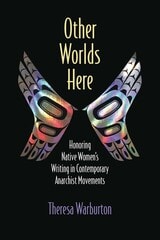
All is not lost, however. Rather than centering a critical indictment of contemporary anarchist politics, Other Worlds Here maintains that a defining characteristic of New Anarchism is its ability to adapt and transform. Through close readings of texts by Native women authors, Warburton argues that anarchists must shift the paradigm that another world is possible to one that recognizes other worlds already here: stories, networks, and histories that lay out methods of building reciprocal relationships with the land and its people. Analyzing memoirs, poetry, and novels by writers including Deborah Miranda, Elissa Washuta, Heid E. Erdrich, Janet Rogers, and Leslie Marmon Silko, Other Worlds Here extends the study of Native women’s literatures beyond ethnographic analysis of Native experience to advance a widely applicable, contemporary political critique.

Others Had It Worse
Sour Dock, Moonshine, and Hard Times in Davis County, IowaVetra Melrose Padget Covert and Chris D. Baker
University of Iowa Press, 2013
Otilia's Body
A NovelBy Sergio Galindo
University of Texas Press, 1994
From reviews of the Spanish edition:
"...among the best works that Mexican fiction has produced."
—Héctor Gally, Sábado
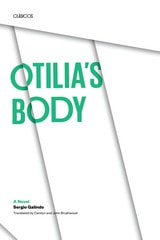
"With homely features, but with a body so shapely and exciting that it sets men (priests included) aflame throughout the novel, with an incandescent voluptuousness and delightful amorality (surely explosive in the conservative Mexican society of her time and place) ...Otilia Rauda could be the protagonist of a Greek tragedy or of a soap opera made of improbable happenings and as many turns of fate as there are chapters used to tell the story of her life."
—Jorge Ruffinelli, Punto y Aparte
Winner of Mexico's prestigious Xavier Villaurrutia prize in 1986, Otilia Rauda is here translated into English for the first time as Otilia's Body. Widely considered Sergio Galindo's best work, the novel dramatizes a sexually liberated woman's obsession with an outlaw lover, played against the backdrop of Mexican history from 1910 to 1940. A fine example of "intimist" fiction, Otilia's Body is noteworthy for its penetratingly described characters who transcend time and place to become universally recognizable.