Results by title
58 books match the query '1865-1950' and 4 start with p
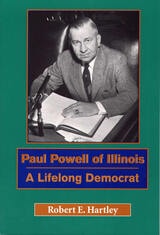
Paul Powell of Illinois
A Lifelong DemocratRobert E. Hartley
Southern Illinois University Press, 1999
Paul Powell emerged from the hill country of southern Illinois to serve in state government from 1935 until his death in 1970. His political tenure included three terms as Speaker of the Illinois House, four terms as minority leader, and two terms as secretary of state. The sponsor of hundreds of bills, he worked tirelessly for his constituents in southern Illinois. He also worked tirelessly to promote his own interests.
In this first political biography of Powell, Robert E. Hartley follows the money. He tells how this man of humble origins and meager means amassed a world-class political and financial base. Part of that story is the disclosure of a personal fortune that boggled minds, including the unbelievable yarn of the $800,000 cash found in the hotel room following Powell's death.
Powell never earned a state salary of more than $30,000 per year, yet in the last year of his life, his federal income tax return showed an income of more than $200,000. At his death his estate totaled $3.2 million, and, when settled in 1978, was worth $4.6 million, including nearly $1 million in racetrack stock.
Following Powell's story, Hartley takes us deep into the Illinois political world of the 1940s, 1950s, and 1960s, a time when politicians were on an "honor system" regarding their financial holdings. This was before disclosure of political contributions, before computer records, and before public meetings laws.
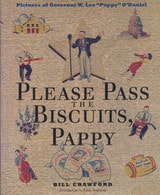
Please Pass the Biscuits, Pappy
Pictures of Governor W. Lee "Pappy" O'DanielBy Bill Crawford
University of Texas Press, 2004
Long before movie stars Ronald Reagan and Arnold Schwarzenegger became governors of California, a popular radio personality with no previous political experience—who wasn't even registered to vote—swept into the governor's office of Texas. W. Lee "Pappy" O'Daniel was a 1930s businessman who discovered the power of radio to sell flour. His musical shows with the Light Crust Doughboys (which launched the career of Bob Wills) and his radio homilies extolling family and Christian values found a vast, enthusiastic audience in Depression-era Texas. When Pappy decided to run for governor in 1938 as a way to sell more flour—a fact he proudly proclaimed throughout the campaign—the people of Texas voted for him in record numbers. And despite the ineptitude for politics he displayed once in office, Texans returned him to the governorship in 1940 and then elected him to the U.S. Senate in 1941 in a special election in which he defeated Lyndon Johnson, as well as to a full term as senator in 1942.
While the hit film O Brother, Where Art Thou? celebrated a fictional "Please Pass the Biscuits, Pappy" O'Daniel, this book captures the essence of the real man through photographs taken by employees of the Texas Department of Public Safety, most of which are previously unpublished. Reminiscent of the work of WPA photographers such as Russell Lee and Dorothea Lange, these photos record the last unscripted era of politics when a charismatic candidate could still address a crowd from an unpainted front porch or a mobile bandstand in the back of a truck. They strikingly confirm that Pappy O'Daniel's ability to connect with people was as great in person as on the radio.
To set the photos in context, Bill Crawford has written an entertaining text that discusses the political landscape in Texas and the United States in the 1930s, as well as the rise of radio as mass medium for advertising and entertainment. He also provides extensive captions for each picture. John Anderson, Photo Archivist of the Texas State Archives, discusses the work of Joel Tisdale and the other DPS photographers who left this extraordinary record of the greatest vote-getter in Texas history, who became one of America's first celebrities to cross the line from entertainment to political office.
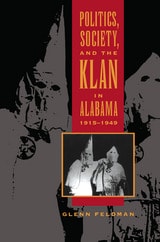
Politics, Society, and the Klan in Alabama, 1915-1949
Glenn Feldman
University of Alabama Press, 1999
This first book-length examination of the Klan in Alabama represents exhaustive research that challenges traditional interpretations.
The Ku Klux Klan has wielded considerable power both as a terrorist group and as a political force. Usually viewed as appearing in distinct incarnations, the Klans of the 20th century are now shown by Glenn Feldman to have a greater degree of continuity than has been previously suspected. Victims of Klan terrorism continued to be aliens, foreigners, or outsiders in Alabama: the freed slave during Reconstruction, the 1920s Catholic or Jew, the 1930s labor organizer or Communist, and the returning black veteran of World War II were all considered a threat to the dominant white culture. Feldman offers new insights into this "qualified continuity" among Klans of different eras, showing that the group remained active during the 1930s and 1940s when it was presumed dormant, with elements of the "Reconstruction syndrome" carrying over to the smaller Klan of the civil rights era.
In addition, Feldman takes a critical look at opposition to Klan activities by southern elites. He particularly shows how opponents during the Great Depression and war years saw the Klan as an impediment to attracting outside capital and federal relief or as a magnet for federal action that would jeopardize traditional forms of racial and social control. Other critics voiced concerns about negative national publicity, and others deplored the violence and terrorism.
This in-depth examination of the Klan in a single state, which features rare photographs, provides a means of understanding the order's development throughout the South. Feldman's book represents definitive research into the history of the Klan and makes a major contribution to our understanding of both that organization and the history of Alabama.
Populism to Progressivism In Alabama
Sheldon Hackney
University of Alabama Press, 2010
WINNER OF THE ALBERT J. BEVERIDGE AWARD OF THE AMERICAN HISTORICAL ASSOCIATION
A classic study of race, reform, and political change in the New South.
Populism to Progressivism in Alabama by Sheldon Hackney is a landmark study of the political and social transformation of Alabama during the pivotal years between 1890 and 1910. Widely recognized as a classic work of Southern history, the book examines the rise of the Populist movement, the emergence of Progressive reform, and the forces that reshaped political power in the state at the turn of the twentieth century.
Hackney explores the complex relationships among race, class, economic change, agrarian protest, and democratic participation. He investigates how farmers, laborers, political leaders, and reformers responded to industrialization, shifting economic conditions, and the challenges of governance in the New South. Central to the narrative are debates over voting rights, disfranchisement, race relations, and the creation of new political institutions that would shape Alabama's future for generations.
Combining quantitative methods with traditional historical scholarship, Hackney provides a nuanced interpretation of both Populism and Progressivism, challenging simplistic accounts of reform and political change. Essential reading for understanding Alabama and the modern South, this influential volume remains a foundational resource for historians, political scientists, students, and anyone interested in the history of American democracy and regional transformation.