59 books match the query '1993-' and 4 start with p

cover of Palestine's Horizon: Toward a Just Peace

Palestine's Horizon

Toward a Just Peace

Richard Falk

Pluto Press, 2017

After enduring years of violent occupation, the Palestinian community is now exploring different avenues for peace. These include the pursuit of rights under international law in venues such as the UN and International Criminal Court, while establishing a new emphasis on global solidarity and non-violent action through the Boycott Divestment Sanctions (BDS) movement, among others. Richard Falk has been working within and studying the Israel/Palestine conflict for several decades, and in Palestine's Horizon, he looks closely at these transformations, offering a close analysis of one of the most controversial issues of our times.
 
Falk explores the intricacies and interconnections within the history and politics of Israel and Palestine, while delving into the complicated relationships the conflict has created within the global community. He refutes the notion that the Palestinian struggle is a lost cause and offers new tactics and possibilities for change. He also puts the ongoing conflict in context, reflecting on the legacy of Edward Said and drawing on the importance of his ideas as a humanist model for peace that is mindful of the formidable difficulties that come with achieving a solution to the long struggle. One of the most established and authoritative voices on the conflict, Falk now presents his most sustained and focused historical overview to date.
 
[more]
cover of Palestinian Refugees: The Right of Return

Palestinian Refugees

The Right of Return

Edited by Naseer Aruri

Pluto Press, 2001

With renewed conflict in the Middle East, the prospect of a peaceful resolution looks more unlikely than ever. The Palestinian right of return to their homes has been upheld in international law and through United Nations' resolutions for fifty years. Equally the right of return has been denied by Israel and deferred to a "final status" issue in the Oslo Accords. It is on this right of return that the Palestinians are united. And it is this issue which is so frequently ignored by the international media.

With major contributions from a range of international experts, including Edward W. Said, Noam Chomsky, Ilan Pappe, Alain Gresh and Norman Finkelstein, this volume examines the Palestinians’ right of return. Chapters cover the historical roots of the Palestinian refugee question; the rights of the refugees under international law; the special case of Lebanon; Israeli perceptions of the refugee question; the practical feasibility of the return; the role of the United States and the European Union and the Refugee Question; the value of the refugee property; the principles of compensation; and a programme for an Independent Rights Campaign.
[more]
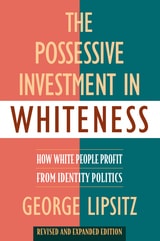
cover of Possessive Investment In Whiteness

Possessive Investment In Whiteness

George Lipsitz

Temple University Press, 1998

Attacking the common view that whiteness is a meaningless category of identity, Lipsitz shows that public policy and private prejudice insure that whites wind up on top of the social hierarchy. Passionately and clearly written, this wide-ranging book probes into the social and material rewards that accrue to "the possessive investment in whiteness." Lipsitz sums up the ways that public policy has virtually excluded communities of color from everything that American society defines as desirable: first-rate education, decent housing, asset accumulation, political power, social status, satisfying  work, and even the power it shape and narrate their own history. White supremacy is no thing of the past, no fringe movement. It is a pervasive and pernicious system that restricts the political and cultural agency of African Americans, Asian Americans, and Latinos every day. Unearned and unacknowledged, race-based advantages, not greater merit or a superior work ethic, account for white privilege.

Lipsitz's ultimate point is not to condemn all white people as racists but to challenge everyone to begin a principled examination of personal actions and political commitments. Exposing the system of unfairness is not enough. People of all groups -- but  especially white people because they benefit from that system -- have to work toward eradicating the rewards of whiteness.
[more]
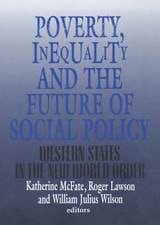
cover of Poverty, Inequality, and the Future of Social Policy: Western States in the New World Order

Poverty, Inequality, and the Future of Social Policy

Western States in the New World Order

Katherine McFate

Russell Sage Foundation, 1995

"Extremely coherent and useful, this much needed volume is concerned with the current status of the poor in Western industrial states. Its closely linked essays allow comparisons between case studies and are often themselves cross-national comparisons....The essays also comment on the meaning of globalization for social policy." —Choice "Excellent and tightly integrated articles by a group of prominent international scholars....A timely and important book, which will surely become the basic reference point for all future research on inequality and social policy." —Contemporary Sociology The social safety net is under strain in all Western nations, as social and economic change has created problems that traditional welfare systems were not designed to handle. Poverty, Inequality, and the Future of Social Policy provides a definitive analysis of the conditions that are fraying the social fabric and the reasons why some countries have been more successful than others in addressing these trends. In the United States, where the poverty rate in the 1980s was twice that of any advanced nation in Europe, the social protection system—and public support for it—has eroded alarmingly. In Europe, the welfare system more effectively buffered the disadvantaged, but social expenditures have been indicted by many as the principal cause of high unemployment. Concluding chapters review the progress and goals of social welfare programs, assess their viability in the face of creeping economic, racial, and social fragmentation, and define the challenges that face those concerned with social cohesion and economic prosperity in the new global economy. This volume illuminates the disparate effects of government intervention on the incidence and duration of poverty in Western countries. Poverty, Inequality, and the Future of Social Policy is full of lessons for anyone who would look beyond the limitations of the welfare debate in the United States.
[more]