Results by title
56 books match the query 'Academic & Scholarly' and 4 start with p

Philosophy in the First Person
A ManifestoHelena de Bres
University of Chicago Press, 0
A bold argument and model for how to bring one’s personal voice and experience into philosophical writing.
Contemporary philosophical writing is deeply impersonal: technical, abstract, and stripped of an individual human voice. In contrast, many of the historical philosophers we most admire saw emotion, style, narrative and humor as essential parts of doing philosophy well. What if they were on to something?
Philosophy in the First Person offers a deft and engaging case for the philosophical personal essay, a genre of writing that unites intimate revelation with intellectual depth and literary flair. As a manifesto, the book argues for a return to the more personal forms of philosophy that preceded academic professionalization. As a guide, it provides substantive advice for aspiring personal-philosophical writers, drawing on ideas from creative nonfiction. As a demonstration, the book is itself a set of philosophical personal essays, tracing one philosopher’s sentimental-intellectual journey through a vocation that frustrates and captivates her in equal measure.
Blending memoir, theory, and model, the book offers a roadmap for writing philosophy that’s enlightening as well as moving, gripping, and fun. Along the way, it makes a refreshing argument for reconnecting a philosophical vocation with a fully human way of life.
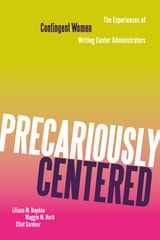
Precariously Centered
The Experiences of Contingent Women Writing Center AdministratorsLiliana M. Naydan
Utah State University Press, 2026
Precariously Centered confronts the troubling intersection of gender and contingency in administrative writing center work—an intersection that has haunted writing centers for decades. Featuring findings from a groundbreaking qualitative study of a diverse group of contingent women writing center administrators, Liliana M. Naydan, Maggie M. Herb, and Clint Gardner demonstrate that gender and its intersections have personal, professional, disciplinary, and pedagogical consequences in writing centers.
This report on interview-based qualitative research documents the experiences of sixteen writing center administrators—how their working lives are often complicated by the intersection of gender, contingency, and other identities. The authors address precarity, identity-based discrimination, extensive and invisible emotional labor, limited resources, lack of institutional support, and barriers to promotion. The words of these administrators come into conversation with scholarship on identity, feminist theory, and the current labor crisis in higher education and reveal challenges ranging from a dearth of resources to discrimination. Their words also reveal dire disciplinary and pedagogical consequences for our institutions and higher education.
Amid increasingly distressing labor conditions in the early twenty-first century, Precariously Centered addresses how writing center professionals—and all academics—can better address contingency, the corporatization of higher education, and the patriarchy. It emphasizes the value of discourse about working conditions, intersectional solidarity, and organizing for labor justice.
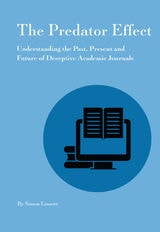
Predator Effect
Understanding the Past, Present and Future of Deceptive Academic JournalsSimon Linacre
Against the Grain, LLC, 2022
The Predator Effect concerns predatory publishing — it is the first to chart both the rise and impact of deceptive publishing. The author — a scientific communications expert with 20 years’ experience — looks at how predatory journals had become an accepted part of scholarly publishing, reviewing in turn the history, development and impact of predatory journals. The book also puts their rise in context of wider issues such as Open Access and publication ethics. Other issues it addresses include: defining predatory journals, the history of predatory publishing practices, Beall’s List, authors’ motivations and the future of predatory publishing practices.
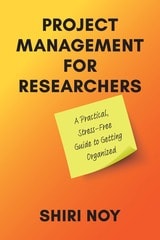
Project Management for Researchers
A Practical, Stress-Free Guide to Getting OrganizedShiri Noy
University of Michigan Press, 2024
Project Management for Researchers tackles the how, what, and why of project management. It offers step-by-step guidance on choosing tools and developing a personalized system that will help the reader manage and organize their research so that steps and decisions are documented for accountability and reproducibility. Readers will find worksheets they can adapt to their own needs, priorities, and research as well as practical tips on issues ranging from emails to scheduling. Suitable for work across methods, experience levels, and disciplines and adaptable for those working alone, with others, or as team managers, this book will guide readers between various research stages–from planning, to execution, to adjustment of research projects big and small.