Results by title
159 books match the query 'Academic writing' and 8 start with p
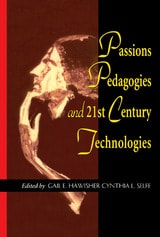
Passions Pedagogies and 21st Century Technologies
edited by Gail E. Hawisher & Cynthia L. Selfe
Utah State University Press, 1999
Gail Hawisher and Cynthia Selfe created a volume that set the agenda in the field of computers and composition scholarship for a decade. The technology changes that scholars of composition studies faced as the new century opened couldn't have been more deserving of passionate study. While we have always used technologies (e.g., the pencil) to communicate with each other, the electronic technologies we now use have changed the world in ways that we have yet to identify or appreciate fully. Likewise, the study of language and literate exchange, even our understanding of terms like literacy, text, and visual, has changed beyond recognition, challenging even our capacity to articulate them.
As Hawisher, Selfe, and their contributors engage these challenges and explore their importance, they "find themselves engaged in the messy, contradictory, and fascinating work of understanding how to live in a new world and a new century." The result is a broad, deep, and rewarding anthology of work still among the standard works of computers and composition study.
Persist and Publish
Helpful Hints for Academic Writing and PublishingRalph Matkin
University Press of Colorado, 2002
Personal Effects
edited by Deborah H. Holdstein & David Bleich
Utah State University Press, 2002
With this volume, then, these scholars move us to explore the intersections of the social with subjectivity, with voice, ideology, and culture, and to consider the roles of these in the work of academics who study writing and literature. Taken together, the essays in this collection carry forward the idea that the personal, the candidly subjective and intersubjective, must be part of the subject of study in humanities scholarship. They propose an understanding of the personal in scholarship that is more helpful because more clearly anchored in human experience.
Personally Speaking
Experience as Evidence in Academic DiscourseCandace Spigelman
Southern Illinois University Press, 2004
Responding to contemporary discussion about using personal accounts in academic writing, Personally Speaking: Experience as Evidence in Academic Discourse draws on classical and current rhetorical theory, feminist theory, and relevant examples from both published writers and first-year writing students to illustrate the advantages of blending experiential and academic perspectives.
Candace Spigelman examines how merging personal and scholarly worldviews produces useful contradictions and contributes to a more a complex understanding in academic writing. This rhetorical move allows for greater insights than the reading or writing of experiential or academic modes separately does. Personally Speaking foregrounds the semi-fictitious nature of personal stories and the rhetorical possibilities of evidence as Spigelman provides strategies for writing instructors who want to teach personal academic argument while supplying practical mechanisms for evaluating experiential claims.
The volume seeks to complicate and intensify disciplinary debates about how compositionists should write for publication and what kinds of writing should be taught to composition students. Spigelman not only supplies evidence as to why the personal can count as evidence but also relates how to use it effectively by including student samples that reflect particular features of personal writing. Finally, she lays the groundwork to move narrative from its current site as confessional writing to the domain of academic discourse.
Pivotal Strategies
Claiming Writing Studies as DisciplineLynn C. Lewis
Utah State University Press, 2024
Because undergraduate degrees in writing studies are relatively new, claiming the discipline has required reinvention and revision at personal and professional levels far different than any other discipline. Suspicions about the viability of the discipline linger in many departments and universities, as well as outside the academy, leading writing studies scholars to develop innovative strategies to deal with covertly hostile attitudes. Within the collection, contributors name explicit claiming strategies from the discipline’s beginnings to the contemporary moment, locating opportune spaces, negotiating identities and fostering resilience, and developing allegiances by foregrounding their embodiment as underrepresented members of academia through a commitment to social justice and equity.
Responding to current conversations on the worth of education with honest stories about the burdens and joys of becoming and being an academic, Pivotal Strategies features a spectrum of voices across racial, gender, class, and age categories. This collection not only makes the discipline more visible but also helps map the contemporary state of writing studies.
Points of Departure
Rethinking Student Source Use and Writing Studies Research MethodsTricia Serviss
Utah State University Press, 2017
The contributors offer methodologies, techniques, and suggestions for research that move beyond decontextualized guides to grapple with the messiness of research-in-process, as well as design, development, and expansion. Serviss and Jamieson’s model of RAD writing studies research is transcontextual and based on hybridized or mixed methods. Among these methods are citation context analysis, research-aloud protocols, textual and genre analysis, surveys, interviews, and focus groups, with an emphasis on process and knowledge as contingent. Chapters report on research projects at different stages and across institution types—from pilot to multi-site, from community college to research university—focusing on the methods and artifacts employed.
A rich mosaic of research about research, Points of Departure advances knowledge about student writing and serves as a guide for both new and experienced researchers in writing studies.
Contributors: Crystal Benedicks, Katt Blackwell-Starnes, Lee-Ann Kastman Breuch, Kristi Murray Costello, Anne Diekema, Rebecca Moore Howard, Sandra Jamieson, Elizabeth Kleinfeld, Brian N. Larson, Karen J. Lunsford, M. Whitney Olsen, Tricia Serviss, Janice R. Walker
Private Virtues, Public Vices
Philanthropy and Democratic EqualityEmma Saunders-Hastings
University of Chicago Press, 2022
Philanthropy plays a huge role in supporting the provision of many public goods in contemporary societies. As a result, decisions that affect public outcomes and people’s diverse interests are often dependent on the preferences and judgments of the rich. Political theorist Emma Saunders-Hastings argues that philanthropy is a deeply political activity. She asks readers to look at how the power wielded by philanthropy impacts democracy and deepens political inequality by enabling the wealthy to exercise outsize influence in public life and by putting in place paternalistic relationships between donors and their intended beneficiaries. If philanthropy is to be made compatible with a democratic society of equals, it must be judged not simply on the benefits it brings but on its wider political consequences. Timely and thought-provoking, Private Virtues, Public Vices will challenge readers’ thoughts on what philanthropy is and how it truly affects us.
Professional Academic Writing in the Humanities and Social Sciences
Susan Peck MacDonald
Southern Illinois University Press, 1994
In Professional Academic Writing in the Humanities and Social Sciences, Susan Peck MacDonald tackles important and often controversial contemporary questions regarding the rhetoric of inquiry, the social construction of knowledge, and the professionalization of the academy. MacDonald argues that the academy has devoted more effort to analyzing theory and method than to analyzing its own texts. Professional texts need further attention because they not only create but are also shaped by the knowledge that is special to each discipline. Her assumption is that knowledge-making is the distinctive activity of the academy at the professional level; for that reason, it is important to examine differences in the ways the professional texts of subdisciplinary communities focus on and consolidate knowledge within their fields.
Throughout the book, MacDonald stresses her conviction that academics need to do a better job of explaining their text-making axioms, clarifying their expectations of students at all levels, and monitoring their own professional practices. MacDonald’s proposals for both textual and sentence-level analysis will help academic professionals better understand how they might improve communication within their professional communities and with their students.