Results by title
240 books match the query 'Agriculture & Food Policy' and 12 start with p
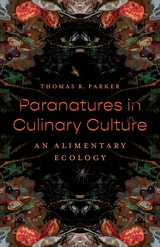
Paranatures in Culinary Culture
An Alimentary EcologyThomas R. Parker
University of Minnesota Press, 2025
Uncovering the intricate cultural threads that inform our dietary practices
Paranatures in Culinary Culture embarks on a gastronomic odyssey, redefining foods we thought we knew and revealing the extraordinary stories of ordinary ingredients and the cultural forces shaping our diets. The book begins with a simple premise: to eat is to assimilate the outer world into the inner body, both physically and mentally. But what happens when this assimilation process goes awry? Thomas R. Parker reveals how culinary staples are not only elements of identity formation but also instruments of cultural disruption when their true nature emerges and challenges our preconceptions.
Parker explores how certain foods—bread, oysters, pigs, cheese, and wine—can both create and destabilize narratives, unsettle assimilation, and decenter Western culinary traditions. Taking inspiration from architectural historian David Gissen’s concept of “subnature” and Michel Serres’s idea of the “parasite,” Parker develops the concept of paranatures: flavors, foods, and practices considered unpalatable by different societies at different times. He reveals how certain ordinary foods live parallel paranatural lives, addressing larger issues of colonial and postcolonial food theory and challenging long-held notions that cuisine was meant to uphold.
Serving up a rich blend of history, culture, and gastronomy, Parker leads readers to perceive food as an adventure, inviting them to taste the untamed side of nature. He offers a thought-provoking invitation to reconceptualize the roles and narratives we assign to the natural world and its produce, allowing us to see food, nature, and ourselves in new ways.

Pasta, Pizza and Propaganda
A Political History of Italian Food TVFrancesco Buscemi
Intellect Books, 2021
In this dynamic interdisciplinary study at the intersection of food studies, media studies, and politics, Francesco Buscemi explores the central role of food in Italian culture through a political history of Italian food on national television. A highly original work of political history, the book tells the story of Italian food television from a political point of view: from the pioneering shows developed under strict Catholic control in the 1950s and 1960s to the left-wing political twists of the 1970s, the conservative riflusso or resurgence of the 1980s, through the disputed Berlusconian era, and into the contemporary rise of the celebrity chef. Through this lively and engaging work, we learn that cooking spaghetti in a TV studio is a political act, and by watching it, we become citizens.
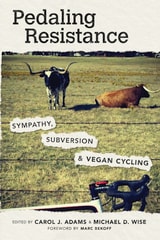
Pedaling Resistance
Sympathy, Subversion, and Vegan CyclingCarol J. Adams
University of Arkansas Press, 2024
The essays in this collection explore the unity between cycling for health, work, competition, transport, and joy, and the issues of animal suffering, environmentalism, and speciesism inherent in veganism—all through lenses of class, race, gender, and disability. Pedaling Resistance illuminates themes of everyday resistance and boundary crossing to uncover the greater social and political issues that underlie the decisions to give up animal products and choose cycling over driving.
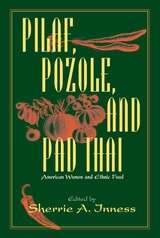
Pilaf, Pozole, and Pad Thai
American Women and Ethnic FoodSherrie A. Inness
University of Massachusetts Press, 2001
For many Americans, eating ethnic food is so commonplace as to be taken for granted. Yet, whether we acknowledge it or not, such foods create a powerful social language that speaks of cultural traditions and tastes that have been handed down from one generation to the next and, in some cases, appropriated and commodified by American commercial culture. Ethnic cooking represents both a source of sustenance and a complex form of communication.
In this volume, eleven scholars explore the role of ethnic food in American culture, with a particular focus on women. The first six chapters offer personal accounts of the ways in which ethnic meals are embedded in women's memories and fortify their connections to one another. From a Sicilian-born mother who affirms her allegiance to her heritage through the loving preparation of traditional tomato sauce and pasta, to a Swedish American woman whose dozens of boxes of recipe cards document a process of cultural assimilation, to an Armenian American who uses a shared passion for cooking to forge a relationship with her lover's family—these essays speak in a personal voice about the power of food as a marker of women's identity. The final five chapters take a more analytic approach, scrutinizing the social and political aspects of ethnic food and the phenomenon of “culinary tourism.” One essay offers a brilliant meditation on the gendered discourse of cooking in the Mexican American community, showing how food preparation provides many Chicanas with a vital language of self-expression. Another essay probes the author's penchant for Thai food and other cuisines from economically dominated cultures, situating it in the context of a larger system of privilege and oppression and as a form of cultural colonialism. By going beyond the obvious, these essays challenge our assumptions and expand our understanding of the significance of ethnic food in women's lives.
Contributors include Meredith E. Abarca, Arlene Voski Avakian, Linda Murray Berzok, Benay Blend, Lynn Z. Bloom, Paul Christensen, Cathie English, Doris Friedensohn, Lisa Heldke, Heather Schell, and Leanne Trapedo Sims.
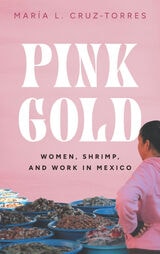
Pink Gold
Women, Shrimp, and Work in MexicoMaria L. Cruz-Torres
University of Texas Press, 2023
A rich, long-term ethnography of women seafood traders in Mexico.
The "shrimp ladies," locally known as changueras in southern Sinaloa, Mexico, sell seafood in open-air markets, forming an extralegal but key part of the economy built around this "pink gold.” Over time, they struggled to evolve from marginalized peddlers to local icons depicted in popular culture, even as they continue to work at an open-air street market.
Pink Gold documents the shrimp traders' resilience and resourcefulness, from their early conflicts with the city, state, and federal authorities and forming a union, to carving out a physical space for a seafood market, and even engaging in conflicts with the Mexican military. Drawing from her two decades of fieldwork, María L. Cruz-Torres explores the inspiring narrative of this overlooked group of women involving grassroots politics, trans-border and familial networking, debt and informal economic practices, personal sacrifices, and simple courage. She argues that, amid intense economic competition, their success relies on group solidarity that creates interlocking networks of mutual trust, or confianza, that in turn enable them to cross social and political boundaries that would typically be closed to them. Ultimately, Pink Gold offers fresh insights into issues of gender and labor, urban public space, the street economy, commodities, and globalization.
Plant Foods of Greece
A Culinary Journey to the Neolithic and Bronze AgesSoultana Maria Valamoti
University of Alabama Press, 2023
2024 INAUGURAL MARY BEAUDRY BOOK AWARD FOR THE ARCHAEOLOGY OF FOOD
A synthesis of culinary practices of prehistoric Greece based on plant food ingredients
In Plant Foods of Greece, Greek archaeologist Soultana Maria Valamoti takes readers on a culinary journey, reconstructing the plant foods and culinary practices of Neolithic and Bronze Age Greece. For more than thirty years, she has been analyzing a large body of archaeobotanical data that was retrieved from nearly twenty sites in mainland Greece and the Greek islands, with an additional analysis of other sites as referenced by published colleagues. Plant foods were the main ingredients of daily meals in prehistoric Greece and most likely of special dishes prepared for feasts and rituals.
Valamoti’s approach allows an exploration of culinary variability through time. The thousands of charred seeds identified from occupation debris correspond to minuscule time capsules. She is able to document changes from the cooking of the first farmers to the sophisticated cuisines of the elites who inhabited palaces in the first cities of Europe in the south of Greece during the Late Bronze Age. Along the way, she explains the complex processes for the addition of new ingredients (such as millet and olives), condiments, sweet tastes, and complex recipes. Valamoti also addresses regional variability and diversity as well as detailing experimentation and research using occasional input from ancient written sources.
Comprehensive and synthetic coverage encompasses bread/cereals, pulses, oils, fruit and nuts, fermented brews, healing foods, cooking, and identity. In addition, Valamoti offers insight into engaging in public archaeology and provides recipes that incorporate ancient plant ingredients and connect prehistory to the present in a critical way. A definitive source for a range of food scientists and scholars, it will also appeal to foodies.
Political Ecologies of Cattle Ranching in Northern Mexico
Private RevolutionsEric P. Perramond
University of Arizona Press, 2010
In this study of the Río Sonora region of northern Mexico, where ranchers own anywhere from several hundred to tens of thousands of acres, Eric Perramond evaluates management techniques, labor expenditures, gender roles, and decision-making on private ranches of varying size. By examining the economic and ecological dimensions of daily decisions made on and off the ranch he shows that, contrary to prevailing notions, ranchers rarely collude as a class unless land titles are at issue, and that their decision-making is as varied as the landscapes they oversee.
Through first-hand observation, field measurements, and intimate ethnographies, Perramond sheds light on a complex set of decisions made, avoided, and confronted by these land managers and their families. He particularly shows that ranching has endured because of its extended kinship network, its reliance on all household members, and its close ties to local politics.
Perramond follows ranchers caught between debt, drought, and declining returns to demonstrate the novel approaches they have developed to adapt to changing economies and ecologies alike—such as strategically marketing the ranches for wild-game hunting or establishing small businesses that subsidize their lifestyles and livelihoods. Even more importantly, he reveals the false dichotomy between private and communal ranching. Political Ecologies of Cattle Ranching in Northern Mexico is essential reading for anyone interested in the future of ranching in western North America.
Population, Agriculture, and Biodiversity
Problems and ProspectsJ. Perry Gustafson
University of Missouri Press, 2020
The world population is projected to be nine to ten billion by 2050, signaling the need to increase world food production by more than 70 percent on the same amount of land currently under production—and this without further damaging our fragile environment. The essays in this collection, written by experts for laypersons, present the problems we face with clarity and assess our prospects for solving them, calling for action but holding out viable solutions.
Porkopolis
American Animality, Standardized Life, and the Factory FarmAlex Blanchette
Duke University Press, 2020
Precarious Eating
Narrating Environmental Harm in the Global SouthBen Jamieson Stanley
University of Minnesota Press, 2024
The role of food and hunger in contemporary South African and Indian environmental writing
From GMOs to vegetarianism and veganism, questions of what we should (and shouldn’t) eat can be frequent sources of debate and disagreement. In Precarious Eating, Ben Jamieson Stanley asks how recentering global South representations of food might shift understandings of environmental precarity.
Precarious Eating follows the lead of writers and thinkers in South Africa and India who are tracing the production and consumption of food, exploring ways to reconnect our narratives about climate change, global capitalism, and social justice. Taking up a diverse range of novels, films, scholar/activist writings, intellectual histories, and cookbooks, Stanley connects the ethics of eating to histories of empire and apartheid, uneven globalization, gender and sexuality, and global South experiences of climate change. They shift the lens of environmental humanities from climate-focused paradigms developed in the global North to food-focused environmental culture and activism in the South, addressing topics that range from foraging and farmer suicides to disordered eating and queer intimacy.
By highlighting authors, activists, and environments of the global South, Precarious Eating joins with scholarship from postcolonial, decolonial, Indigenous, and Black studies to underscore how capitalism and empire shape our planetary environmental crisis.
Retail e-book files for this title are screen-reader friendly with images accompanied by short alt text and/or extended descriptions.
Preparing the Modern Meal
Urban Capitalism and Working-Class Food in Kenya's Port CityDevin Smart
Ohio University Press, 2025
A case study on how urban capitalism created a new working-class food system in the port city of Mombasa during the twentieth century.
In the early twentieth century, East Africans lived primarily in rural areas, cultivating most of the food they consumed. By the start of the twenty-first century, though, millions of people lived in cities, where they purchased their food from markets and eateries. This transformation reflects broader historical shifts in food production, preparation, and consumption throughout the world from a rural subsistence model to a commercial system. Preparing the Modern Meal explores this economic revolution in Mombasa, Kenya, and examines the experiences of those who migrated from rural settings to an Indian Ocean town where they became dependent on the capitalist market for their daily meals.
The change to a commercial food system reshaped the culinary culture of East Africa. In rural communities, diets were diverse and varied with the seasons. Conversely, Mombasa’s commercial supply chains, which steadily delivered staples like maize meal, wheat flour, tea, and meat, led to a more uniform urban cuisine that remained consistent throughout the year.
Urbanization also altered gender roles in cooking. In rural households women prepared the food, but in Mombasa many workers lived in all-male housing and had to cook for themselves. Some even took up cooking as a profession, thus expanding the role of men in the culinary domain. In addition to these themes, Preparing the Modern Meal reviews the emergence of new businesses, particularly those of street food vendors who provided affordable meals in residential neighborhoods and to nearby workplaces. However, these makeshift eateries often clashed with the vision for commerce in a modern city held by municipal officials, who often sought to eliminate these businesses through fines, arrests, and demolition campaigns. Through the lens of food, this book explores the conflicts between elite ideas about urban modernity and the actual ways that poor communities made their lives work in an unequal city.
Prosperity Far Distant
The Journal of an American Farmer, 1933–1934Charles M. Wiltse
Ohio University Press, 2012
Fresh from receiving a doctorate from Cornell University in 1933, but unable to find work, Charles M. Wiltse joined his parents on the small farm they had recently purchased in southern Ohio. There, the Wiltses scratched out a living selling eggs, corn, and other farm goods at prices that were barely enough to keep the farm intact.
In wry and often affecting prose, Wiltse recorded a year in the life of this quintessentially American place during the Great Depression. He describes the family’s daily routine, occasional light moments, and their ongoing frustrations, small and large—from a neighbor’s hog that continually broke into the cornfields to the ongoing struggle with their finances. Franklin Roosevelt’s New Deal had little to offer small farmers, and despite repeated requests, the family could not secure loans from local banks to help them through the hard economic times. Wiltse spoke the bitter truth when he told his diary, “We are not a lucky family.” In this he represented millions of others caught in the maw of a national disaster.
The diary is introduced and edited by Michael J. Birkner, Wiltse’s former colleague at the Papers of Daniel Webster Project at Dartmouth College, and coeditor, with Wiltse, of the final volume of Webster’s correspondence.