85 books match the query 'Americas' and 4 start with p
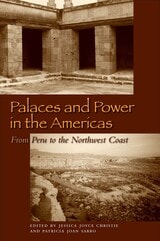
cover of Palaces and Power in the Americas: From Peru to the Northwest Coast

Palaces and Power in the Americas

From Peru to the Northwest Coast

Edited by Jessica Joyce Christie and Patricia Joan Sarro

University of Texas Press, 2006

Ancient American palaces still captivate those who stand before them. Even in their fallen and ruined condition, the palaces project such power that, according to the editors of this new collection, it must have been deliberately drawn into their formal designs, spatial layouts, and choice of locations. Such messages separated palaces from other elite architecture and reinforced the power and privilege of those residing in them. Indeed, as Christie and Sarro write, "the relation between political power and architecture is a pervasive and intriguing theme in the Americas."

Given the variety of cultures, time periods, and geographical locations examined within, the editors of this book have grouped the articles into four sections. The first looks at palaces in cultures where they have not previously been identified, including the Huaca of Moche Site, the Wari of Peru, and Chaco Canyon in the U.S. Southwest. The second section discusses palaces as "stage sets" that express power, such as those found among the Maya, among the Coast Salish of the Pacific Northwest, and at El Tajín on the Mexican Gulf Coast. The third part of the volume presents cases in which differences in elite residences imply differences in social status, with examples from Pasado de la Amada, the Valley of Oaxaca, Teotihuacan, and the Aztecs. The final section compares architectural strategies between cultures; the models here are Farfán, Peru, under both the Chimú and the Inka, and the separate states of the Maya and the Inka.

Such scope, and the quality of the scholarship, make Palaces and Power in the Americas a must-have work on the subject.
[more]
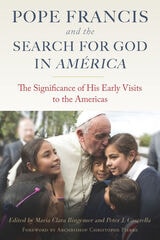
cover of Pope Francis and the Search for God in America: The Significance of His Early Visits to the Americas

Pope Francis and the Search for God in America

The Significance of His Early Visits to the Americas

Maria Clara Bingemer

Catholic University of America Press, 2021
In Tutti Fratelli, Pope Francis has called again for a “culture of encounter,” But how should his theology, pastoral practice, and social message be understood and applied in the Church of the Americas, a single but complex reality that extends from South to North? This volume offers analyses from experts looking back to the Argentine pontiff’s first fateful encuentros in the Americas as a help for understanding the present reality of the Church in the Western Hemisphere. The group includes theologians, historians, and political scientists, and the unique contribution of the volume lies in the panoramic perspective offered by the book as a whole. The initial essays set the stage for the volume as a whole, offering rich insight into Argentine and Latin American history, the world from which the Pope came and to which he returned in 2015, as well as surveying the impact of the Latin American “theology of the people” on the Pope’s visit to the U.S. Additional essays address theological, historical, and pastoral engagements that cut across several of the visits. The final group of essays is dedicated to the visits themselves and is arranged in the order that they occurred. Pope Francis and the Search for God in América is offered to all the members of the Church in América, South and North, old and young, with the hope that it will spur even more thought, reflection, prayer, and service.
[more]
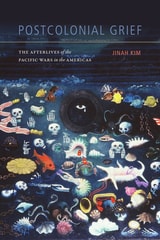
cover of Postcolonial Grief: The Afterlives of the Pacific Wars in the Americas

Postcolonial Grief

The Afterlives of the Pacific Wars in the Americas

Jinah Kim

Duke University Press, 2019

In Postcolonial Grief Jinah Kim explores the relationship of mourning to transpacific subjectivities, aesthetics, and decolonial politics since World War II. Kim argues that Asian diasporic subjectivity exists in relation to afterlives because the deaths of those killed by U.S. imperialism and militarism in the Pacific remain unresolved and unaddressed. Kim shows how primarily U.S.-based Korean and Japanese diasporic writers, artists, and filmmakers negotiate the necropolitics of Asia and how their creative refusal to heal from imperial violence may generate transformative antiracist and decolonial politics. She contests prevalent interpretations of melancholia by engaging with Frantz Fanon's and Hisaye Yamamoto's decolonial writings; uncovering the noir genre's relationship to the U.S. war in Korea; discussing the emergence of silenced colonial histories during the 1992 Los Angeles riots; and analyzing the 1996 hostage takeover of the Japanese ambassador's home in Peru. Kim highlights how the aesthetic and creative work of the Japanese and Korean diasporas offers new insights into twenty-first-century concerns surrounding the state's erasure of military violence and colonialism and the difficult work of remembering histories of war across the transpacific.
[more]
cover of Premier Issue: Studies in Working-Class History of the Americas, Volume 1

Premier Issue

Studies in Working-Class History of the Americas, Volume 1

Leon Fink

Duke University Press, 0

The inaugural issue of Labor offers an example of what readers can expect to find on a regular basis—full coverage of new trends in labor history. It features an extensive interview with retired Yale University professor David Montgomery, the acclaimed “dean” of the new labor history since the 1970s. One article plumbs management and labor archives as well as oral histories to reconstruct the patterns of abuse encountered by women on automobile shop floors from 1930 to 1970. Drawing on fieldwork in a southern California domestic service placement agency, a contributor documents the commodification of gender and ethnic stereotypes in the international maid trade. Another essay begins a two-part series on the history of U.S. labor and international solidarity; still another explores the recent desecration of the memorial to victims of the Ludlow Massacre.

Contributors. James R. Barrett, Joshua Brown, Leon Fink, Dana Frank, John French, James Green, Julie Greene, Gregory Kealey, Kristen Hill Maher, Steve Meyer

[more]
