57 books match the query 'Antisemitism' and 4 start with p
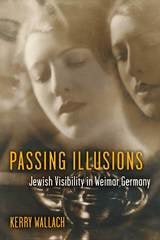
cover of Passing Illusions: Jewish Visibility in Weimar Germany

Passing Illusions

Jewish Visibility in Weimar Germany

Kerry Wallach

University of Michigan Press, 2017

Weimar Germany (1919–33) was an era of equal rights for women and minorities, but also of growing antisemitism and hostility toward the Jewish population. This led some Jews to want to pass or be perceived as non-Jews; yet there were still occasions when it was beneficial to be openly Jewish. Being visible as a Jew often involved appearing simultaneously non-Jewish and Jewish. Passing Illusions examines the constructs of German-Jewish visibility during the Weimar Republic and explores the controversial aspects of this identity—and the complex reasons many decided to conceal or reveal themselves as Jewish. Focusing on racial stereotypes, Kerry Wallach outlines the key elements of visibility, invisibility, and the ways Jewishness was detected and presented through a broad selection of historical sources including periodicals, personal memoirs, and archival documents, as well as cultural texts including works of fiction, anecdotes, images, advertisements, performances, and films. Twenty black-and-white illustrations (photographs, works of art, cartoons, advertisements, film stills) complement the book’s analysis of visual culture.

 
[more]
cover of Passion of Israel: Jacques Maritain, Catholic Conscience, and the Holocaust

Passion of Israel

Jacques Maritain, Catholic Conscience, and the Holocaust

Richard Francis Crane

University of Scranton Press, 2010

In his lifetime, French philosopher Jacques Maritain (1882–1973) achieved a reputation as both a leading Catholic intellectual and as an outspoken critic of antisemitism. Here historian Richard Francis Crane traces the development of Maritain’s opposition toward antisemitism and analyzes the Catholic appreciation of Judaism that animated his stance. Crane probes the writings and teachings of Maritain—from before, during, and after the Holocaust—and illuminates how his ideas altered Christian perceptions of Jews and Judaism during his lifetime and continue to do so today.
[more]
cover of Pound in Purgatory: From Economic Radicalism to Anti-Semitism

Pound in Purgatory

From Economic Radicalism to Anti-Semitism

Leon Surette

University of Illinois Press, 1999

Pound in Purgatory, available now in paperback, overturns all previous explanations of Ezra Pound's anti-Semitism by uncovering its roots in economic and conspiracy theory. Leon Surette demonstrates that, contrary to popular opinion, Pound was not a life-long anti-Semite and consistently ignored or resisted anti-Semitic comments from his correspondents until after 1931.
 
From 1931 to 1945 Pound's poetry took a back seat to his activities as an economic reformer and propagandist for the corporate state. Pound believed he had a simple and practical solution for the economic woes of the world brought on by the Great Depression, and he became increasingly preoccupied with capturing political power for the economic reform he envisioned.
 
As the world spiraled toward war, Pound's program of economic reform foundered and he gradually succumbed to a paranoid belief in a Jewish conspiracy. Through an incisive analysis of Pound's correspondence and writings, much of it previously unexamined, Surette shows how this belief fostered the virulent anti-Semitism that pervades his work-–both poetry and prose-–from this time forward.
 
[more]
cover of Primed for Violence: Murder, Antisemitism, and Democratic Politics in Interwar Poland

Primed for Violence

Murder, Antisemitism, and Democratic Politics in Interwar Poland

Paul Brykczynski

University of Wisconsin Press, 2017

In 1922, the new Republic of Poland democratically elected its first president, Gabriel Narutowicz. Because his supporters included a Jewish political party, an opposing faction of antisemites demanded his resignation. Within hours, bloody riots erupted in Warsaw, and less than a week later the president was assassinated. In the wake of these events, the radical right asserted that only “ethnic Poles” should rule the country, while the left silently capitulated to this demand.
            As Paul Brykczynski tells this gripping story, he explores the complex role of antisemitism, nationalism, and violence in Polish politics between the two World Wars. Though focusing on Poland, the book sheds light on the rise of the antisemitic right in Europe and beyond, and on the impact of violence on political culture and discourse.
[more]