Results by title
69 books match the query 'Art, American' and 5 start with p
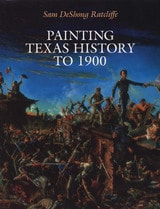
Painting Texas History to 1900
By Sam D. Ratcliffe
University of Texas Press, 1992
Certificate of Commendation, American Association for State and Local History, 1994
T. R. Fehrenbach Book Award, Texas Historical Commission, 1992
San Antonio Conservation Society Citation, 1993
Dramatic historical events have frequently provided subject matter for artists, particularly in pre-twentieth-century Texas, where works portraying historical, often legendary, events and individuals predominated. Until now, however, these paintings of Texas history have never received the kind of study given to historical, fictional, and film versions of the same events. Painting Texas History to 1900 fills this gap with an interdisciplinary approach that explores these paintings both as works of art and as historical documents.
The author examines the works of more than forty artists, including Henry McArdle, Theodore Gentilz, Robert Onderdonk, William Huddle, Frederic Remington, Friedrich Richard Petri, Arthur T. Lee, Seth Eastman, Sarah Hardinge, Frank Reaugh, W. G. M. Samuel, Carl G. von Iwonski, and Julius Stockfleth. He places each work within its historical and cultural context to show why such subject matter was chosen, why it was depicted in a particular way, and why such a depiction gained popular acceptance. For example, paintings of heroic events of the Texas Revolution were especially popular in the years following the Civil War, when, in Ratcliffe's view, Texans needed such images to assuage the loss of the war and the humiliation of Reconstruction.
Though the paintings cut across traditional art history categories—from the pictographs of early historic Indians to European-inspired oil paintings—they are bound together by their artists' intent for them to function as historically evocative documents. With their visual narratives of events that characterized all of America's westward expansion—Indian encounters, military battles, farming, ranching, surveying, and the closing of the frontier—these works add an important chapter to the story of the American West.
Pay for Your Pleasures
Mike Kelley, Paul McCarthy, Raymond PettibonCary Levine
University of Chicago Press, 2013
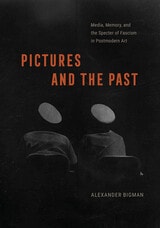
Pictures and the Past
Media, Memory, and the Specter of Fascism in Postmodern ArtAlexander Bigman
University of Chicago Press, 2024
A fresh take on the group of artists known as the Pictures Generation, reinterpreting their work as haunted by the history of fascism, the threat of its return, and the effects of its recurring representation in postwar American culture.
The artists of the Pictures Generation, converging on New York City in the late 1970s, indelibly changed the shape of American art. Rebelling against abstraction, they borrowed liberally from the aesthetics of mass media and sometimes the work of other artists. It has long been thought that the group’s main contribution was to upend received conceptions of authorial originality. In Pictures and the Past, however, art critic and historian Alexander Bigman shows that there is more to this moment than just the advent of appropriation art. He presents us with a bold new interpretation of the Pictures group’s most significant work, in particular its recurring evocations of fascist iconography.
In the wake of the original Pictures show, curated by Douglas Crimp in 1977, artists such as Sarah Charlesworth, Jack Goldstein, Troy Brauntuch, Robert Longo, and Gretchen Bender raised pressing questions about what it means to perceive the world historically in a society saturated by images. Bigman argues that their references to past cataclysms—to the violence wrought by authoritarianism and totalitarianism—represent not only a coded form of political commentary about the 1980s but also a piercing reflection on the nature of collective memory. Throughout, Bigman situates their work within a larger cultural context including parallel trends in music, fashion, cinema, and literature. Pictures and the Past probes the shifting relationships between art, popular culture, memory, and politics in the 1970s and ’80s, examining how the specter of fascism loomed for artists then—and the ways it still looms for us today.
Picturing
Edited by Rachael Z. DeLue
Terra Foundation for American Art, 2016
The first volume in a new series on critical concerns in the history of American art, Picturing brings together essays by a distinguished international group of scholars who discuss the creation and consumption of images from the early modern period through the end of the twentieth century. Some of the contributions focus on art critical texts, like Gertrude Stein’s portrait of Cézanne, while others have as their point of departure particular artworks, from a portrait of Benjamin Franklin to Eadweard Muybridge’s nineteenth-century photographs of the California Coast. Works that addressed images and image making were not confined to the academy; they spilled out into poetry, literature, theater, and philosophy, and the essays’ considerations likewise range freely, from painting to natural history illustrations, travel narratives, and popular fiction. Together, the contributions demonstrate a rich deliberation that thoroughly debunks the notion that American art is merely derivative of a European tradition.
With a wealth of new research and full-color illustrations, Picturing significantly expands the terrain of scholarship on American art.
Pope.L
Showing Up to WithholdThe Renaissance Society at the University of Chicago
University of Chicago Press, 2014
Published to accompany his wonderfully inscrutable exhibition Forlesen at the Renaissance Society at the University of Chicago, Pope.L: Showing Up to Withhold is simultaneously an artist’s book and a monograph. In addition to reproductions of a number of his most recent artworks, it includes images of significant works from the past decade, and presents a forum for reflection and analysis on art making today with contributions by renowned critics and scholars, including Lawrie Balfour, Nick Bastis, Lauren Berlant, and K. Silem Mohammad.