95 books match the query 'Art & Politics' and 7 start with p

cover of Phenomenology for Actors: Theatre-Making and the Question of Being

Phenomenology for Actors

Theatre-Making and the Question of Being

Daniel Johnston

Intellect Books, 2021

A valuable new touchstone for phenomenology and performance as research.

In this book, Daniel Johnston examines how phenomenology can describe, analyze, and inspire theater-making. Each chapter introduces themes to guide the creative process through objects, bodies, spaces, time, history, freedom, and authenticity. Key examples in the work are drawn from Chekhov’s The Cherry Orchard, Sophocles’ Antigone, and Shakespeare’s Hamlet. Practical tasks throughout explore how the theatrical event can offer unique insights into being and existence, as Johnston’s philosophical perspective shines a light on broader existential issues of being. In this way, the book makes a bold contribution to the study of acting as an embodied form of philosophy and reveals how phenomenology can be a rich source of creativity for actors, directors, designers, and collaborators in the performance process.

Brimming with insight into the practice and theory of acting, this original new work stimulates new approaches to rehearsal and sees theater-making as capable of speaking back to philosophical discourse.
[more]
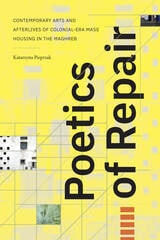
cover of Poetics of Repair: Contemporary Arts and Afterlives of Colonial-Era Mass Housing in the Maghreb

Poetics of Repair

Contemporary Arts and Afterlives of Colonial-Era Mass Housing in the Maghreb

Katarzyna Pieprzak

Duke University Press, 2025
Today, most colonial-era modernist mass housing is seen as fundamentally broken: crumbling concrete spaces of social alienation and containment that fractured societies both then and now. In Poetics of Repair, Katarzyna Pieprzak examines how contemporary visual, literary, and performance art of the Maghreb has the potential to change the terms, histories, and imagined futures of mass housing in North Africa and France. Pieprzak dives deeply into contemporary art engagements with three mass housing sites that epitomize the French colonial geography of modernist architecture in the Maghreb. She identifies in this art what she names a transformative “poetics of repair”: a practice that conjoins, puts in relation, or simply brings closer together broken materials, separated people, and severed timelines. Reading art and its engagements with mass housing, Pieprzak argues, has the potential to unmoor established knowledge and rehearse the tensions and productive ambiguities inherent to practices of constitution and revision. She demonstrates that such a reading practice is a step toward a reparative epistemology for mass housing that turns sites of wreckage and alienation into sites of possible solidarities and new formulations of history and experience.
[more]
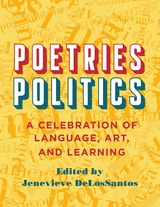
cover of Poetries - Politics: A Celebration of Language, Art, and Learning

Poetries - Politics

A Celebration of Language, Art, and Learning

Jenevieve DeLosSantos

Rutgers University Press, 2023

Poetries – Politics: A Celebration of Language, Art, and Learning celebrates the best of innovative humanities pedagogy and creative graphic design. Designed and implemented during a time of political divisiveness, the Poetries – Politics project created a space of inviting, multilingual walls on the Rutgers campus, celebrating diversity, community, and cross-cultural exchange. This book, like the original project, provides a platform for the incredible generative power of student-led work. Essays feature the perspectives of three students and professors originally involved in the project, reflecting on their learning and exploring the works they selected for the original exhibition. The essays lead to a beautifully illustrated catalogue of the original student designs.

Reproduced in full color and with the accompanying poems in both their original language and a translation, this catalogue commemorates the incredible creative spirit of the project and provides a new way of contemplating these great poetic works.
[more]
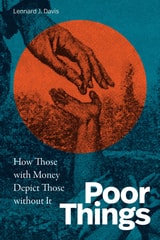
cover of Poor Things: How Those with Money Depict Those without It

Poor Things

How Those with Money Depict Those without It

Lennard J. Davis

Duke University Press, 2024
For generations most of the canonical works that detail the lives of poor people have been created by rich or middle-class writers like Charles Dickens, John Steinbeck, or James Agee. This has resulted in overwhelming depictions of poor people as living abject, violent lives in filthy and degrading conditions. In Poor Things, Lennard J. Davis labels this genre “poornography”: distorted narratives of poverty written by and for the middle and upper classes. Davis shows how poornography creates harmful and dangerous stereotypes that build barriers to social justice and change. To remedy this, Davis argues, poor people should write realistic depictions of themselves, but because of representational inequality they cannot. Given the obstacles to the poor accessing the means of publication, Davis suggests that the work should, at least for now, be done by “transclass” writers who were once poor and who can accurately represent poverty without relying on stereotypes and clichés. Only then can the lived experience of poverty be more fully realized.
[more]
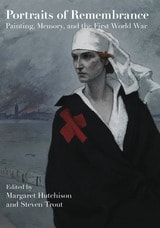
cover of Portraits of Remembrance: Painting, Memory, and the First World War

Portraits of Remembrance

Painting, Memory, and the First World War

Edited by Margaret Hutchison and Steven Trout

University of Alabama Press, 2020

Interdisciplinary collection of essays on fine art painting as it relates to the First World War and commemoration of the conflict
 
Although photography and moving pictures achieved ubiquity during the First World War as technological means of recording history, the far more traditional medium of paint­ing played a vital role in the visual culture of combatant nations. The public’s appetite for the kind of up-close frontline action that snapshots and film footage could not yet pro­vide resulted in a robust market for drawn or painted battle scenes.
 
Painting also figured significantly in the formation of collective war memory after the armistice. Paintings became sites of memory in two ways: first, many governments and communities invested in freestanding pan­oramas or cycloramas that depicted the war or featured murals as components of even larger commemorative projects, and second, certain paintings, whether created by official artists or simply by those moved to do so, emerged over time as visual touchstones in the public’s understanding of the war.
 
Portraits of Remembrance: Painting, Memory, and the First World War examines the relationship between war painting and collective memory in Australia, Austria, Belgium, Canada, Croatia, France, Germany, Great Britain, New Zealand, Russia, Serbia, Turkey, and the United States. The paintings discussed vary tremendously, ranging from public murals and panoramas to works on a far more intimate scale, including modernist masterpieces and crowd-pleasing expressions of sentimentality or spiritualism. Contribu­tors raise a host of topics in connection with the volume’s overarching focus on memory, including national identity, constructions of gender, historical accuracy, issues of aesthetic taste, and connections between painting and literature, as well as other cultural forms.
 
[more]
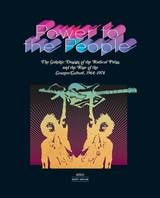
cover of Power to the People: The Graphic Design of the Radical Press and the Rise of the Counter-Culture, 1964-1974

Power to the People

The Graphic Design of the Radical Press and the Rise of the Counter-Culture, 1964-1974

Geoff Kaplan

University of Chicago Press, 2013
Though we think of the 1960s and the early ‘70s as a time of radical social, cultural, and political upheaval, we tend to picture the action as happening on campuses and in the streets. Yet the rise of the underground newspaper was equally daring and original. Thanks to advances in cheap offset printing, groups involved in antiwar, civil rights, and other social liberation issues began to spread their messages through provocatively designed newspapers and broadsheets. This vibrant new media was essential to the counterculture revolution as a whole—helping to motivate the masses and proliferate ideas. Power to the People presents more than 700 full-color images and excerpts from these astonishing publications, many of which have not been seen since they were first published almost fifty years ago.
 
From the psychedelic pages of the Oracle, Haight-Ashbury’s paper of choice, to the fiery editorials of the Black Panther Party Paper, these papers were remarkable for their editors’ fervent belief in freedom of expression and their DIY philosophy. They were also extraordinary for their graphic innovations. Experimental typography and wildly inventive layouts reflect an alternative media culture as much informed by the space age, television, and socialism as it was by the great trinity of sex, drugs, and rock ‘n’ roll. Assembled by renowned graphic designer Geoff Kaplan, Power to the People pays homage in its layout to the radical press. Beyond its unparalleled images, Power to the People includes essays by Gwen Allen, Bob Ostertag, and Fred Turner, as well as a series of recollections edited by Pamela M. Lee, all of which comment on the critical impact of the alternative press in the social and popular movements of those turbulent years. Power to the People treats the design practices of that moment as activism in its own right that offers a vehement challenge to the dominance of official media and a critical form of self-representation.
 
No other book surveys in such variety the highly innovative graphic design of the underground press, and certainly no other book captures the era with such an unmatched eye toward its aesthetic and look. Power to the People is not just a major compendium of art from the ’60s and ’70s—it showcases how the radical media graphically fashioned the image of a countercultural revolution that still resounds to this day.

[more]
cover of Powers of No: The Infra Noir Surrealist Group

Powers of No

The Infra Noir Surrealist Group

Catherine L. Hansen

University of Minnesota Press, 2026

How five dissident poets applied Surrealism to everyday life under totalitarian rule

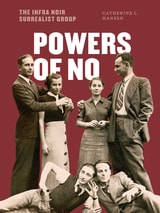
A collective biography of the Surrealist group Infra Noir, Powers of No reveals an important chapter in the history of the postwar European avant-garde. Detailing the group’s innovative program for cultivating community and political resistance, Catherine L. Hansen examines how its five members reimagined Surrealism as a means to endure life under totalitarianism and war.

Encompassing the careers and friendships of Gherasim Luca, Gellu Naum, Trost, Paul Păun, and Virgil Teodorescu, Powers of No is the first English-language book about this Francophone Romanian group active between 1941 and 1947. The members of Infra Noir created radical art and publications that attracted the attention of André Breton and other central figures in the wider Surrealist movement. Charting their course from the Bucharest avant-garde amid the rising tide of fascism through the turbulent intellectual and political scene of postwar France and Stalinist repression, Hansen unpacks the concepts this group developed, which envisioned new possibilities for emancipatory thought and praxis.

Grounded in a wealth of archival materials and original translations, Powers of No situates the unique legacy of Infra Noir’s revolutionary project among the various intellectual currents of a tumultuous era. Establishing Infra Noir as more than an obscure clique of dissident poets and artists, this book presents their work as a repertoire of lessons for resisting authoritarian oppression and avoiding despair even under the harshest political conditions.

Retail e-book files for this title are screen-reader friendly with images accompanied by short alt text and/or extended descriptions.

[more]