Results by title
138 books match the query 'Art and society' and 6 start with p
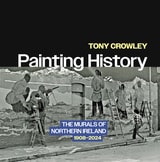
Painting History
The Murals of Northern Ireland, 1908–2024Tony Crowley
Amherst College Press, 2025
In Painting History, Tony Crowley provides a detailed analysis of the complex tradition of muralism in the context of the history that produced it, with particular attention given to the cultural politics of this remarkable form. The book also raises and discusses a series of theoretical questions about murals and muralism that transcend Northern Ireland: issues of propriety and legality, form and content, authority and censorship. The work ends with a consideration of the future of the murals in a still polarized but changing region.
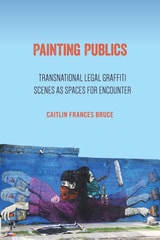
Painting Publics
Transnational Legal Graffiti Scenes as Spaces for EncounterCaitlin Frances Bruce
Temple University Press, 2019
Public art is a form of communication that enables spaces for encounters across difference. These encounters may be routine, repeated, or rare, but all take place in urban spaces infused with emotion, creativity, and experimentation. In Painting Publics, Caitlin Bruce explores how various legal graffiti scenes across the United States, Mexico, and Europe provide diverse ways for artists to navigate their changing relationships with publics, institutions, and commercial entities.
Painting Publics draws on a combination of interviews with more than 100 graffiti writers as well as participant observation, and uses critical and rhetorical theory to argue that graffiti should be seen as more than counter-cultural resistance. Bruce claims it offers resources for imagining a more democratic city, one that builds and grows from personal relations, abandoned or under-used spaces, commercial sponsorship, and tacit community resources. In the case of Mexico, Germany, and France, there is even some state support for the production and maintenance of civic education through visual culture.
In her examination of graffiti culture and its spaces of inscription, Bruce allows us to see moments where practitioners actively reckon with possibility.
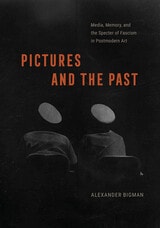
Pictures and the Past
Media, Memory, and the Specter of Fascism in Postmodern ArtAlexander Bigman
University of Chicago Press, 2024
A fresh take on the group of artists known as the Pictures Generation, reinterpreting their work as haunted by the history of fascism, the threat of its return, and the effects of its recurring representation in postwar American culture.
The artists of the Pictures Generation, converging on New York City in the late 1970s, indelibly changed the shape of American art. Rebelling against abstraction, they borrowed liberally from the aesthetics of mass media and sometimes the work of other artists. It has long been thought that the group’s main contribution was to upend received conceptions of authorial originality. In Pictures and the Past, however, art critic and historian Alexander Bigman shows that there is more to this moment than just the advent of appropriation art. He presents us with a bold new interpretation of the Pictures group’s most significant work, in particular its recurring evocations of fascist iconography.
In the wake of the original Pictures show, curated by Douglas Crimp in 1977, artists such as Sarah Charlesworth, Jack Goldstein, Troy Brauntuch, Robert Longo, and Gretchen Bender raised pressing questions about what it means to perceive the world historically in a society saturated by images. Bigman argues that their references to past cataclysms—to the violence wrought by authoritarianism and totalitarianism—represent not only a coded form of political commentary about the 1980s but also a piercing reflection on the nature of collective memory. Throughout, Bigman situates their work within a larger cultural context including parallel trends in music, fashion, cinema, and literature. Pictures and the Past probes the shifting relationships between art, popular culture, memory, and politics in the 1970s and ’80s, examining how the specter of fascism loomed for artists then—and the ways it still looms for us today.
Picturing
Edited by Rachael Z. DeLue
Terra Foundation for American Art, 2016
The first volume in a new series on critical concerns in the history of American art, Picturing brings together essays by a distinguished international group of scholars who discuss the creation and consumption of images from the early modern period through the end of the twentieth century. Some of the contributions focus on art critical texts, like Gertrude Stein’s portrait of Cézanne, while others have as their point of departure particular artworks, from a portrait of Benjamin Franklin to Eadweard Muybridge’s nineteenth-century photographs of the California Coast. Works that addressed images and image making were not confined to the academy; they spilled out into poetry, literature, theater, and philosophy, and the essays’ considerations likewise range freely, from painting to natural history illustrations, travel narratives, and popular fiction. Together, the contributions demonstrate a rich deliberation that thoroughly debunks the notion that American art is merely derivative of a European tradition.
With a wealth of new research and full-color illustrations, Picturing significantly expands the terrain of scholarship on American art.
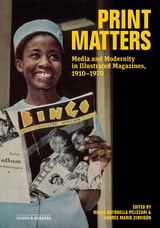
Print Matters
Media and Modernity in Illustrated Magazines, 1910–1970Maria Antonella Pelizzari
J. Paul Getty Trust, The, 2025
In the early to mid-twentieth century, the vast majority of printed photographs appeared in the pages of illustrated magazines. Publications such as Life, China Pictorial, Drum, Picture Post, and Ebony did more than showcase photographs; they crafted visual narratives by combining images, text, and graphics into influential cultural artifacts. These periodicals shaped public perception and mass media consensus like the Internet does today, bringing a shared visual experience to homes and newsstands around the world.
The essays in this volume delve into the technologies and visual strategies behind these publications, showing how their layouts were affected by political, commercial, editorial, and artistic factors leading up to World War II. The commentaries also explore how democracy, dictatorships, colonization, and modernity at large gave rise to experimental magazine designs, turning avant-garde art and lifestyle reporting into popular formats. Featuring over 150 images, Print Matters traces how illustrated magazines evolved across countries and continents, offering new insights into their history and enduring impact on culture and society.
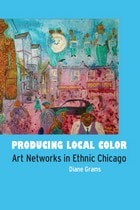
Producing Local Color
Art Networks in Ethnic ChicagoDiane Grams
University of Chicago Press, 2010
In big cities, major museums and elite galleries tend to dominate our idea of the art world. But beyond the cultural core ruled by these moneyed institutions and their patrons are vibrant, local communities of artists and art lovers operating beneath the high-culture radar. Producing Local Color is a guided tour of three such alternative worlds that thrive in the Chicago neighborhoods of Bronzeville, Pilsen, and Rogers Park.
These three neighborhoods are, respectively, historically African American, predominantly Mexican American, and proudly ethnically mixed. Drawing on her ethnographic research in each place, Diane Grams presents and analyzes the different kinds of networks of interest and support that sustain the making of art outside of the limelight. And she introduces us to the various individuals—from cutting-edge artists to collectors to municipal planners—who work together to develop their communities, honor their history, and enrich the experiences of their neighbors through art. Along with its novel insights into these little examined art worlds, Producing Local Color also provides a thought-provoking account of how urban neighborhoods change and grow.