109 books match the query 'Artificial intelligence' and 5 start with p

cover of Partiality, Modality and Nonmonotonicity

Partiality, Modality and Nonmonotonicity

Patrick Doherty

CSLI, 1996

This edited volume of articles provides a state-of-the-art description of research in logic-based approaches to knowledge representation which combines approaches to reasoning with incomplete information that include partial, modal, and nonmonotonic logics. The collection contains two parts: foundations and case studies. The foundations section provides a general overview of partiality, multi-valued logics, use of modal logic to model partiality and resource-limited inference, and an integration of partial and modal logics. The case studies section provides specific studies of issues raised in the foundations section. Several of the case studies integrate modal and partial modal logics with nonmonotonic logics. Both theoretical and practical aspects of such integration are considered. Knowledge representation issues such as default reasoning, theories of action and change, reason maintenance, awareness, and automation of nonmonotonic reasoning are covered.
[more]
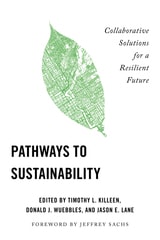
cover of Pathways to Sustainability: Collaborative Solutions for a Resilient Future

Pathways to Sustainability

Collaborative Solutions for a Resilient Future

Edited by Timothy L. Killeen, Donald J. Wuebbles, and Jason E. Lane

University of Illinois Press, 2025

In an era defined by unprecedented environmental challenges and rapid societal change, how can we build a sustainable and resilient future? In this collection, the editors bring together groundbreaking insights and inspiring stories from around the globe, illuminating how innovative partnerships across sectors and borders are driving meaningful progress toward sustainability. Contributors from science, business, non-governmental organizations, and university leadership engage across their areas of expertise to discuss how to apply cutting-edge research toward understanding, mitigating, and adapting to today’s alarming environmental stresses. Throughout, the essayists showcase breakthroughs in sustainability science while providing a blueprint for creating collaborations, expanding networks, and connecting with new markets. Essential reading for sustainability leaders, educators, policymakers, and change-makers everywhere, this volume offers a visionary yet practical roadmap for harnessing the power of collaboration to advance practical solutions necessary to ensure a thriving planet for future generations. Expert and interdisciplinary, Pathways to Sustainability focuses on human capacity building and innovation to explore holistic solutions to climate change, unsustainable resource consumption, and other inevitable challenges of our time. Contributors: Nicole Arbour, Rebecca T. Barnes, Kyle Blount, Kayla Boparai, Caleb S. Brooks, Benjamin B. Campion, Christopher Castle, William L. Chadderton, Kenneth T. Christensen, Emily M. Clegg, Asher Cohen, Jonathan Coppess, Nathan L. Cummins, John D. Den Uyl, Miranda N. Domico, Francina Dominguez, Patrick J. Doran, Kelvin K. Droegemeier, Pengyue Du, Luis Gomez Echeverri, Brian Fath, John Ferry, Trent W. Ford, Regina Mae Francia, Georgie B. Geraghty, Janet Gooch, Timothy P. Grunloh, Kaiyu Guan, Luiz Gutierrez, Sam S. Haapaniemi, Julian Heiss, Barb Helland, Catherine Hurley, Atul K. Jain, Paul Kearns, Timothy L. Killeen, Rao Kotamarthi, Jason E. Lane, Wendy Larner, John T. Legge, L. Ruby Leung, Peiyuan Li, Leila Loupis, Josephine M. Malonza, Mark Manns, Lia Merminga, Maria J. Molina, David Muchangi Mugo, Meridith F. Muth, Selvaprabu Nadarajah, Cristina Negri, Pratik Patil, Andreas F. Prein, Ziqi Qin, Fany Ramos Quispe, Jonathan Radcliffe, Omer Rana, Dan Reed, Alyssa Rodway, Christine Rovelli, Elena Rovenskaya, Gabriella Pinheiro Servi, Gavin Shaddick, John Shalf, Ashish Sharma, Bjorn Stevens, Tih-Fen Ting, Dennis Todey, John Towns, Andrew J. Tucker, Albert van Jaarsveld, Carolina Veiga, Abhinav Wadhwa, Peter W. Wangai, Melissa Widhalm, Aaron B. Wilson, Molly Woloszyn, Sicheng Wu, Donald J. Wuebbles, and Joel Zavala
[more]
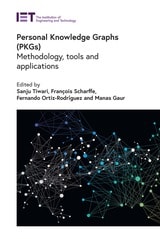
cover of Personal Knowledge Graphs (PKGs): Methodology, tools and applications

Personal Knowledge Graphs (PKGs)

Methodology, tools and applications

Sanju Tiwari

The Institution of Engineering and Technology, 2023

Since the development of the semantic web, knowledge graphs (KGs) have been used by search engines, knowledge-engines and question-answering services as well as social networks. A knowledge graph, also known as a semantic network, represents and illustrates a network of real-world entities such as objects, events, situations, or concepts and the relationships between them. This information is usually stored in a graph database and visualized as a graph structure, prompting the term "knowledge graph". Knowledge graphs structure the information of entities, their properties and the relation between them.
[more]
cover of Perspectives on Contexts

Perspectives on Contexts

Edited by Paolo Bouquet, Luciano Serafini, and Richmond H. Thomason

CSLI, 2008

Most human thinking is thoroughly informed by context but, until recently, theories of reasoning have concentrated on abstract rules and generalities that make no reference to this crucial factor. Perspectives on Contexts brings together essays from leading cognitive scientists to forge a vigorous interdisciplinary understanding of the contextual phenomenon. Applicable to human and machine cognition in philosophy, artificial intelligence, and psychology, this volume is essential to the current renaissance in thinking about context.

[more]
cover of Putting Linguistics into Speech Recognition: The Regulus Grammar Compiler

Putting Linguistics into Speech Recognition

The Regulus Grammar Compiler

Manny Rayner, Beth Ann Hockey, and Pierrette Bouillon

CSLI, 2006

Most computer programs that analyze spoken dialogue use a spoken command grammar, which limits what the user can say when talking to the system. To make this process simpler, more automated, and effective for command grammars even at initial stages of a project, the Regulus grammar compiler was developed by a consortium of experts—including NASA scientists. This book presents a complete description of both the practical and theoretical aspects of Regulus and will be extremely helpful for students and scholars working in computational linguistics as well as software engineering.
[more]