Results by title
208 books match the query 'Autobiography' and 6 start with p
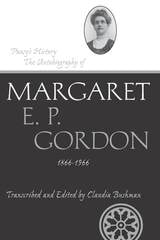
Pansy's History
The Autobiography of Margaret E. P. Gordon, 1866-1966Claudia L. Bushman
Utah State University Press, 2011
Margaret "Pansy" Gordon's life covered a remarkable span of years and territory. She lived one century, and the years took her from England to residences in British Columbia, Salt Lake City, and an Ojibway village on Georgian Bay; back to Utah and then Canada to homes at the shore of Bear Lake, on an Alberta farm, and in a prairie town; and to Los Angeles for the last decades of her life. She had gone to British Columbia as the daughter of an Anglican missionary to the Tsimshian Indians. She lived in Los Angeles as a Mormon missionary assigned to work as a genealogist. Her personal journey through repeated frontier adventures, religious service, and economic challenges is as worth noting as where she went, but it would be far less engaging if she did not write about it so well. Her memory for detail and her felicity in putting it to paper will reward those who delve into her "Family History," as she titled her memoir. Claudia L. Bushman, descendant of Pansy Gordon, author of numerous books, taught American studies at Columbia University for many years and taught Mormon studies at Claremont Graduate University from 2008 to 2011. She has included letters and other documents that complement this memoir.
Personally Speaking
Experience as Evidence in Academic DiscourseCandace Spigelman
Southern Illinois University Press, 2004
Responding to contemporary discussion about using personal accounts in academic writing, Personally Speaking: Experience as Evidence in Academic Discourse draws on classical and current rhetorical theory, feminist theory, and relevant examples from both published writers and first-year writing students to illustrate the advantages of blending experiential and academic perspectives.
Candace Spigelman examines how merging personal and scholarly worldviews produces useful contradictions and contributes to a more a complex understanding in academic writing. This rhetorical move allows for greater insights than the reading or writing of experiential or academic modes separately does. Personally Speaking foregrounds the semi-fictitious nature of personal stories and the rhetorical possibilities of evidence as Spigelman provides strategies for writing instructors who want to teach personal academic argument while supplying practical mechanisms for evaluating experiential claims.
The volume seeks to complicate and intensify disciplinary debates about how compositionists should write for publication and what kinds of writing should be taught to composition students. Spigelman not only supplies evidence as to why the personal can count as evidence but also relates how to use it effectively by including student samples that reflect particular features of personal writing. Finally, she lays the groundwork to move narrative from its current site as confessional writing to the domain of academic discourse.
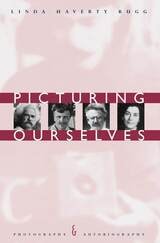
Picturing Ourselves
Photography and AutobiographyLinda Haverty Rugg
University of Chicago Press, 1997
Rugg tracks photography's impact on the formation of self-image through the study of four literary autobiographers concerned with the transformative power of photography. Obsessed with self-image, Mark Twain and August Strindberg both attempted (unsuccessfully) to integrate photographs into their autobiographies. While Twain encouraged photographers, he was wary of fakery and kept a fierce watch on the distribution of his photographic image. Strindberg, believing that photographs had occult power, preferred to photograph himself.
Because of their experiences under National Socialism, Walter Benjamin and Christa Wolf feared the dangerously objectifying power of photographs and omitted them from their autobiographical writings. Yet Benjamin used them in his photographic conception of history, which had its testing ground in his often-ignored Berliner Kindheit um 1900. And Christa Wolf's narrator in Patterns of Childhood attempts to reclaim her childhood from the Nazis by reconstructing mental images of lost family photographs.
Confronted with multiple and conflicting images of themselves, all four of these writers are torn between the knowledge that texts, photographs, and indeed selves are haunted by undecidability and the desire for the returned glance of a single self.
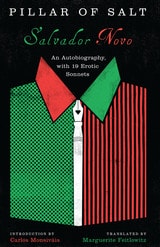
Pillar of Salt
An Autobiography, with 19 Erotic SonnetsBy Salvador Novo, Translated by Marguerite Feitlowitz, Introduction by Carlos Monsiváis
University of Texas Press, 2014
Written with exquisite sensitivity and wit, this memoir by one of Mexico’s foremost men of letters describes coming of age during the violence of the Mexican Revolution and “living dangerously” as an openly homosexual man in a brutally machista society.
Salvador Novo (1904–1974) was a provocative and prolific cultural presence in Mexico City through much of the twentieth century. With his friend and fellow poet Xavier Villaurrutia, he cofounded Ulises and Contemporáneos, landmark avant-garde journals of the late 1920s and 1930s. At once “outsider” and “insider,” Novo held high posts at the Ministries of Culture and Public Education and wrote volumes about Mexican history, politics, literature, and culture. The author of numerous collections of poems, including XX poemas, Nuevo amor, Espejo, Dueño mío, and Poesía 1915–1955, Novo is also considered one of the finest, most original prose stylists of his generation.
Pillar of Salt is Novo’s incomparable memoir of growing up during and after the Mexican Revolution; shuttling north to escape the Zapatistas, only to see his uncle murdered at home by the troops of Pancho Villa; and his initiations into literature and love with colorful, poignant, complicated men of usually mutually exclusive social classes. Pillar of Salt portrays the codes, intrigues, and dynamics of what, decades later, would be called “a gay ghetto.” But in Novo’s Mexico City, there was no name for this parallel universe, as full of fear as it was canny and vibrant. Novo’s memoir plumbs the intricate subtleties of this world with startling frankness, sensitivity, and potential for hilarity. Also included in this volume are nineteen erotic sonnets, one of which was long thought to have been lost.
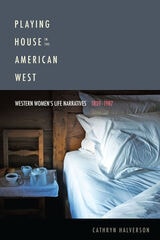
Playing House in the American West
Western Women's Life Narratives, 1839–1987Cathryn Halverson
University of Alabama Press, 2013
How domestic life shaped identity, gender, and power in the American West
The controlling metaphor Cathryn Halverson uses in her engrossing study is “playing house.” From Caroline Kirkland and Laura Ingalls Wilder to Willa Cather and Marilynne Robinson, from the mid-nineteenth to the late-twentieth centuries, western authors have persistently embraced wayward or eccentric housekeeping to prove a woman’s difference from western neighbors and eastern readers alike.
The readings in Playing House investigate the surprising textual ends to which westerners turn the familiar terrain of the home: evaluating community; arguing for different conceptions of race and class; and perhaps most especially, resisting traditional gender roles. Western women writers, Halverson argues, render the home as a stage for autonomy, resistance, and imagination rather than as a site of sacrifice and obligation.
The western women examined in Playing House in the American West are promoted and read as representatives of a region, as insiders offering views of distant and intriguing ways of life, even as they conceive of themselves as outsiders. By playing with domestic conventions, they recast the region they describe, portraying the West as a place that fosters female agency, individuality, and subjectivity.
Public History, Private Stories
Italian Women’s AutobiographyGraziella Parati
University of Minnesota Press, 1996
Explores the way Italian women writers craft identities through writing.
In this important volume, Graziella Parati examines the ways in which Italian women writers articulate their identities through autobiography—a public act that is also the creation of a private life. Considering autobiographical writings by five women writers from the seventeenth century to the present, Parati draws important connections between self-writing and the debate over women’s roles, both traditional and transgressive.
Parati considers the first prose autobiography written by an Italian woman -Camilla Faà Gonzaga’s 1622 memoir—as her beginning point, citing it as a central “pre-text.” In her memoir, Gonzaga makes explicit her conflict over the public silence imposed on her, yet succeeds in writing herself into history through self-narrative. Parati then examines Enif Robert’s autobiography, in which Robert strives to enter the public sphere of the post-World War I futurist movement by writing about her fight to overcome cancer of the uterus. Next, Parati considers Fausta Cialente’s life story, an account of her family's life in Trieste from World War I through the fascist era, as well as the narrative in which Rita Levi Montalcini describes her life as a woman, a Nobel-Prize winning scientist, and a Jew who lived under fascism in the thirties and forties. Finally, Parati analyzes Luisa Passerini's look back on her involvement with the student movement of 1968. Through her discussion of these women’s writings, Parati demonstrates the complex negotiations over identity contained within them, negotiations that challenge dichotomies between male and female, maternal and paternal, and private and public. Public History, Private Stories is a compelling exploration of the disparate identities created by these women through the act of writing autobiography.