Results by title
66 books match the query 'Biblical teaching' and 5 start with p
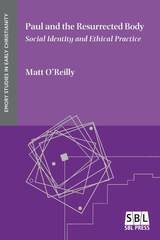
Paul and the Resurrected Body
Social Identity and Ethical PracticeMatt O'Reilly
SBL Press, 2020
A new reading of Pauline theology, ethics, and eschatology grounded in social-identity theory and sociorhetorical criticism
Readers often think of Paul’s attitude toward the resurrection of the body in individual terms: a single body raised as the climax of an individual’s salvation. In Paul and the Resurrected Body: Social Identity and Ethical Practice, Matt O’Reilly makes the case that, for Paul, the social dimension of future bodily resurrection is just as important, if not more so. Through a close reading of key texts in the letters to the Corinthians, Romans, and Philippians, O’Reilly argues that resurrection is integral to Paul’s understanding of Christian social identity. In Paul’s theological reasoning, a believer’s hope for the future depends on being identified as part of the people of God who will be resurrected.
Features
- A clarification of the eschatological basis for Paul’s ethical expectations
- Exploration of the social significance of Paul’s theological reasoning
- An integration of ancient rhetorical theory with contemporary social-identity theory
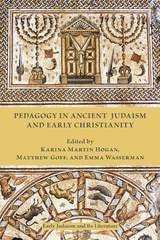
Pedagogy in Ancient Judaism and Early Christianity
Karina Martin Hogan
SBL Press, 2017
Engage fourteen essays from an international group of experts
There is little direct evidence for formal education in the Bible and in the texts of Second Temple Judaism and early Christianity. At the same time, pedagogy and character formation are important themes in many of these texts. This book explores the pedagogical purpose of wisdom literature, in which the concept of discipline (Hebrew musar) is closely tied to the acquisition of wisdom. It examines how and why the concept of musar came to be translated as paideia (education, enculturation) in the Greek translation of the Hebrew Bible (Septuagint), and how the concept of paideia was deployed by ancient Jewish authors writing in Greek. The different understandings of paideia in wisdom and apocalyptic writings of Second Temple Judaism are this book's primary focus. It also examines how early Christians adapted the concept of paideia, influenced by both the Septuagint and Greco-Roman understandings of this concept.
Features
Poverty, Law, and Divine Justice in Persian and Hellenistic Judah
Johannes Unsok Ro
SBL Press, 2018
A view of Persian and Hellenistic Judean communities through theological and socioeconomic lenses
Johannes Unsok Ro employs philological, historical, and sociological approaches to investigate the close connections between socioeconomic structures, social inequality, and theological developments in the Judean communities in Persian- and Hellenistic-era Palestine. Ro contends that competing points of view from communities of lay returnees, priestly returnees, and communities of resident Judeans and Samaritans were juxtaposed within the Hebrew Bible, which took shape during the postexilic period. By exploring issues such as the relationship between the shaping of the canon and literacy in the Judean community, the term strangers in the biblical law codes, the socioeconomic structures of Judean communities reflected in the biblical law codes, the development of the theological concept of divine punitive justice, the piety of the poor in certain psalms, and the concept of poverty in the Dead Sea Scrolls, Ro illustrates that the communities behind each text and its redactions can be ascertained through sociological and theological lenses.
Features
- Demonstration that a theology of the poor materialized orally among the poor but found written expression among Levites
- Insight into the socioeconomic and theological concerns of the authorial groups behind various biblical law codes
- A case that biblical “poverty” sometimes refers to humility and a theologically reflected consciousness of lowliness toward God

Priests and Cults in the Book of the Twelve
Lena-Sofia Tiemeyer
SBL Press, 2016
Key essays that explore a range of attitudes toward clergy and ritual
This book discusses the depictions of the cult and its personnel in the twelve prophetic books commonly referred to as the Book of the Twelve or the Minor Prophets. The articles in the volume explore the following questions: How did these prophetic writers envision the priests and the Levites? What did they think about the ritual aspects of ancient Israelite faith, including not only the official temple cult in Jerusalem but also cultic expressions outside the capital? What, in their views, characterized a faithful priest and what should the relationship be between his cultic performance and the ways in which he lived his life? How does the message of each individual author fit in with the wider Israelite traditions? Finally, who were these prophetic authors, in which historical contexts did they live and work, and what stylistic tools did they use to communicate their message?
Features:
Prophets Male and Female
Gender and Prophecy in the Hebrew Bible, the Eastern Mediterranean, and theJonathan Stökl
SBL Press, 2013