384 books match the query 'Black Studies (Global)' and 12 start with p
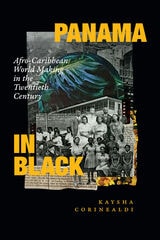
cover of Panama in Black: Afro-Caribbean World Making in the Twentieth Century

Panama in Black

Afro-Caribbean World Making in the Twentieth Century

Kaysha Corinealdi

Duke University Press, 2022
In Panama in Black, Kaysha Corinealdi traces the multigenerational activism of Afro-Caribbean Panamanians as they forged diasporic communities in Panama and the United States throughout the twentieth century. Drawing on a rich array of sources including speeches, yearbooks, photographs, government reports, radio broadcasts, newspaper editorials, and oral histories, Corinealdi presents the Panamanian isthmus as a crucial site in the making of an Afro-diasporic world that linked cities and towns like Colón, Kingston, Panamá City, Brooklyn, Bridgetown, and La Boca. In Panama, Afro-Caribbean Panamanians created a diasporic worldview of the Caribbean that privileged the potential of Black innovation. Corinealdi maps this innovation by examining the longest-running Black newspaper in Central America, the rise of civic associations created to counter policies that stripped Afro-Caribbean Panamanians of citizenship, the creation of scholarship-granting organizations that supported the education of Black students, and the emergence of national conferences and organizations that linked anti-imperialism and Black liberation. By showing how Afro-Caribbean Panamanians used these methods to navigate anti-Blackness, xenophobia, and white supremacy, Corinealdi offers a new mode of understanding activism, community, and diaspora formation.
[more]
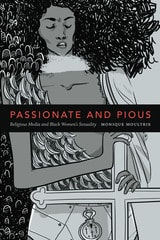
cover of Passionate and Pious: Religious Media and Black Women's Sexuality

Passionate and Pious

Religious Media and Black Women's Sexuality

Monique Moultrie

Duke University Press, 2018
In Passionate and Pious Monique Moultrie explores the impact of faith-based sexual ministries on black women's sexual agency to trace how these women navigate sexuality, religious authority, and their spiritual walk with God. Providing churchwomen a space to candidly discuss these issues, these popular ministries exist largely beyond the traditional church, with dialogues about sex taking place in chat rooms and through text messages, social media, email, and other media. Moultrie foregrounds televangelist Juanita Bynum's construction of the black Christian sexual identity these ministries promote while emphasizing how churchwomen reconcile these prescriptive identities with their individual experiences. What does it mean for senior women to exercise sexual agency when their church standing could be questioned? What does celibacy mean for women who experience same-sex desire while believing that such desire goes against God's will? Advancing a womanist sexual ethics, Moultrie reframes biblical interpretations and conceptions of what constitutes a healthy relationship to provide a basis for sexual decision making that does not privilege monogamy or deny female pleasure, thereby calling on black churchwomen to experience responsible and life-enhancing sex.
[more]
cover of Performances of Spiral Time

Performances of Spiral Time

Leda Maria Martins. Translated by Bruna Barros and Jess Oliveira

Duke University Press, 2025
In Performances of Spiral Time, famed Afro-Brazilian thinker Leda Maria Martins theorizes forms of African and African diasporic temporality, corporeality, and space that exist apart from and critique Eurocentric notions of linear time. Martins introduces the notion of “spiral time”—curved and recurrent temporalities materialized in Black corporealities in which the body is the place of the inscription of memory and knowledge. She draws on African and African diasporic philosophy as well as the ritual performance and quotidian practices of Afro-Brazilians, arguing that spiral time is most powerfully expressed by the moving body. Embodied performance—whether manifested as capoeira, Candomblé, or theater—and the influence of oral traditions, sacredness, and ancestrality, cause time and memory to curve and return. With this theorization, Martins not only counters the claim to dominance of Western linear time; she provides a polyvalent and foundational account of African and African diasporic thought and ontology.
[more]
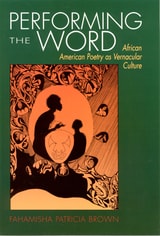
cover of Performing The Word: African American Poetry As Vernacular Culture

Performing The Word

African American Poetry As Vernacular Culture

Brown, Fahamisha Patricia

Rutgers University Press, 1999

Performing the Word offers readers of African American poetry a way of understanding and appreciating body of work that has received little critical attention. While African American literary tradition begins with eighteenth-century poets like Lucy Terry, Jupiter Hammon, and Phillis Wheatley, critical discussions of African American Poetry have been sparse. Aside from a few studies of "major" poets, such as Langston Hughes, Gwendolyn Brooks, Robert Hayden, Rita Dove, or period histories of phenomena such as the Harlem Renaissance, there has been little sustained critical inquiry into African American poetry as a body of literature- until now.

Fahamista Patricia Brown examines elements of African American expressive culture- its language practices, both fold and popular. Her book is an excellent introduction to a diverse group of poets and the common basis of their work in language practices and performativity, in the expressive culture of a people. Performing the Word is an important contribution to the understanding of African American culture and American poetry as a whole.
[more]
cover of Phenomenal Blackness: Black Power, Philosophy, and Theory

Phenomenal Blackness

Black Power, Philosophy, and Theory

Mark Christian Thompson

University of Chicago Press, 2022

This unorthodox account of 1960s Black thought rigorously details the field’s debts to German critical theory and explores a forgotten tradition of Black singularity. 
 
Phenomenal Blackness examines the changing interdisciplinary investments of key mid-century Black writers and thinkers, including the growing interest in German philosophy and critical theory. Mark Christian Thompson analyzes this shift in intellectual focus across the post-war decades, placing Black Power thought in a philosophical context.

Prior to the 1960s, sociologically oriented thinkers such as W. E. B. Du Bois had understood Blackness as a singular set of socio-historical characteristics. In contrast, writers such as Amiri Baraka, James Baldwin, Angela Y. Davis, Eldridge Cleaver, and Malcolm X were drawn to notions of an African essence, an ontology of Black being. With these perspectives, literary language came to be seen as the primary social expression of Blackness. For this new way of thinking, the works of philosophers such as Adorno, Habermas, and Marcuse were a vital resource, allowing for continued cultural-materialist analysis while accommodating the hermeneutical aspects of Black religious thought. Thompson argues that these efforts to reimagine Black singularity led to a phenomenological understanding of Blackness—a “Black aesthetic dimension” wherein aspirational models for Black liberation might emerge.
[more]
cover of Playful Protest: The Political Work of Joy in Latinx Media

Playful Protest

The Political Work of Joy in Latinx Media

Kristie Soares

University of Illinois Press, 2023

Pleasure-based politics in Puerto Rican and Cuban pop culture

Joy is a politicized form of pleasure that goes beyond gratification to challenge norms of gender, sexuality, race, and class. Kristie Soares focuses on the diasporic media of Puerto Rico and Cuba to examine how music, public activist demonstrations, social media, sitcoms, and other areas of culture resist the dominant stories told about Latinx joy. As she shows, Latinx creators compose versions of joy central to social and political struggle and at odds with colonialist and imperialist narratives that equate joy with political docility and a lack of intelligence. Soares builds her analysis around chapters that delve into gozando in salsa music, precise joy among the New Young Lords Party, choteo in the comedy ¿Qué Pasa U.S.A.?, azúcar in the life and death of Celia Cruz, dale as Pitbull’s signature affect, and Alexandria Ocasio-Cortez’s use of silliness to take seriously political violence.

Daring and original, Playful Protest examines how Latinx creators resist the idea that joy only exists outside politics and activist struggle.
[more]
cover of Political Life in the Wake of the Plantation: Sovereignty, Witnessing, Repair

Political Life in the Wake of the Plantation

Sovereignty, Witnessing, Repair

Deborah A. Thomas

Duke University Press, 2019
In 2010, Jamaican police and military forces entered the West Kingston community of Tivoli Gardens to apprehend Christopher “Dudus” Coke, who had been ordered for extradition to the United States on gun and drug-running charges. By the time Coke was detained, somewhere between seventy-five and two hundred civilians had been killed. In Political Life in the Wake of the Plantation, Deborah A. Thomas uses the incursion as a point of departure for theorizing the roots of contemporary state violence in Jamaica and in post-plantation societies in general. Drawing on visual, oral historical, and colonial archives, Thomas traces the long-term legacies of the plantation system and how its governing logics continue to shape and replicate forms of violence. She places affect at the center of sovereignty to destabilize disembodied narratives of liberalism and progress and to raise questions about recognition, repair, and accountability. In tying theories of politics, colonialism, race, and affect together with Jamaica's history, Thomas presents a robust framework for understanding what it means to be human in the plantation's wake.
[more]
cover of Political Theology Reimagined

Political Theology Reimagined

Alex Dubilet and Vincent W. Lloyd, editors

Duke University Press, 2025

Political theology has emerged as an enormously energetic, creative way of exploring the complex relationships between religion, politics, and culture around the world. Political Theology Reimagined centers decolonial, Black, queer, feminist, and Marxist modes of critical practice to offer a cutting-edge vision of the field that foregrounds a political theology animated by both a fascination with and a suspicion of the secular. Among other things, contributors explore how religious ideas, practices, and imaginations are inflected by anti-Blackness, patriarchy, and colonial histories; theorize anew the status of secularization narratives; probe the universality and translatability of conceptual abstractions; and experiment with the powers of genealogy and speculation. In short, they grapple with religion and critique in all their complexity, opening new itineraries in political theology by transforming its fundamental theoretical coordinates. Traversing diverse sites, from South Asia to the Middle East to Indigenous North America, and working across diverse scales, from the national to the planetary to the cosmic, this volume models the future of political theology by pairing rigorous critique with a commitment to collective liberation.

Contributors. Prathama Banerjee, Agata Bielik-Robson, Kirill Chepurin, Alex Dubilet, James Edward Ford III, Lucia Hulsether, Basit Kareem Iqbal, Ada S. Jaarsma, Siobhan Kelly, David Kline, Adam Kotsko, Dana Lloyd, Vincent W. Lloyd, Beatrice Marovich, Aseel Najib, Milad Odabaei, Inese Radzins, George Shulman, Martin Shuster, Rafael Vizcaíno
[more]
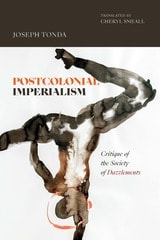
cover of Postcolonial Imperialism: Critique of the Society of Dazzlements

Postcolonial Imperialism

Critique of the Society of Dazzlements

Joseph Tonda. Translated by Cheryl Smeall

Duke University Press, 2026
Postcolonial Imperialism considers the inability to distinguish between reality and fiction as a key condition of contemporary life. If postcolonial theory has highlighted how white colonizers created images of racialized Others which project their own self-hatred or disavowal, Joseph Tonda here shows how these images have in turn colonized Western imaginaries. He argues that the Global North’s obsession with its own phantoms takes a newly powerful form in the dazzling images of postcolonial screens. With examples ranging from Nicki Minaj to Osama Bin Laden and child soldier Johnny Mad Dog, Tonda reflects on power by analyzing the dazzlements of both Central Africa and the West, showing how African life prefigures Western experiences. Translated from its original French, Postcolonial Imperialism is a prescient critique of authoritarian attempts to enforce alternate realities, and of the many ways screens can distort our vision.
[more]
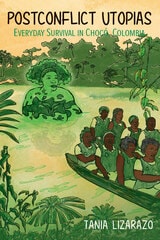
cover of Postconflict Utopias: Everyday Survival in Chocó, Colombia

Postconflict Utopias

Everyday Survival in Chocó, Colombia

Tania Lizarazo

University of Illinois Press, 2024

Black women in the department of Chocó, Colombia, respond to the violence endemic to their region with activism and storytelling. Tania Lizarazo focuses on members of COCOMACIA, a Black farmers’ association that defends communities and territories along the nation’s Pacific lowlands’ rivers. Drawing on the life stories of members, Lizarazo explains how Chocó’s Black Colombian women answered firsthand experiences of violence with a dedication to survival and activism. Survival amid armed conflict proves to be an embodied practice. Day by day, the women imagine what memory, peace, and justice could look like when the bloodshed ends. Though peace may seem impossible, wishing and working for a better world motivates these women to steadily dismantle the scaffolding of violence built around their lives.

A merger of eyewitness accounts and theory, Postconflict Utopias explores the links between lived knowledge and survival while revealing the power unleashed when women ask the simple question, “Why not?”
[more]
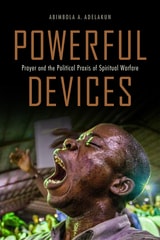
cover of Powerful Devices: Prayer and the Political Praxis of Spiritual Warfare

Powerful Devices

Prayer and the Political Praxis of Spiritual Warfare

Abimbola Adunni Adelakun

Rutgers University Press, 2023
Powerful Devices studies spiritual warfare performances as an apparatus for disestablishing structures of power and knowledge, and establishing righteousness in their stead. Drawing on performance studies’ emphasis on radicality and breaking of social norms as devices of social transformation, the book demonstrates how Christian groups with dominant cultural power but who perceive themselves as embattled wield the ideas of performance activism. Combining religious studies with ethnography, Powerful Devices explores Nigerian Pentecostals and US Evangelicals’ praxis of transnational spiritual warfare. By closely studying spiritual warfare prayers as a “device,” Powerful Devices shows how the rituals of prayer enable an apprehension of time, paradigms of self-enhancement, and the subversion of politics and authority. A critical intervention, Powerful Devices explores charismatic Christianity’s relationship to science and secular authority, technology and temporality, neoliberalism, and reactionary ideology.
[more]
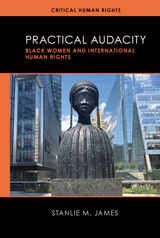
cover of Practical Audacity: Black Women and International Human Rights

Practical Audacity

Black Women and International Human Rights

Stanlie James

University of Wisconsin Press, 2022

Goler Teal Butcher (1925–93), a towering figure in international human rights law, was a scholar and advocate who advanced an intersectional approach to human empowerment influenced by Black women’s intellectual traditions. Practical Audacity follows the stories of fourteen women whose work honors and furthers Butcher’s legacy. Their multilayered and sophisticated contributions have critically reshaped human rights scholarship and activism—including their major role in developing critical race feminism, community-based applications, and expanding the boundaries of human rights discourse.
 
Stanlie M. James weaves narratives by and about these women throughout the history of the field, illustrating how they conceptualize, develop, and implement human rights. By centering the courage and innovative interventions of capable and visionary Black women, she places them rightfully alongside such figures as Thurgood Marshall and Charles Hamilton Houston. This volume fundamentally shifts the frame through which human rights struggles are understood, illuminating how those who witness and experience oppression have made some of the biggest contributions to building a better world.
[more]