Results by title
63 books match the query 'Bolivia' and 3 start with p
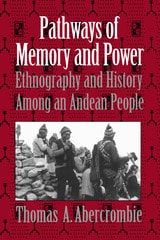
Pathways of Memory and Power
Ethnography and History among an Andean PeopleThomas A. Abercrombie
University of Wisconsin Press, 1998
Making clear the early and deep intermingling of practices and world views among Spaniards and Andeans, Christians and non-Christians, Abercrombie critiques both the romanticist tendency to regard Andean culture as still separate from and resistant to European influences, and the melodramatic view that all indigenous practices have been obliterated by colonial and national elites. He challenges prejudices that, from colonial days to the present, have seen Andean historical knowledge only in mythic narratives or narratives of personal experience. Bringing an ethnographer’s approach to historiography, he shows how complex Andean rituals that hybridize European and indigenous traditions—such as libation dedications and llama sacrifices held on saints’ day festivals—are in fact potent evidence of social memory in the community.
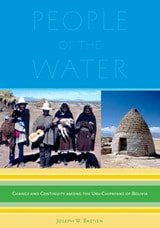
People of the Water
Change and Continuity among the Uru-Chipayans of BoliviaJoseph Bastien
University of Utah Press, 2012
People of the Water is an ethnographic analysis of the cultural practices of the Uru-Chipayans—how they have maintained their culture and how they have changed. The Chipayans are an Andean people whose culture predates the time of the Incas (c. AD 1400), but they were almost wiped out by 1940, when only around 400 remained. Yet their population has quadrupled in the last 60 years. Joseph Bastien has spent decades living with and studying the Chipayans, and here for the first time he discusses the dynamics between traditional, social, and religious practices and the impending forces of modernity upon them. With the support of more than 100 illustrations he documents how, in spite of challenges, the Chipayans maintain ecological sustainability through an ecosystem approach that is holistic and symbolically embedded in rituals and customs.
Chipayans have a resilient and innovative culture, maintaining dress, language, hairstyle, rituals, and behavior while also re-creating their culture from a dialectic between themselves and the world around them. Bastien provides the reader with a series of experienced observations and intimate details of a group of people who strive to maintain their ancient traditions while adapting to modern society. This ethnographic study offers insightful, surprising, and thoughtful conclusions applicable to interpreting the world around us.
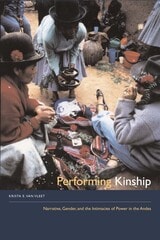
Performing Kinship
Narrative, Gender, and the Intimacies of Power in the AndesBy Krista E. Van Vleet
University of Texas Press, 2008
In the highland region of Sullk'ata, located in the rural Bolivian Andes, habitual activities such as sharing food, work, and stories create a sense of relatedness among people. Through these day-to-day interactions—as well as more unusual events—individuals negotiate the affective bonds and hierarchies of their relationships. In Performing Kinship, Krista E. Van Vleet reveals the ways in which relatedness is evoked, performed, and recast among the women of Sullk'ata.
Portraying relationships of camaraderie and conflict, Van Vleet argues that narrative illuminates power relationships, which structure differences among women as well as between women and men. She also contends that in the Andes gender cannot be understood without attention to kinship.
Stories such as that of the young woman who migrates to the city to do domestic work and later returns to the highlands voicing a deep ambivalence about the traditional authority of her in-laws provide enlightening examples of the ways in which storytelling enables residents of Sullk'ata to make sense of events and link themselves to one another in a variety of relationships. A vibrant ethnography, Performing Kinship offers a rare glimpse into an compelling world.