Results by title
57 books match the query 'Business Ethics' and 2 start with p
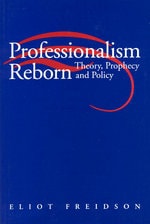
Professionalism Reborn
Theory, Prophecy, and PolicyEliot Freidson
University of Chicago Press, 1994
In industrialized societies, professionals have long been valued and set apart from other workers because of their specialized knowledge and skill. But has their role in these societies declined? Of what significance are they today?
In this concise synthesis of the major debates about the professions since World War II, Eliot Freidson explores several broad questions about professionalism today—what it is, what its future is likely to be, and its value to public policy. Freidson argues that because professionalism is based on specialized knowledge, it is distinct from either bureaucratic or market-based forms of work. He predicts a rebirth of the professions during which practitioners lose some of their independence and become more accountable to standards of a professional elite. And, defending professionalism as a desirable method of providing complex, discretionary services to the public, Freidson argues that market-based or bureaucratic methods would impoverish the quality of service to consumers, and suggests ways the virtues of professionalism can be reinforced.
The most accessible survey available of almost fifty years of theory and research by the scholar whose own work helped define the field, this book will appeal to the growing international body of scholars concerned with studying and theorizing about the professions.
[more]

Profits and Morality
Edited by Robin Cowan and Mario J. Rizzo
University of Chicago Press, 1995
Are profits morally justifiable? While neoclassical economists have traditionally endorsed the pursuit of profits, many moral philosophers have challenged profit making on a variety of ethical grounds. Through the lenses of economics, philosophy, and law, these six essays explore the morality of profits from libertarian, utilitarian, and consequentialist perspectives.
Presenting arguments for and against the morality of profit making, the contributors examine the nature of profits and which ethical theories can support them. Two essays address how profits are made: one explores entrepreneurship as a legitimate source of profit, while another argues that recent advances in welfare economics weaken the case for the morality of profits. The other chapters focus on ethical theory, covering the right to profits from economic rent; the morality of how profits are used—those directed toward library or university endowments, for example, are considered morally acceptable—and whether or not profits are deserved.
Presenting arguments for and against the morality of profit making, the contributors examine the nature of profits and which ethical theories can support them. Two essays address how profits are made: one explores entrepreneurship as a legitimate source of profit, while another argues that recent advances in welfare economics weaken the case for the morality of profits. The other chapters focus on ethical theory, covering the right to profits from economic rent; the morality of how profits are used—those directed toward library or university endowments, for example, are considered morally acceptable—and whether or not profits are deserved.
[more]