198 books match the query 'Campaigns' and 11 start with p
cover of Pacific Blitzkrieg: World War II in the Central Pacific

Pacific Blitzkrieg

World War II in the Central Pacific

Sharon Tosi Lacey

University of North Texas Press, 2013
[more]
cover of Patton's Pawns: The 94th US Infantry Division at the Siegfried Line

Patton's Pawns

The 94th US Infantry Division at the Siegfried Line

Tony Le Tissier

University of Alabama Press, 2007

The 94th US Infantry Division was an organization formed late in the Second World War, made up largely of draft-deferred university students as enlisted men and an officer corps pulled together from various domestic postings with unfortunate consequences for mutual trust and respect.
Initially used as part of the force blockading the Brittany ports after D-Day, in December of 1944, the division was incorporated into General Patton’s Third Army south of the Moselle-Saar Triangle, the base of which was a portion of the Siegfried Line known as the Orscholz Switch. Its first combat experience came in battalion-sized attacks during that terrible winter while the Battle of the Bulge raged to the north, and the Division suffered heavy casualties, many due to the ferocity of the winter weather. Patton, with characteristic zeal, excoriated the division’s officers and senior NCOs for the rate of non-combat casualties. Thereafter, the division was ordered forward on an all-out assault to break through the Siegfried Line. After horrific fighting against entrenched defenders, with ice turning to mud as spring approached, on February 19, 1945, the 94th broke through to open the roads to Trier and the Rhine.

This book is the most comprehensive study to date of the fierce fighting between the 94th U.S. Infantry Division and their German counterparts during that spring of 1945. It sheds new light on the achievements of the outnumbered division in penetrating Germany’s Westwall. With characteristic verve and detail, Tony Le Tissier narrates the action and illuminates the tribulations and sacrifices of American soldiers who won their laurels at great cost.
[more]
cover of Patton's War: An American General's Combat Leadership Volume 3: January 1-December 21, 1945

Patton's War

An American General's Combat Leadership Volume 3: January 1-December 21, 1945

Kevin M. Hymel

University of Missouri Press, 2026

The third and final volume of Kevin Hymel’s Patton’s War trilogy finds Lieutenant General George S. Patton on January 1, 1945, as the master of the battlefield in World War II Europe. Throughout the war, Patton showed the same kind of aggressive leadership and battlefield smarts that made his name synonymous with victory. Patton’s leadership was almost flawless as he led his men through enemy fire and one of the worst winters in European history. 

As with his previous volume, Hymel relies on Patton’s original diaries (not the transcribed, embellished versions historians have relied on for many years) and personal letters to tell the general’s story. Hymel also mined various archives to explain Patton’s encounters with soldiers, government officials, civilians, and reporters to expand on his narrative.

Throughout this three-volume work, Patton emerges not as a larger-than-life myth, but as a human being, one held back by the personal prejudices and antisemitism that ultimately proved to be his demise. Despite these personal failings, Patton was, above all, as Hymel reveals, a commander bent on winning, or, as the general himself might have put it, getting the enemy to dance to his tune. 
 
[more]
cover of Patton's War: An American General's Combat Leadership, Volume 2: August–December 1944

Patton's War

An American General's Combat Leadership, Volume 2: August–December 1944

Kevin M. Hymel

University of Missouri Press, 2023

Winner of the 2023 Army Historical Foundation Distinguished Writing Award for Biography

Finalist for the 2023 Gilder Lehrman Military History Prize


This second of three volumes of Patton’s War picks up where the first one left off, examining General George S. Patton’s leadership of the U.S. Third Army. The book follows Patton’s contributions to both the Normandy and Brittany campaigns—the closing of the Falaise Pocket in Normandy, and racing to the port cities in Brittany. It ends with Patton and his corps rescuing the besieged town of Bastogne in the Battle of the Bulge.

As he did in the preceding volume, Hymel relies not only on Patton’s diaries and letters, but countless veteran interviews, sur­veys, and memoirs. He also provides a unique insight missed by previous Patton scholars. Instead of using Patton’s transcribed diaries, which were heavily edited and embellished, he consults Patton’s original, hand-written diaries to uncover previously un­known information about the general.

This second volume of Hymel’s groundbreaking work shows Patton at the height of his generalship, successfully leading his army without the mistakes and caustic behavior that almost got him sent home earlier—even if we also see a Patton still guided at times by racism and antisemitism.
 
[more]
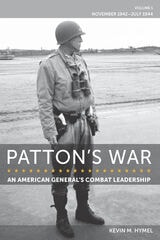
cover of Patton's War: An American General's Combat Leadership, Volume I: November 1942–July 1944

Patton's War

An American General's Combat Leadership, Volume I: November 1942–July 1944

Kevin M. Hymel

University of Missouri Press, 2021
George S. Patton Jr. lived an exciting life in war and peace, but he is best remembered for his World War II battlefield exploits. Patton’s War: An American General’s Combat Leadership: November 1942–July 1944, the first of three volumes, follows the general from the beaches of Morocco to the fields of France, right before the birth of Third Army on the continent. In highly engaging fashion, Kevin Hymel uncovers new facts and challenges long-held beliefs about the mercurial Patton, not only examining his relationships with his superiors and fellow generals and colonels, but also with the soldiers of all ranks whom he led. Using new sources unavailable to previous historians and through extensive research of soldiers’ memoirs and interviews, Hymel adds a new dimension to the telling of Patton’s WWII story.
 
[more]
cover of Peculiar Honor: A History of the 28th Texas Cavalry 1862-1865

Peculiar Honor

A History of the 28th Texas Cavalry 1862-1865

Jane Johansson

University of Arkansas Press, 1998
This regimental history tells the story of the 28th Texas Cavalry (dismounted), a unit of Walker's Texas Division which campaigned throughout the Civil War in Arkansas, Louisiana and Texas. Part of the division known as "Walker's Greyhounds" because of their amazing mobility and stamina, the men of the 28th, helped preserve Texas from Federal invasion. 1997 Winner of the Ottis Lock Award for the Best Book on East Texas History
[more]
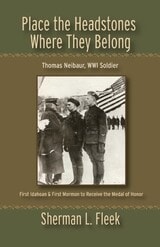
cover of Place the Headstones Where They Belong: Thomas Neibaur, World War 1 Soldier

Place the Headstones Where They Belong

Thomas Neibaur, World War 1 Soldier

Sherman L. Fleek

Utah State University Press, 2008

After a long journey from Sugar City, Idaho, to France’s Argonne Forest France during World War I,
young Thomas Neibaur found himself in the core of the American Expeditionary Force’s most important offensive.
After becoming separated in advance of his unit, he, despite serious wounds, single-handedly stopped a German
counterattack at a critical hill known as Côte de Châtillon. For this remarkable feat of valor, he received the Medal of
Honor and other awards, becoming the first Idaho and first Mormon recipient of the nation’s highest combat award.
But after a heroic return and brief celebrity, his life followed a tragic downward arc, culminating in his attempt to return
his medal because, as he put it, it could not feed his family.
[more]
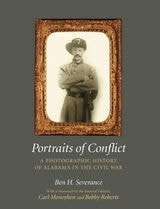
cover of Portraits of Conflict: A Photographic History of Alabama in the Civil War

Portraits of Conflict

A Photographic History of Alabama in the Civil War

Ben H. Severance

University of Arkansas Press, 2012

Portraits of Conflict: A Photographic History of Alabama in the Civil War is the tenth volume in this acclaimed series showing the human side of the country's great national conflict. Over 230 photographs of soldiers and civilians from Alabama, many never seen before, are accompanied by their personal stories and woven into the larger narrative of the war both on the battlefield and the home front. Alabama is unusual among the Rebel states in that, while its people saw little fighting inside its boundaries, nearly one hundred thousand Alabamians served with Confederate units throughout the South. This volume chronicles their experiences in almost every battle east of the Mississippi River--especially at Sharpsburg, Chancellorsville, and Gettysburg under the legendary Robert E. Lee; at Murfreesboro and Chickamauga as part of the ill-fated Army of Tennessee; and at the famous siege of Vicksburg. Ultimately Union soldiers did invade the state, and Alabamians defended their homeland against enemy cavalry raiders at Selma and against Federal warships in the fight for Mobile Bay. The volume also includes accounts of some of Alabama's leading politicians as well as several of its more ordinary citizens. This new volume contains the same quality of photography and storytelling that has attracted Civil War enthusiasts since the first volume was published in 1987, making it another welcome addition to the series Civil War History called "a sensibly priced, beautifully produced photographic history."
[more]
cover of Portraits of Conflict: A Photographic History of Louisiana in the Civil War

Portraits of Conflict

A Photographic History of Louisiana in the Civil War

Carl H. Moneyhon

University of Arkansas Press, 1990
[more]
cover of Price's Lost Campaign: The 1864 Invasion of Missouri

Price's Lost Campaign

The 1864 Invasion of Missouri

Mark A. Lause

University of Missouri Press, 2013
 
In the fall of 1864, during the last brutal months of the Civil War, the Confederates made one final, desperate attempt to rampage through the Shenandoah Valley, Tennessee, and Missouri. Price’s Raid was the common name for the Missouri campaign led by General Sterling Price. Involving tens of thousands of armed men, the 1864 Missouri campaign has too long remained unexamined by a book-length modern study, but now, Civil War scholar Mark A. Lause fills this long-standing gap in the literature, providing keen insights on the problems encountered during and the myths propagated about this campaign.
Price marched Confederate troops 1,500 miles into Missouri, five times as far as his Union counterparts who met him in the incursion. Along the way, he picked up additional troops; the most exaggerated estimates place Price’s troop numbers at 15,000. The Federal forces initially underestimated the numbers heading for Missouri and then called in troops from Illinois and Kansas, amassing 65,000 to 75,000 troops and militia members. The Union tried to downplay its underestimation of the Confederate buildup of troops by supplanting the term campaign with the impromptu raid.
            This term was also used by Confederates to minimize their lack of military success. The Confederates, believing that Missourians wanted liberation from Union forces, had planned a two-phase campaign. They intended not only to disrupt the functioning government through seizure of St. Louis and the capital, Jefferson City, but also to restore the pro-secessionist government driven from the state three years before. The primary objective, however, was to change the outcome of the Federal elections that fall, encouraging votes against the Republicans who incorporated ending slavery into the Union war goals. What followed was widespread uncontrolled brutality in the form of guerrilla warfare, which drove support for the Federalists. Missouri joined Kansas in reelecting the Republicans and ensuring the end of slavery.
Lause’s account of the Missouri campaign of 1864 brings new understanding of the two distinct phases of the campaign, as based upon declared strategic goals. Additionally, as the author reveals the clear connection between the military campaign and the outcome of the election, he successfully tests the efforts of new military historians to integrate political, economic, social, and cultural history into the study of warfare. In showing how both sides during Price’s Raid used self-serving fictions to provide a rationale for their politically motivated brutality and were unwilling to risk defeat, Lause reveals the underlying nature of the American Civil War as a modern war.
 
[more]
cover of Project 9: The Birth of the Air Commandos in World War II

Project 9

The Birth of the Air Commandos in World War II

Dennis R. Okerstrom

University of Missouri Press, 2026

Project 9: The Birth of the Air Commandos in World War II is a thoroughly researched narrative of the Allied joint project to invade Burma by air. Beginning with its inception at the Quebec Conference of 1943 and continuing through Operation Thursday until the death of the brilliant British General Orde Wingate in March 1944, less than a month after the successful invasion of Burma, Project 9 details all aspects of this covert mission, including the selection of the American airmen, the procurement of the aircraft, the joint training with British troops, and the dangerous night-time assault behind Japanese lines by glider.
Based on review of hundreds of documents as well as interviews with surviving Air Commandos, this is the history of a colorful, autonomous, and highly effective military unit that included some of the most recognizable names of the era. Tasked by the General of the Army Air Forces, H. H. “Hap” Arnold, to provide air support for British troops under the eccentric Major General Wingate as they operated behind Japanese lines in Burma, the Air Commandos were breaking entirely new ground in operational theory, tactics, and inter-Allied cooperation. Okerstrom’s in-depth research and analysis in Project 9 shed light on the operations of America’s first foray into special military operations, when these heroes led the way for the formation of modern special operations teams such as Delta Force and Seal Team Six.
[more]