Results by title
282 books match the query 'Caribbean & West Indies' and 10 start with p
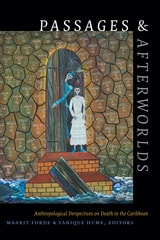
Passages and Afterworlds
Anthropological Perspectives on Death in the CaribbeanMaarit Forde and Yanique Hume, editors
Duke University Press, 2018
Contributors. Donald Cosentino, Maarit Forde, Yanique Hume, Paul Christopher Johnson, Aisha Khan, Keith E. McNeal, George Mentore, Richard Price, Karen Richman, Ineke (Wilhelmina) van Wetering, Bonno (H.U.E.) Thoden van Velzen
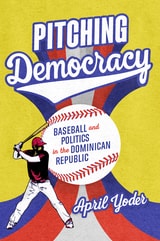
Pitching Democracy
Baseball and Politics in the Dominican RepublicApril Yoder
University of Texas Press, 2023
How Dominicans contribute to Major League Baseball and what they receive in return.
From Juan Marichal and Pedro Martínez to Albert Pujols and Juan Soto, Dominicans have long been among Major League Baseball’s best. How did this small Caribbean nation become a hothouse of baseball talent? To many fans, the answer is both obvious and disconcerting: pro teams use their riches to develop talent abroad, creating opportunities for superhuman athletes and corrupt officials, while the rest of the population sees little benefit.
Yet this interpretation of history is incomplete. April Yoder traces how baseball has empowered Dominicans in their struggles for democracy and social justice. While the dictatorship of Rafael Trujillo saw the sport as a means of cementing its power at home and abroad, the Dominican people fashioned an emancipated civic sphere by seeing their potential for democratic success in their compatriots’ baseball success. Later, Dominicans articulated demands for democracy, economic opportunity, and civil rights through successful calls for public support of amateur and professional baseball. Today, Dominicans continue to demand that incentives for the baseball industry foster human as well as economic development. A revelatory and innovative history, Pitching Democracy restores agency to the Dominican people and honors their true love of the game.
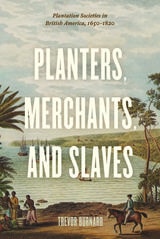
Planters, Merchants, and Slaves
Plantation Societies in British America, 1650-1820Trevor Burnard
University of Chicago Press, 2015
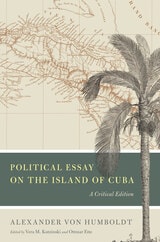
Political Essay on the Island of Cuba
A Critical EditionAlexander von Humboldt
University of Chicago Press, 2011
The research Alexander von Humboldt amassed during his five-year trek through the Americas in the early nineteenth-century proved foundational to the fields of botany, geography, and geology. But his visit to Cuba during this time yielded observations that extended far beyond the natural world. Political Essay on the Island of Cuba is a physical and cultural study of the island nation. In it, Humboldt denounces colonial slavery on both moral and economic grounds and stresses the vital importance of improving intercultural relations throughout the Americas.
Humboldt’s most controversial book, Political Essay on the Island of Cuba was banned, censored, and willfully mistranslated to suppress Humboldt’s strong antislavery sentiments. It reemerges here, newly translated from the original two volume French edition, to introduce a new generation of readers to Humboldt’s astonishing multiplicity of scientific and philosophical perspectives. In their critical introduction, Vera Kutzinski and Ottmar Ette emphasize Humboldt’s rare ability to combine scientific rigor with a cosmopolitan consciousness and a deeply felt philosophical humanism. The result is a work on Cuba of historical import that will attract historians of science as well as cultural historians, political scientists, and literary scholars.
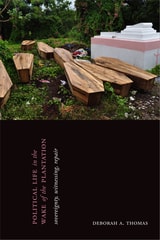
Political Life in the Wake of the Plantation
Sovereignty, Witnessing, RepairDeborah A. Thomas
Duke University Press, 2019
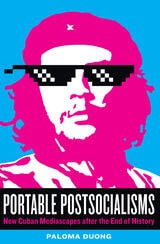
Portable Postsocialisms
New Cuban Mediascapes after the End of HistoryPaloma Duong
University of Texas Press, 2024
2025 Honorable Mention, Bryce Wood Book Award, Latin American Studies Association
A study of Cuban culture and media in the twenty-first century as both a global phenomenon and a local reality, at a time when the declared death of socialism coexists in tension with emerging anticapitalist movements worldwide.
Why does Cuban socialism endure as an object of international political desire, while images of capitalist markets consume Cuba’s national imagination? This bold new study argues that Cuba’s changing media cultures are key to our understanding of the global postsocialist condition and its competing political imaginaries.
Portable Postsocialisms calls on a vast multimedia archive to offer a groundbreaking cultural interpretation of Cuban postsocialism. Paloma Duong examines songs, artworks, advertisements, memes, literature, jokes, and networks that refuse exceptionalist and exoticizing visions of Cuba. Expanding postsocialist critical theory to read this complex mediascape, Duong argues that a materialist critique of Cuba’s revolutionary legacy must account for Cubans’ everyday demands for agency and self-representation. This long overdue reassessment of Cuba’s place in Latin American and post-Marxist studies shows Cuban postsocialism to be an urgent and indispensable referent for core debates on the politics of participatory cultures in new media studies. Portable Postsocialisms performs the crucial task of redefining how we envision imaginaries of social change in Latin America and the Caribbean.
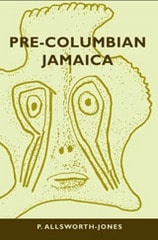
Pre-Columbian Jamaica
Phillip Allsworth-Jones
University of Alabama Press, 2008
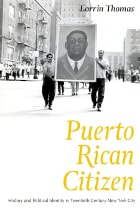
Puerto Rican Citizen
History and Political Identity in Twentieth-Century New York CityLorrin Thomas
University of Chicago Press, 2010
Building its incisive narrative from a wide range of archival sources, interviews, and first-person accounts of Puerto Rican life in New York, this book illuminates the rich history of a group that is still largely invisible to many scholars. At the center of Puerto Rican Citizen are Puerto Ricans’ own formulations about political identity, the responses of activists and ordinary migrants to the failed promises of American citizenship, and their expectations of how the American state should address those failures. Complicating our understanding of the discontents of modern liberalism, of race relations beyond black and white, and of the diverse conceptions of rights and identity in American life, Thomas’s book transforms the way we understand this community’s integral role in shaping our sense of citizenship in twentieth-century America.
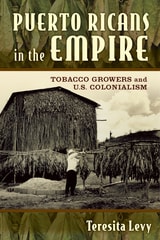
Puerto Ricans in the Empire
Tobacco Growers and U.S. ColonialismTeresita A. Levy
Rutgers University Press, 2015
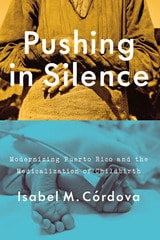
Pushing in Silence
Modernizing Puerto Rico and the Medicalization of ChildbirthBy Isabel M. Córdova
University of Texas Press, 2017
As Puerto Rico rapidly industrialized from the late 1940s until the 1970s, the social, political, and economic landscape changed profoundly. In the realm of heath care, the development of medical education, new medical technologies, and a new faith in science radically redefined childbirth and its practice. What had traditionally been a home-based, family-oriented process, assisted by women and midwives and “accomplished” by mothers, became a medicalized, hospital-based procedure, “accomplished” and directed by biomedical, predominantly male, practitioners, and, ultimately reconfigured, after the 1980s, into a technocratic model of childbirth, driven by doctors’ fears of malpractice suits and hospitals’ corporate concerns.
Pushing in Silence charts the medicalization of childbirth in Puerto Rico and demonstrates how biomedicine is culturally constructed within regional and historical contexts. Prior to 1950, registered midwives on the island outnumbered registered doctors by two to one, and they attended well over half of all deliveries. Isabel M. Córdova traces how, over the next quarter-century, midwifery almost completely disappeared as state programs led by scientifically trained experts and organized by bureaucratic institutions restructured and formalized birthing practices. Only after cesarean rates skyrocketed in the 1980s and 1990s did midwifery make a modest return through the practices of five newly trained midwives. This history, which mirrors similar patterns in the United States and elsewhere, adds an important new chapter to the development of medicine and technology in Latin America.