99 books match the query 'Censorship' and 6 start with p
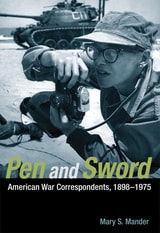
cover of Pen and Sword: American War Correspondents, 1898-1975

Pen and Sword

American War Correspondents, 1898-1975

Mary S. Mander

University of Illinois Press, 2010

Addressing the ever-changing, overlapping trajectories of war and journalism, this introduction to the history and culture of modern American war correspondence considers a wealth of original archival material. In powerful analyses of letters, diaries, journals, television news archives, and secondary literature related to the U.S.'s major military conflicts of the twentieth century, Mary S. Mander highlights the intricate relationship of the postmodern nation state to the free press and to the public. Pen and Sword: American War Correspondents, 1898-1975 situates war correspondence within the larger framework of the history of the printing press to make perceptive new points about the nature of journalism and censorship, the institution of the press as a source of organized dissent, and the relationship between the press and the military. Fostering a deeper understanding of the occupational culture of war correspondents who have accompanied soldiers into battle, Mander offers interpretive analysis of the reporters' search for meaning while embedded with troops in war-torn territories. Broadly encompassing the history of Western civilization and modern warfare, Pen and Sword prompts new ways of thinking about contemporary military conflicts and the future of journalism.
[more]
cover of Performing Spanishness: History, Cultural Identity & Censorship in the Theatre of José María Rodríguez Méndez

Performing Spanishness

History, Cultural Identity & Censorship in the Theatre of José María Rodríguez Méndez

Michael Thompson

Intellect Books, 1995

José María Rodríguez Méndez is a noted playwright, an acerbic cultural critic, and a political dissident under Franco. In Performing Spanishness, the first English-language examination of Méndez’s life and work, Michael Thompson sets the playwright’s lifelong struggle against censorship in the context of Spain’s shifting national identity. Méndez’s work presents “Spanishness” not as a static trait, but as an ongoing performance; Performing Spanishness is an indispensable resource to those interested in theater, Spain, and the relationship between art and activism.
[more]
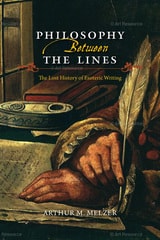
cover of Philosophy Between the Lines: The Lost History of Esoteric Writing

Philosophy Between the Lines

The Lost History of Esoteric Writing

Arthur M. Melzer

University of Chicago Press, 2014

Philosophical esotericism—the practice of communicating one’s unorthodox thoughts “between the lines”—was a common practice until the end of the eighteenth century. The famous Encyclopédie of Diderot, for instance, not only discusses this practice in over twenty different articles, but admits to employing it itself. The history of Western thought contains hundreds of such statements by major philosophers testifying to the use of esoteric writing in their own work or others’. Despite this long and well-documented history, however, esotericism is often dismissed today as a rare occurrence. But by ignoring esotericism, we risk cutting ourselves off from a full understanding of Western philosophical thought.
           
Arthur M. Melzer serves as our deeply knowledgeable guide in this capacious and engaging history of philosophical esotericism. Walking readers through both an ancient (Plato) and a modern (Machiavelli) esoteric work, he explains what esotericism is—and is not. It relies not on secret codes, but simply on a more intensive use of familiar rhetorical techniques like metaphor, irony, and insinuation. Melzer explores the various motives that led thinkers in different times and places to engage in this strange practice, while also exploring the motives that lead more recent thinkers not only to dislike and avoid this practice but to deny its very existence. In the book’s final section, “A Beginner’s Guide to Esoteric Reading,” Melzer turns to how we might once again cultivate the long-forgotten art of reading esoteric works.

Philosophy Between the Lines is the first comprehensive, book-length study of the history and theoretical basis of philosophical esotericism, and it provides a crucial guide to how many major writings—philosophical, but also theological, political, and literary—were composed prior to the nineteenth century.
[more]
cover of Policing Pop

Policing Pop

edited by Martin Cloonan and Reebee Garofalo

Temple University Press, 2002

Fans and detractors of popular music tend to agree on one thing: popular music is a bellwether of an individual's political and cultural values. In the United States, for example, one cannot think of the counterculture apart from its music. For that reason, in virtually every country in the world, some group identifies popular music as a source of potential danger and wants to regulate it. Policing Pop looks into the many ways in which popular music and artists around the world are subjected to censorship, ranging from state control and repression to the efforts of special interest or religious groups to limit expression.The essays collected here focus on the forms of censorship as well as specific instances of how the state and other agencies have attempted to restrict the types of music produced, recorded and performed within a culture. Several show how even unsuccessful attempts to exert the power of the state can cause artists to self-censor. Others point to material that taxes even the most liberal defenders of free speech. Taken together, these essays demonstrate that censoring agents target popular music all over the world, and they raise questions about how artists and the public can resist the narrowing of cultural expression.
[more]
cover of Protecting Intellectual Freedom in Your Public Library

Protecting Intellectual Freedom in Your Public Library

American Library Association, 2012
[more]
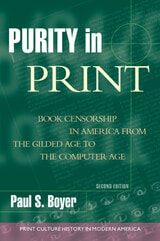
cover of Purity in Print: Book Censorship in America from the Gilded Age to the Computer Age

Purity in Print

Book Censorship in America from the Gilded Age to the Computer Age

Paul S. Boyer

University of Wisconsin Press, 2002

The first edition of Purity in Print documented book censorship in America from the 1870s to the 1930s, embedding it within the larger social and cultural history of the time. In this second edition, Boyer adds two new chapters carrying his history forward to the beginning of the twenty-first century.

[more]