84 books match the query 'Century' and 4 start with p
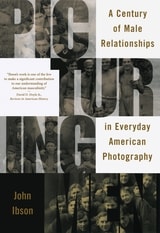
cover of Picturing Men: A Century of Male Relationships in Everyday American Photography

Picturing Men

A Century of Male Relationships in Everyday American Photography

John Ibson

University of Chicago Press, 2006

There was a time in America when two men pictured with their arms wrapped around each other, or perhaps holding hands, weren’t necessarily seen as sexually involved—a time when such gestures could be seen simply as those of intimate friendship rather than homoeroticism. 

Such is the time John Ibson evokes in Picturing Men, a striking visual record of changes in attitudes about relationships between gentlemen, soldiers, cowboys, students, lumberjacks, sailors, and practical jokers. Spanning from 1850 to 1950, the 142 everyday photographs that richly illustrate Picturing Men radiate playfulness, humor, and warmth. They portray a lost world for American men: a time when their relationships with each other were more intimate than they commonly are today, regardless of sexual orientation. Picturing Men starkly contrasts the calm affection displayed in earlier photographs with the absence of intimacy in photos from the mid-1950s on. In doing so, this lively, accessible book makes a significant contribution to American history and cultural studies, gender studies, and the history of photography.
[more]
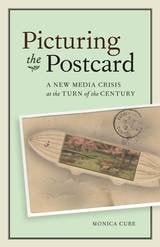
cover of Picturing the Postcard: A New Media Crisis at the Turn of the Century

Picturing the Postcard

A New Media Crisis at the Turn of the Century

Monica Cure

University of Minnesota Press, 2018

The first full-length study of a once revolutionary visual and linguistic medium

Literature has “died” many times—this book tells the story of its death by postcard. Picturing the Postcard looks to this unlikely source to shed light on our collective, modern-day obsession with new media. The postcard, almost unimaginably now, produced at the end of the nineteenth century the same anxieties and hopes that many people think are unique to twenty-first-century social media such as Facebook or Twitter. It promised a newly connected social world accessible to all and threatened the breakdown of authentic social relations and even of language. 

Arguing that “new media” is as much a discursive object as a material one, and that it is always in dialogue with the media that came before it, Monica Cure reconstructs the postcard’s history through journals, legal documents, and sources from popular culture, analyzing the postcard’s representation in fiction by well-known writers such as E. M. Forster and Edith Wharton and by more obscure writers like Anne Sedgwick and Herbert Flowerdew. Writers deployed uproar over the new medium of the postcard by Anglo-American cultural critics to mirror anxieties about the changing nature of the literary marketplace, which included the new role of women in public life, the appeal of celebrity and the loss of privacy, an increasing dependence on new technologies, and the rise of mass media. Literature kept open the postcard’s possibilities and in the process reimagined what literature could be. 
[more]
cover of Problem of the Century: Racial Stratification in the United States

Problem of the Century

Racial Stratification in the United States

Elijah Anderson

Russell Sage Foundation, 2001
In 1899 the great African American scholar, W.E.B. DuBois, published The Philadelphia Negro, the first systematic case study of an African American community and one of the foundations of American sociology. DuBois prophesied that the color line would be the problem of the twentieth century. One hundred years later, Problem of the Century reflects upon his prophecy, exploring the ways in which the color line is still visible in the labor market, the housing market, education, family structure, and many other aspects of life at the turn of a new century. The book opens with a theoretical discussion of the way racial identity is constructed and institutionalized. When the government classifies races and confers group rights upon them, is it subtly reenforcing damaging racial divisions, or redressing the group privileges that whites monopolized for so long? The book also delineates the social dynamics that underpin racial inequality. The contributors explore the causes and consequences of high rates of mortality and low rates of marriage in black communities, as well as the way race affects a person's chances of economic success. African Americans may soon lose their historical position as America's majority minority, and the book also examines how race plays out in the sometimes fractious relations between blacks and immigrants. The final part of the book shows how the color line manifests itself at work and in schools. Contributors find racial issues at play on both ends of the occupational ladder—among absentee fathers paying child support from their meager earnings and among black executives prospering in the corporate world. In the schools, the book explores how race defines a student's peer group and how peer pressure affects a student's grades. Problem of the Century draws upon the distinguished faculty of sociologists at the University of Pennsylvania, where DuBois conducted his research for The Philadelphia Negro. The contributors combine a scrupulous commitment to empirical inquiry with an eclectic openness to different methods and approaches. Problem of the Century blends ethnographies and surveys, statistics and content analyses, census data and historical records, to provide a far-reaching examination of racial inequality in all its contemporary manifestations.
[more]
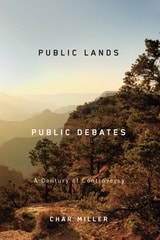
cover of Public Lands, Public Debates: A Century of Controversy

Public Lands, Public Debates

A Century of Controversy

Char Miller, editor

Oregon State University Press, 2012

The subject of historic struggle and contemporary dispute, public lands in the United States are treasured spaces. In Public Lands, Public Debates, environmental historian Char Miller explores the history of conservation thinking and the development of a government agency with stewardship at its mission.
 
Owned in common, our national forests, monuments, parks, and preserves are funded through federal tax receipts, making these public lands national in scope and significance. Their controversial histories demonstrate their vulnerability to shifting tides of public opinion, alterations in fiscal support, and overlapping authorities for their management—including federal, state, and local mandates, as well as critical tribal prerogatives and military claims.
 
Miller takes the Forest Service as a gauge of the broader debates in which Americans have engaged since the late nineteenth century. In nineteen essays,he examines critical moments of public and private negotiation to help explain the particular, and occasionally peculiar, tensions that have shaped the administration of public lands in the United States.
 
 “Watching democracy at work can be bewildering, even frustrating, but the only way individuals and organizations can sift through the often messy business of public deliberation is to deliberate...”

—Char Miller, from the introduction

[more]