208 books match the query 'Christian Church' and 10 start with p
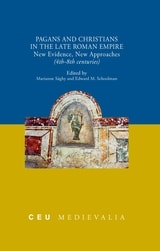
cover of Pagans and Christians in the Late Roman Empire: New Evidence, New Approaches (4th–8th centuries)

Pagans and Christians in the Late Roman Empire

New Evidence, New Approaches (4th–8th centuries)

Marianne Sághy

Central European University Press, 2017

Do the terms 'pagan' and 'Christian,' 'transition from paganism to Christianity' still hold as explanatory devices to apply to the political, religious and cultural transformation experienced Empire-wise? Revisiting 'pagans' and 'Christians' in Late Antiquity has been a fertile site of scholarship in recent years: the paradigm shift in the interpretation of the relations between 'pagans' and 'Christians' replaced the old 'conflict model' with a subtler, complex approach and triggered the upsurge of new explanatory models such as multiculturalism, cohabitation, cooperation, identity, or group cohesion. This collection of essays, inscribes itself into the revisionist discussion of pagan-Christian relations over a broad territory and time-span, the Roman Empire from the fourth to the eighth century. A set of papers argues that if 'paganism' had never been fully extirpated or denied by the multiethnic educated elite that managed the Roman Empire, 'Christianity' came to be presented by the same elite as providing a way for a wider group of people to combine true philosophy and right religion. The speed with which this happened is just as remarkable as the long persistence of paganism after the sea-change of the fourth century that made Christianity the official religion of the State. For a long time afterwards, 'pagans' and 'Christians' lived 'in between' polytheistic and monotheist traditions and disputed Classical and non-Classical legacies.
[more]
cover of Papal Letters in the Early Middle Ages

Papal Letters in the Early Middle Ages

Detlev Jasper

Catholic University of America Press, 2001
[more]
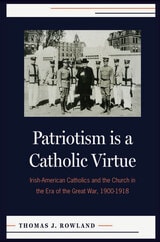
cover of Patriotism is a Catholic Virtue: Irish-American Catholics, The American Church and the Coming of the Great War

Patriotism is a Catholic Virtue

Irish-American Catholics, The American Church and the Coming of the Great War

Thomas J. Rowland

Catholic University of America Press, 2023
Most of the literature concerning the momentous challenges facing Irish American Catholics in the first two decades of the twentieth century pay but scant attention to the role played in addressing them by the American Church. Among the myriad political, social, cultural and economic issues confronting Irish American Catholics none stand out as prominently as the unabated burden of combatting scurrilous attacks upon them by nativist forces, the task of proving themselves as loyal American citizens, and navigating the perilous waves in advancing the course of directing Irish American nationalism and the cause of Ireland’s freedom. Patriotism is a Catholic Virtue ferrets out the impact the institutional Church played in affecting the course of action Irish American Catholics took regarding these three crucial missions. Whereas the task of confronting the assaults of nativism, seemingly the natural task for the institutional Church, this study provides extensive evidence of the relentless defense of Catholic virtue conducted by diocesan newspapers. Similarly, the mission of promoting Catholics as loyal American citizens was largely left in the hands of the American hierarchy, its clergy, newspapers and Catholic societies and affiliates. Lastly, this book provides evidence that the Church may well have played the decisive role in guiding its Irish American faithful along paths that, while conservatively promoting Irish nationalism, did not jeopardize an “American First” policy for Catholics. All of this was accomplished in the crucible of an emerging worldwide war.
[more]
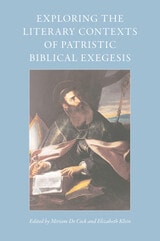
cover of Patristic Exegesis in Context: Exploring the Genres of Early Christian Biblical Interpretation

Patristic Exegesis in Context

Exploring the Genres of Early Christian Biblical Interpretation

Miriam De Cock

Catholic University of America Press, 2023
The essays of Patristic Exegesis in Context examine the biblical exegesis of early Christians beyond the formal genre of biblical commentary. The past couple of decades have seen a broadening of perspective on the study of patristic exegesis; the phenomenon is increasingly situated within its various literary contexts and genres, and the definition of what counts as patristic exegesis is therefore widened. This volume thus situates itself within this emerging scholarly tradition, which aims not to give an account of exegetical strategies and methodologies as found primarily in exegetical commentaries and homilies, but to demonstrate the highly sophisticated nature of biblical exegesis in other genres, and the manifold uses to which this exegesis was put. Ancient Christian authors lived and breathed scripture; it served as their primary source of theological and liturgical vocabulary, their way of processing the world, their social ethic, and their mode of constructing self and communal identity. Scripture therefore permeates all ancient Christian literature, regardless of genre, and the various contexts in which interpretation of scripture took place resulted in a wide variety of uses of the church’s authoritative texts. The essays in this volume demonstrate the interpretive skill, creativity, and sophistication of early Christian authors in a myriad of other early Christian genres, such as poetry, paraphrase, hymns, martyr accounts, homilies, prophetic vision accounts, monastic writings, argumentative treatises, encomia, apocalypses, and catenae. Accordingly, the volume aims to help the modern person, who is used to hearing the Bible explained in explicitly expository situations (for example, in academic commentaries or religious sermons) to become more habituated to ancient ways of interacting with and expounding the biblical text. These essays attempt to contextualize various types of patristic exegesis, in order for us to glimpse the complex and diverse uses of the Bible in this period.
[more]
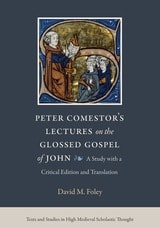
cover of Peter Comestor's Lectures on the Glossed Gospel of John: A Study with a Critical Edition and Translation

Peter Comestor's Lectures on the Glossed Gospel of John

A Study with a Critical Edition and Translation

Peter Comestor

Catholic University of America Press, 2023

This monograph encompasses the first critical edition, translation, and historical study of a series of lectures from the cathedral school of Notre-Dame, Peter Comestor’s Glosses on the Glossed Gospel of John. Delivered in Paris in the mid-1150s, Comestor’s expansive lecture course on the Glossa ordinaria on the Gospel of John has survived in no fewer than seventeen manuscript witnesses, being preserved in the form of continuous transcripts taken in shorthand by a student-reporter (reportationes). The editor has selected the fifteen best witnesses to produce a critical edition and translation of the first chapter of Comestor’s lectures on the Gospel of John. In addition to the text of the original lectures, the edition includes appendices containing accretions to the lecture materials added by Comestor and his students, as well as the corresponding text of the Glossa ordinaria from which Comestor lectured. The Latin text and translation of Peter Comestor’s lectures are preceded by a wide-ranging critical study of the historical and intellectual context of Peter Comestor’s biblical teaching. This study begins with an outline of Comestor’s scholastic career and known works, with a detailed introduction to his Gospel lectures and the relevant historiography. Subsequently, a survey is made of the intellectual landscape of Comestor’s lectures: namely, the tradition of biblical teaching originating at the School of Laon, preserved in the Glossa ordinaria, and developed in the classroom by Peter Lombard and a succession of Parisian masters, notably Comestor himself. The following section examines the portion of the lectures presented in this book, encompassing an overview of its contents and structure, a description of Comestor’s teaching method and scholastic setting, a study of the text’s sources, and a consideration of Comestor’s participation and reception in the scholastic tradition. The final chapters contain a careful description of the manuscripts and editorial principles adopted in the Latin edition and translation.
[more]
cover of Peter Comestor's Lectures on the Gospel of Luke and its Glosses

Peter Comestor's Lectures on the Gospel of Luke and its Glosses

Peter Comestor

Catholic University of America Press, 0

Through a partial critical edition and study of Peter Comestor’s lectures, this volume recontextualizes the biblical exegesis of the twelfth-century Latin cathedral schools within the frameworks of the study of ars grammatica, underscoring the importance of the master-disciple relationship in forming medieval exegetical schools of thought. This study critically examines the Latin biblical lectures of Peter Comestor, a twelfth-century scholar based in Paris, focusing on his commentary on the Gospel of Luke and its glossing tradition. The study positions Comestor’s lectures among Latin biblical commentaries produced in the cathedral schools of Laon and Paris, a vital intellectual movement shaped by well-known figures such as Anselm of Laon and Peter Lombard, and which provided the foundations for the University of Paris. Recent scholarship has sought to bridge the gap between biblical commentaries and systematic theological treatises by highlighting the shared didactic methodologies between the medieval study of the liberal arts and sacred scripture. This study of Comestor’s Luke lectures expands these efforts, underscoring the role of classical philology and liberal arts pedagogy in shaping medieval theological thought. The volume highlights how the cathedral school scholars of northern France approached Christian theology as a work of textual criticism, exploring a wide range of subjects—from geometry to canon law—through biblical interpretation. By tracing these intellectual traditions, the study uncovers the pedagogical practices that informed the understanding of Christian biblical exegesis in the Latin Middle Ages, particularly in the period leading up to the establishment of Europe’s first universities and theology faculties.
[more]
cover of Peter Lombard and the Biblical Gloss: Textual Fluidity in Mid-Twelfth-Century Paris

Peter Lombard and the Biblical Gloss

Textual Fluidity in Mid-Twelfth-Century Paris

Mark Clark

Catholic University of America Press, 2026
This monograph presents altogether new and substantial evidence showing that the view of the development of Scholasticism and Scholastic thought going back three centuries at least is mistaken. Peter Lombard's Sentences and his career did not mark and mirror a transition from the traditional biblical theology to the newer systematic theology, as so long supposed. Rather, the traditional genres of medieval theology served as the indispensable foundation for the development of new forms for teaching Christian doctrine to clerics, forms organized systematically. The Bible was not displaced or abandoned in favor of various summas but was rather integrated into a medieval theology that looks surprisingly like the ideal of the Second Vatican Council. Dei Verbum, the dogmatic constitution that deals with the place of Sacred Scripture, doesn't mention the Schoolmen, because longstanding historiography on Scholastic thought in the High Middle Ages misled popes and prelates into supposing the medieval theology had abandoned the Bible in favor of cold, logical, systematic treatises. In fact, however, Peter Lombard, Bonaventure, Thomas Aquinas and many others could themselves have authored Dei Verbum, which reads like the prologues and primers that the masters teaching theology to clerics in the High Middle Ages wrote themselves.
[more]
cover of Pope Francis and the Search for God in America: The Significance of His Early Visits to the Americas

Pope Francis and the Search for God in America

The Significance of His Early Visits to the Americas

Maria Clara Bingemer

Catholic University of America Press, 2021
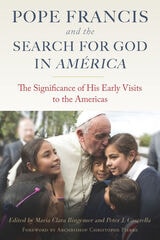
In Tutti Fratelli, Pope Francis has called again for a “culture of encounter,” But how should his theology, pastoral practice, and social message be understood and applied in the Church of the Americas, a single but complex reality that extends from South to North? This volume offers analyses from experts looking back to the Argentine pontiff’s first fateful encuentros in the Americas as a help for understanding the present reality of the Church in the Western Hemisphere. The group includes theologians, historians, and political scientists, and the unique contribution of the volume lies in the panoramic perspective offered by the book as a whole. The initial essays set the stage for the volume as a whole, offering rich insight into Argentine and Latin American history, the world from which the Pope came and to which he returned in 2015, as well as surveying the impact of the Latin American “theology of the people” on the Pope’s visit to the U.S. Additional essays address theological, historical, and pastoral engagements that cut across several of the visits. The final group of essays is dedicated to the visits themselves and is arranged in the order that they occurred. Pope Francis and the Search for God in América is offered to all the members of the Church in América, South and North, old and young, with the hope that it will spur even more thought, reflection, prayer, and service.
[more]
cover of Portraits of a Generation: Early Pentecostal Leaders

Portraits of a Generation

Early Pentecostal Leaders

James Goff

University of Arkansas Press, 2002

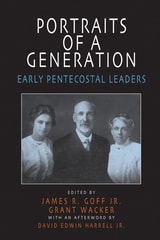
A spirit of religious revival blazed across the United States just after 1900. With a focus on Holy Spirit power, early adherents stirred an enthusiastic response, first at a Bible school in Topeka and then in a small mission on Asuza Street in Los Angeles. Almost immediately, the movement spread to Houston, Chicago, and then northeastern urban centers. By the early 1910s the fervor had reached most parts of the United States, Canada, and northern Mexico, and eventually the converts called themselves pentecostals. Today there are pentecostals all over the world. From the beginning the movement was unusually diverse: women and African Americans were active in many of the early fellowships, and although some groups were segregated, some were interracial. Everytwhere, ordinary people passionately devoted themselves to salvation, Holy Ghost baptism evidenced by speaking in tongues, divine healing, and anticipation of the Lord’s imminent return.

This movement saw itself as leaderless, depending on individual conversion and a radical equality of souls — or, as early devotees would say, on the Holy Spirit. But a closer look reveals a host of forceful, clear-eyed leaders. This volume offers twenty biographical portraits of the first-generation pioneers who wove the different strands of Holy Spirit revivalism into a coherent and dramatically successful movement.
[more]
cover of Prefaces to Canon Law Books in Latin Christianity: Selected Translations, 500-1317, second edition

Prefaces to Canon Law Books in Latin Christianity

Selected Translations, 500-1317, second edition

Robert Somerville

Catholic University of America Press, 2021

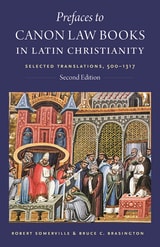
An updated and expanded version of the original edition, published in 1998. That original edition went up through 1245. This new version extends to 1317 and adds two important prefaces. Praise for the First Edition “Both students and specialists can be grateful to the authors for this major contribution in English to the study of medieval canon law. It is a clear statement--one emphasized by the late John Gilchrist-that because of its critical importance in medieval life and culture canon law should not remain the obscure domain of specialists, but should be shared with students and non-specialists alike.” – The American Journal of Legal History “[A] learned and useful book, which for the first time assembles a body of canonistic prefaces, presents them in an accessible form, and provides students of medieval canonical thought with a valuable new resource for study and teaching.” – The Catholic Historical Review “This volume is an important and welcome addition to a field of studies where translations into English are few and far between. The breadth of the works selected, the quality of the translations, and the attention to detail that has long characterized the work of both editors make this a valuable resource for specialist and student alike.” – Church History “A welcome combination: a text that is informative for students and professionals alike. The translations succeed in rendering accessible to a general audience some otherwise highly inaccessible material. Somerville and Brasington are to be greatly commended for undertaking this very original enterprise and bringing it to successful parturition.” – Journal of Law and Religion “Somerville and Brasington have chosen to let their compilers and commentators speak for themselves. In doing so, they have had to wrestle with often obscure Latin and frequently less than satisfactory editions. That they succeed in making these texts intelligible through translation and annotation is no small feat.” – Sixteenth Century Journal “This is a significant, elegantly presented contribution to the field of theology, cultural history, and canon law.” – Theological Studies
[more]