95 books match the query 'Christian Living' and 4 start with p
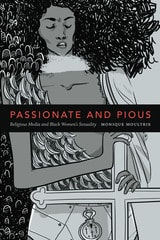
cover of Passionate and Pious: Religious Media and Black Women's Sexuality

Passionate and Pious

Religious Media and Black Women's Sexuality

Monique Moultrie

Duke University Press, 2018

In Passionate and Pious Monique Moultrie explores the impact of faith-based sexual ministries on black women's sexual agency to trace how these women navigate sexuality, religious authority, and their spiritual walk with God. Providing churchwomen a space to candidly discuss these issues, these popular ministries exist largely beyond the traditional church, with dialogues about sex taking place in chat rooms and through text messages, social media, email, and other media. Moultrie foregrounds televangelist Juanita Bynum's construction of the black Christian sexual identity these ministries promote while emphasizing how churchwomen reconcile these prescriptive identities with their individual experiences. What does it mean for senior women to exercise sexual agency when their church standing could be questioned? What does celibacy mean for women who experience same-sex desire while believing that such desire goes against God's will? Advancing a womanist sexual ethics, Moultrie reframes biblical interpretations and conceptions of what constitutes a healthy relationship to provide a basis for sexual decision making that does not privilege monogamy or deny female pleasure, thereby calling on black churchwomen to experience responsible and life-enhancing sex.
[more]
cover of Piercing the Clouds: Lectio Divina and the Preparation for Ministry

Piercing the Clouds

Lectio Divina and the Preparation for Ministry

Kevin Zilverberg

Saint Paul Seminary Press, 2021
This book’s six essays pertain to the “piercing of the clouds,” or the experience of heavenly mysteries, which characterizes lectio divina practiced well. Moreover, these peer-reviewed essays give special attention to the practice of lectio divina during preparation for ministry, especially the ministry of Catholic priests. That being said, any current or prospective Bible-reader may profit from this book; most of its content applies to Catholic seminarians and literate Christians alike. Here follow brief descriptions of each chapter. Laurence Kriegshauser, OSB, begins the book with a chapter on the Western monastic tradition of lectio divina and seminary formation, including an historical survey of lectio divina, a description of its characteristics, and reflections on its practice in seminaries. Michael Magee reflects upon the implications of exegetical method for lectio divina, with a comparison and critique of three commentaries’ treatments of John 6. Konrad Schaefer, OSB, advocates for fostering growth and formation through lectio divina, beginning his chapter with a description of its theological underpinnings and then taking up some practical considerations for students. Marcin Kowalski focuses on meditatio of lectio divina following upon exegesis-informed lectio, with an examination of Romans 7:7–25 as a test case. Daniel Keating examines oratio and contemplatio (and actio) of lectio divina, giving attention to theologians from twelfth-century Carthusian Prior Guigo II to Pope Benedict XVI. Anthony Giambrone, OP, contributes the final essay, on searching the Scriptures and the mystery of preaching. For him, exquisitio (intellectual engagement) leads to supplicatio (prayerful supplication), which culminates in praedicatio (preaching).
[more]
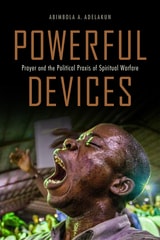
cover of Powerful Devices: Prayer and the Political Praxis of Spiritual Warfare

Powerful Devices

Prayer and the Political Praxis of Spiritual Warfare

Abimbola Adunni Adelakun

Rutgers University Press, 2023
Powerful Devices studies spiritual warfare performances as an apparatus for disestablishing structures of power and knowledge, and establishing righteousness in their stead. Drawing on performance studies’ emphasis on radicality and breaking of social norms as devices of social transformation, the book demonstrates how Christian groups with dominant cultural power but who perceive themselves as embattled wield the ideas of performance activism. Combining religious studies with ethnography, Powerful Devices explores Nigerian Pentecostals and US Evangelicals’ praxis of transnational spiritual warfare. By closely studying spiritual warfare prayers as a “device,” Powerful Devices shows how the rituals of prayer enable an apprehension of time, paradigms of self-enhancement, and the subversion of politics and authority. A critical intervention, Powerful Devices explores charismatic Christianity’s relationship to science and secular authority, technology and temporality, neoliberalism, and reactionary ideology.
[more]
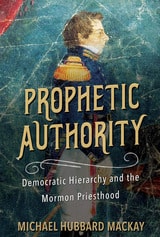
cover of Prophetic Authority: Democratic Hierarchy and the Mormon Priesthood

Prophetic Authority

Democratic Hierarchy and the Mormon Priesthood

Michael Hubbard MacKay

University of Illinois Press, 2020

The Mormon tradition's emphasis on prophetic authority makes the Church of Jesus Christ of Latter-day Saints unique within America's religious culture. The religion that Joseph Smith created established a kingdom of God in a land distrustful of monarchy while positioning Smith as Christ's voice on earth, with the power to form cities, establish economies, and arrange governments.

Michael Hubbard MacKay traces the Church of Jesus Christ of Latter-day Saints' claim to religious authority and sets it within the context of its times. Delving into the evolution of the concept of prophetic authority, MacKay shows how the Church emerged as a hierarchical democracy with power diffused among leaders Smith chose. At the same time, Smith's settled place atop the hierarchy granted him an authority that spared early Mormonism the internal conflict that doomed other religious movements. Though Smith faced challenges from other leaders, the nascent Church repeatedly turned to him to decide civic plans and define the order of both the cosmos and the priesthood.

[more]