63 books match the query 'Christian Ministry' and 5 start with p
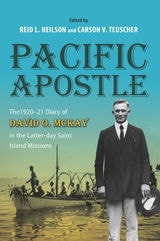
cover of Pacific Apostle: The 1920-21 Diary of David O. McKay in the Latter-day Saint Island Missions

Pacific Apostle

The 1920-21 Diary of David O. McKay in the Latter-day Saint Island Missions

David O. McKay, Edited by Reid L. Neilson and Carson V. Teuscher

University of Illinois Press, 2020

In 1920, David O. McKay embarked on a journey that forever changed the Church of Jesus Christ of Latter-day Saints. His visits to the Latter-day Saint missions, schools, and branches in the Pacific solidified the Church leadership's commitment to global outreach. As importantly, the trip inspired McKay's own initiatives when he later became Church president. McKay's account of his odyssey brings to life the story of the Church of Jesus Christ’s transformation into a global faith. Throughout his diary, McKay expressed his humanity, curiosity, and fascination with cultures and places--the Maori hongi, East Asian customs, Australian wildlife, and more. At the same time, he and his travel companion, Hugh J. Cannon, detailed the Latter-day Saint missionary life of the era, closely observing logistical challenges and cultural differences, guiding various church efforts, and listening to followers' impressions and concerns. Reid L. Neilson and Carson V. Teuscher's meticulous notes provide historical, religious, and general context for the reader.Blending travelogue with history, Pacific Apostle illuminates the thought and work of an essential figure in the twentieth-century Church of Jesus Christ.
[more]
cover of Piercing the Clouds: Lectio Divina and the Preparation for Ministry

Piercing the Clouds

Lectio Divina and the Preparation for Ministry

Kevin Zilverberg

Saint Paul Seminary Press, 2021
This book’s six essays pertain to the “piercing of the clouds,” or the experience of heavenly mysteries, which characterizes lectio divina practiced well. Moreover, these peer-reviewed essays give special attention to the practice of lectio divina during preparation for ministry, especially the ministry of Catholic priests. That being said, any current or prospective Bible-reader may profit from this book; most of its content applies to Catholic seminarians and literate Christians alike. Here follow brief descriptions of each chapter. Laurence Kriegshauser, OSB, begins the book with a chapter on the Western monastic tradition of lectio divina and seminary formation, including an historical survey of lectio divina, a description of its characteristics, and reflections on its practice in seminaries. Michael Magee reflects upon the implications of exegetical method for lectio divina, with a comparison and critique of three commentaries’ treatments of John 6. Konrad Schaefer, OSB, advocates for fostering growth and formation through lectio divina, beginning his chapter with a description of its theological underpinnings and then taking up some practical considerations for students. Marcin Kowalski focuses on meditatio of lectio divina following upon exegesis-informed lectio, with an examination of Romans 7:7–25 as a test case. Daniel Keating examines oratio and contemplatio (and actio) of lectio divina, giving attention to theologians from twelfth-century Carthusian Prior Guigo II to Pope Benedict XVI. Anthony Giambrone, OP, contributes the final essay, on searching the Scriptures and the mystery of preaching. For him, exquisitio (intellectual engagement) leads to supplicatio (prayerful supplication), which culminates in praedicatio (preaching).
[more]
cover of Praying in the Pine Straw: The Camp-Meeting Experience in Alabama

Praying in the Pine Straw

The Camp-Meeting Experience in Alabama

Robert C. Morgan

University of Alabama Press, 2025

Step into the South’s brush arbors and piney woods where faith runs deep, stories run wild, and the old-time camp meeting was anything but quiet.

Praying in Pine Straw immerses readers in the raw, rollicking, and deeply human world of Alabama’s camp meetings—a Southern tradition where fire-and-brimstone preaching echoed through pine forests and where faith was often accompanied by contradiction. From “treeing the Devil” to “holy laughter,” these revivals blended heartfelt worship with all the complications of human nature. Mule-drawn wagons brought the faithful to rustic camps, where gospel fervor mingled with whiskey traders, local politicians, and opportunists of every kind. Preachers thundered against sin—even as they sometimes flirted with it themselves.

Robert C. Morgan offers a textured portrait of camp meetings as both spiritual experience and cultural spectacle, reviving a Southern tradition that flourished from the late nineteenth to mid-twentieth centuries. With a blend of humor and keen insight, Praying in the Pine Straw unveils the enduring contradictions of “old-time religion” and its significant influence on Southern culture and faith—a legacy that is both treasured and complex.
[more]
cover of Preaching to Convert: Evangelical Outreach and Performance Activism in a Secular Age

Preaching to Convert

Evangelical Outreach and Performance Activism in a Secular Age

John Fletcher

University of Michigan Press, 2015

Preaching to Convert offers an intriguing new perspective on the outreach strategies of U.S. evangelicals, framing them as examples of activist performance, broadly defined as acts performed before an audience in the hopes of changing hearts and minds. Most writing about activist performance has focused on left-progressive causes, events, and actors. Preaching to Convert argues against such a constricted view of activism and for a more nuanced understanding of U.S. evangelicalism as a movement defined by its desire to win converts and spread the gospel.
 
The book positions evangelicals as a diverse, complicated group confronting the loss of conservative Christianity’s default status in 21st-century U.S. culture. In the face of an increasingly secular age, evangelicals have been reassessing models of outreach. In acts like handing out Bible tracts to strangers on the street or going door-to-door with a Bible in hand, in elaborately staged horror-themed morality plays or multimillion-dollar creationist discovery centers, in megachurch services beamed to dozens of satellite campuses, and in controversial “ex-gay” ministries striving to return gays and lesbians to the straight and narrow, evangelicals are redefining what it means to be deeply committed in a pluralist world. The book’s engaging style and careful argumentation make it accessible and appealing to scholars and students across a range of fields.
[more]
cover of Preaching to Latinos: Welcoming the Hispanic Moment in the U.S. Church

Preaching to Latinos

Welcoming the Hispanic Moment in the U.S. Church

Michael Kueber

Catholic University of America Press, 2022

There is a wide and growing gap in the Catholic Church in the United States between the clergy, who are mostly of European descent, and the large percentages of Catholics who identify as Latinos. While the US Church has made a concerted effort to build Hispanic ministries, many clergy and lay ministers are still ill-equipped to understand the cultural background of their parishioners, especially the large numbers who are foreign born. Because of this disconnect, the Church risks missing "the Hispanic Moment" in the US Church, in which the faith and traditions of these newest waves of US immigration could not just exist in parallel to English-language congregations, but enrich and enliven the faith of the whole community while passing on the faith to subsequent generations. Learning Spanish--while helpful--is not enough. There are intercultural competencies that can only be developed through practice, but it also helps already-busy clergy to have a concise guide. In addition to knowing the scholarly literature on cross-cultural preaching and Hispanic culture, Father Michael Kueber has twenty years of experience serving first generation Hispanic immigrants and their second generation children. In Preaching to Latinos, Kueber provides the readers with best practices for preaching to and leading their churches. As a member of an ecumenical community, he is able to speak to members of all Christian denominations.
[more]