496 books match the query 'Christian Theology' and 27 start with p
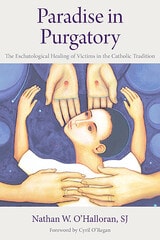
cover of Paradise in Purgatory: The Eschatological Healing of Victims in the Catholic Tradition

Paradise in Purgatory

The Eschatological Healing of Victims in the Catholic Tradition

Nathan W. O'Halloran

Catholic University of America Press, 2024
The claim of this book is that it is a precondition for Heaven that victims experience an eschatological healing of their other-inflicted wounds. Nathan O’Halloran, SJ, argues that the best theological space in which to locate this eschatological healing is in what he terms Paradise-in-Purgatory. The doctrine of Purgatory developed as a postmortem theological category for addressing sins committed after baptism and for which adequate penance has not been completed before death. In its full doctrinal articulations at Lyons II, Florence, and Trent, Purgatory is a doctrine concerned with personal, self-inflicted sin. Victims, on the other hand, require healing from other-inflicted sin rather than self-inflicted sin. For this reason, a certain expansion of this Catholic doctrine is required to make theological space for victims. O’Halloran argues that he has found that theological space within the Church’s ample tradition. The wellspring from which the doctrine of Purgatory emerged contains a richer content than has been represented thus far by conciliar definitions. Paradise in Purgatory maintains that the soteriological logic out of which Purgatory developed can be extended also to the postmortem healing of victims, and the soteriological logic of the New Testament supports this conclusion. Using as fundamental touchstones the wiping away of victims’ tears in the Book of Revelation, and the healing of Dinocrates through the prayers of his sister Perpetua in the Passion of Perpetua and Felicity, O’Halloran argues that victims must have an opportunity to experience full postmortem salvation from other-inflicted sin. The volume concludes that Purgatory can be theologically expanded to include a Paradise-in-Purgatory, i.e., a process that heals the other-inflicted wounds of sin which victims carry with them through death. The wounds of victims cannot be eschatologically discarded but must be subjected to the healing salvation which Christ came to offer.
[more]
cover of Paradox at Play: Metaphor in Meister Eckhart's Sermons: with previously unpublished sermons

Paradox at Play

Metaphor in Meister Eckhart's Sermons: with previously unpublished sermons

Clint Johnson

Catholic University of America Press, 2022
Fresh translations of Meister Eckhart’s sermons are made available in this volume: three for the first time in English and sixteen others for the first time since C. de B. Evans translated them in 1924 and 1931, long before the critical editions of the manuscripts were published in 2003. Other important sermons are included in the translations as well. They improve upon previous translations which were not as sensitive to Eckhart’s metaphorical repertoire and his subtle word choice and phrasing. The extended introductory essay describes Eckhart’s metaphors and how they work together to form a cohesive whole. By looking at what his metaphors tell us about what an individual person is and how the view of the individual changed in the late medieval world, his ostensibly shocking rhetoric (in places where it is actually novel) is shown to be indicative of a larger cultural tide that culminated in the modern worldview. Finally, all of his homiletic choices are shown to be in service of the greater goal: catalyzing transformative change in his audience by stubbornly insisting on his paradoxes and jarring people out of their customary way of relating to God and themselves.
[more]
cover of Patristic Exegesis in Context: Exploring the Genres of Early Christian Biblical Interpretation

Patristic Exegesis in Context

Exploring the Genres of Early Christian Biblical Interpretation

Miriam De Cock

Catholic University of America Press, 2023
The essays of Patristic Exegesis in Context examine the biblical exegesis of early Christians beyond the formal genre of biblical commentary. The past couple of decades have seen a broadening of perspective on the study of patristic exegesis; the phenomenon is increasingly situated within its various literary contexts and genres, and the definition of what counts as patristic exegesis is therefore widened. This volume thus situates itself within this emerging scholarly tradition, which aims not to give an account of exegetical strategies and methodologies as found primarily in exegetical commentaries and homilies, but to demonstrate the highly sophisticated nature of biblical exegesis in other genres, and the manifold uses to which this exegesis was put. Ancient Christian authors lived and breathed scripture; it served as their primary source of theological and liturgical vocabulary, their way of processing the world, their social ethic, and their mode of constructing self and communal identity. Scripture therefore permeates all ancient Christian literature, regardless of genre, and the various contexts in which interpretation of scripture took place resulted in a wide variety of uses of the church’s authoritative texts. The essays in this volume demonstrate the interpretive skill, creativity, and sophistication of early Christian authors in a myriad of other early Christian genres, such as poetry, paraphrase, hymns, martyr accounts, homilies, prophetic vision accounts, monastic writings, argumentative treatises, encomia, apocalypses, and catenae. Accordingly, the volume aims to help the modern person, who is used to hearing the Bible explained in explicitly expository situations (for example, in academic commentaries or religious sermons) to become more habituated to ancient ways of interacting with and expounding the biblical text. These essays attempt to contextualize various types of patristic exegesis, in order for us to glimpse the complex and diverse uses of the Bible in this period.
[more]
cover of Peace in the Thought of Thomas Aquinas: Philosophy, Theology, and Ethics

Peace in the Thought of Thomas Aquinas

Philosophy, Theology, and Ethics

John M. Meinert

Catholic University of America Press, 2024
What does Aquinas have to teach us on the topic of peace? Looking over the scholarly literature, one would think very little. Most Thomists ignore Aquinas’s thought on peace. Most peace researchers summarily dismiss Aquinas. Peace in the Thought of Thomas Aquinas challenges both these trends and offers the first book length study of peace in Aquinas’s thought. John Meinert outlines Aquinas's historical predecessors, then provides an exposition and interpretation of the full scope of Aquinas's thought on peace: metaphysics, Trinitarian theology, Christology, Pneumatology, ecclesiology, natural theology, ethics, and sacramental theology. What emerges from this extended study is a new vision of Aquinas’s work. Peace in the Thought of Thomas Aquinas establishes Aquinas as an indispensable dialogue partner for anyone thinking rigorously about the theology, philosophy, and ethics of peace. As Aquinas himself says, “observe peace and you will come to salvation.”
[more]
cover of Perfecting Human Actions: St. Thomas Aquinas on Human Participation in Eternal Law

Perfecting Human Actions

St. Thomas Aquinas on Human Participation in Eternal Law

John Rziha

Catholic University of America Press, 2009
During the last few centuries, a practical dichotomy between God and humans has developed within moral theory. As a result, moral theory tends to focus only on humans where human autonomy is foundational or only on God where divine commands capriciously rule. However, the moral theology of Thomas Aquinas overcomes this dichotomy. For Thomas, humans reach their perfection by participating in God's wisdom and love. Perfecting Human Actions explores the ways humans participate in eternal law--God's wisdom that guides and moves all things to their proper action. The book begins with a thoughtful examination of the philosophic recovery of the notion of participation in Thomistic metaphysics. It then explains Thomas's theological understanding of the notion of participation to show how humans are related to God. It is discovered that when performing human actions, humans participate in the eternal law in two ways: as moved and governed by it, and cognitively. In reference to participation as moved and governed, humans are directed by God to their proper end of eternal happiness. This mode of participation can be increased by perfecting the natural inclinations through virtue, grace, and the gifts of the Holy Spirit. In reference to cognitive participation, humans as rational creatures can know their proper end and how to attain it. Through this knowledge of moral truths, the intellect participates in the eternal law. Cognitive participation is perfected by the intellectual virtues (especially faith) and the gifts of the Holy Spirit (especially wisdom). The book concludes by showing how the notion of human participation in the eternal law is a much better foundation for moral theory than the contemporary notion of autonomy.
[more]
cover of Personal Catholicism: The Theological Epistemologies of John Henry Newman and Michal Polanyi

Personal Catholicism

The Theological Epistemologies of John Henry Newman and Michal Polanyi

Martin X. Moleski

Catholic University of America Press, 2020
"Both Newman and Polanyi rank high among the pioneers in the history of the post-critical movement in epistemology. They pointed out the limitations of the methods that had become current since the time of Descartes and Spinoza. . . . The systems of these two authors are exceptionally useful for dealing with the major issues that trouble the theological climate today."—From the Foreword by Avery Dulles, S.J. "This engaging and lucid study brings into dialogue two thinkers whose methods share much in common despite their different purposes. . . . A principal contribution of Moleski's study is its cultivation of the common ground that religion shares with science."—Theological Studies "An important and utterly engaging study. . . . Those familiar with Newman's Grammar of Assent and Polanyi's Personal Knowledge will appreciate the ways in which Moleski makes sometimes unexpected connections between the two thinkers, despite Polanyi's critical disposition toward Catholicism. Personal Catholicism is a most welcome contribution to today's rethinking of the relationship between faith and reason."—First Things "There is a wealth of material here that could be applied to issues of faith and reason, science and faith, faith and the nature of reality as they are raised in contemporary society. . . ."—The Gospel and Our Culture
[more]
cover of Personalist Papers

Personalist Papers

John F. Crosby

Catholic University of America Press, 2004
In Personalist Papers, John F. Crosby continues the discussion of Christian personalism begun in his highly acclaimed book, The Selfhood of the Human Person.
[more]
cover of Persons of the Market: Conservatism, Corporate Personhood, and Economic Theology

Persons of the Market

Conservatism, Corporate Personhood, and Economic Theology

Kevin Musgrave

Michigan State University Press, 2022

Taking corporate personhood as a starting point, Persons of the Market observes the complex historical entanglement of Christian theology and liberal capitalism to shed new
light on their seemingly odd marriage in contemporary American politics. Author Kevin Musgrave highlights the ways that theories of corporate and human personhood have long been and remain bound together by examining four case studies: the U.S. Supreme Court’s 1886 Santa Clara decision, the role of early twentieth-century advertisers in endowing corporations with souls, Justice Lewis Powell Jr.’s eponymous memo of 1971, and the arc of the conservative movement from Ronald Reagan to Donald Trump. Tracing this rhetorical history of the extension and attribution of personhood to the corporate form illustrates how the corporation has for many increasingly become a normative model or ideal to which human persons should aspire. In closing, the book offers preliminary ideas about how we might fashion a more democratic and humane understanding of what it means to be a person.
[more]
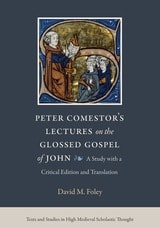
cover of Peter Comestor's Lectures on the Glossed Gospel of John: A Study with a Critical Edition and Translation

Peter Comestor's Lectures on the Glossed Gospel of John

A Study with a Critical Edition and Translation

Peter Comestor

Catholic University of America Press, 2023

This monograph encompasses the first critical edition, translation, and historical study of a series of lectures from the cathedral school of Notre-Dame, Peter Comestor’s Glosses on the Glossed Gospel of John. Delivered in Paris in the mid-1150s, Comestor’s expansive lecture course on the Glossa ordinaria on the Gospel of John has survived in no fewer than seventeen manuscript witnesses, being preserved in the form of continuous transcripts taken in shorthand by a student-reporter (reportationes). The editor has selected the fifteen best witnesses to produce a critical edition and translation of the first chapter of Comestor’s lectures on the Gospel of John. In addition to the text of the original lectures, the edition includes appendices containing accretions to the lecture materials added by Comestor and his students, as well as the corresponding text of the Glossa ordinaria from which Comestor lectured. The Latin text and translation of Peter Comestor’s lectures are preceded by a wide-ranging critical study of the historical and intellectual context of Peter Comestor’s biblical teaching. This study begins with an outline of Comestor’s scholastic career and known works, with a detailed introduction to his Gospel lectures and the relevant historiography. Subsequently, a survey is made of the intellectual landscape of Comestor’s lectures: namely, the tradition of biblical teaching originating at the School of Laon, preserved in the Glossa ordinaria, and developed in the classroom by Peter Lombard and a succession of Parisian masters, notably Comestor himself. The following section examines the portion of the lectures presented in this book, encompassing an overview of its contents and structure, a description of Comestor’s teaching method and scholastic setting, a study of the text’s sources, and a consideration of Comestor’s participation and reception in the scholastic tradition. The final chapters contain a careful description of the manuscripts and editorial principles adopted in the Latin edition and translation.
[more]
cover of Peter Comestor's Lectures on the Gospel of Luke and its Glosses

Peter Comestor's Lectures on the Gospel of Luke and its Glosses

Peter Comestor

Catholic University of America Press, 0

Through a partial critical edition and study of Peter Comestor’s lectures, this volume recontextualizes the biblical exegesis of the twelfth-century Latin cathedral schools within the frameworks of the study of ars grammatica, underscoring the importance of the master-disciple relationship in forming medieval exegetical schools of thought. This study critically examines the Latin biblical lectures of Peter Comestor, a twelfth-century scholar based in Paris, focusing on his commentary on the Gospel of Luke and its glossing tradition. The study positions Comestor’s lectures among Latin biblical commentaries produced in the cathedral schools of Laon and Paris, a vital intellectual movement shaped by well-known figures such as Anselm of Laon and Peter Lombard, and which provided the foundations for the University of Paris. Recent scholarship has sought to bridge the gap between biblical commentaries and systematic theological treatises by highlighting the shared didactic methodologies between the medieval study of the liberal arts and sacred scripture. This study of Comestor’s Luke lectures expands these efforts, underscoring the role of classical philology and liberal arts pedagogy in shaping medieval theological thought. The volume highlights how the cathedral school scholars of northern France approached Christian theology as a work of textual criticism, exploring a wide range of subjects—from geometry to canon law—through biblical interpretation. By tracing these intellectual traditions, the study uncovers the pedagogical practices that informed the understanding of Christian biblical exegesis in the Latin Middle Ages, particularly in the period leading up to the establishment of Europe’s first universities and theology faculties.
[more]
cover of Peter Lombard and the Biblical Gloss: Textual Fluidity in Mid-Twelfth-Century Paris

Peter Lombard and the Biblical Gloss

Textual Fluidity in Mid-Twelfth-Century Paris

Mark Clark

Catholic University of America Press, 2026
This monograph presents altogether new and substantial evidence showing that the view of the development of Scholasticism and Scholastic thought going back three centuries at least is mistaken. Peter Lombard's Sentences and his career did not mark and mirror a transition from the traditional biblical theology to the newer systematic theology, as so long supposed. Rather, the traditional genres of medieval theology served as the indispensable foundation for the development of new forms for teaching Christian doctrine to clerics, forms organized systematically. The Bible was not displaced or abandoned in favor of various summas but was rather integrated into a medieval theology that looks surprisingly like the ideal of the Second Vatican Council. Dei Verbum, the dogmatic constitution that deals with the place of Sacred Scripture, doesn't mention the Schoolmen, because longstanding historiography on Scholastic thought in the High Middle Ages misled popes and prelates into supposing the medieval theology had abandoned the Bible in favor of cold, logical, systematic treatises. In fact, however, Peter Lombard, Bonaventure, Thomas Aquinas and many others could themselves have authored Dei Verbum, which reads like the prologues and primers that the masters teaching theology to clerics in the High Middle Ages wrote themselves.
[more]
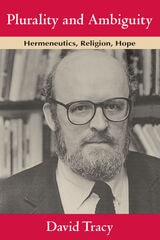
cover of Plurality and Ambiguity: Hermeneutics, Religion, Hope

Plurality and Ambiguity

Hermeneutics, Religion, Hope

David Tracy

University of Chicago Press, 1994
In Plurality and Ambiguity, David Tracy lays the philosophical groundwork for a practical application of hermeneutics, while constructing an innovative model of theological interpretation developed out of the notions of conversation and argument. He concludes with an appraisal of the religious significance of hope in an age of radically different voices and constantly shifting meanings.
[more]
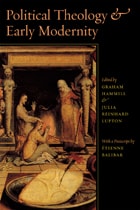
cover of Political Theology and Early Modernity

Political Theology and Early Modernity

Edited by Graham Hammill and Julia Reinhard Lupton

University of Chicago Press, 2012
Political theology is a distinctly modern problem, one that takes shape in some of the most important theoretical writings of the twentieth and twenty-first centuries. But its origins stem from the early modern period, in medieval iconographies of sacred kinship and the critique of traditional sovereignty mounted by Hobbes and Spinoza. In this book, Graham Hammill and Julia Reinhard Lupton assemble established and emerging scholars in early modern studies to examine the role played by sixteenth- and seventeenth-century literature and thought in modern conceptions of political theology.
 
Political Theology and Early Modernity explores texts by Shakespeare, Machiavelli, Milton, and others that have served as points of departure for such thinkers as Schmitt, Strauss, Benjamin, and Arendt. Written from a spectrum of positions ranging from renewed defenses of secularism to attempts to reconceive the religious character of collective life and literary experience, these essays probe moments of productive conflict, disavowal, and entanglement in politics and religion as they pass between early modern and modern scenes of thought. This stimulating collection is the first to answer not only how Renaissance and baroque literature help explain the persistence of political theology in modernity and postmodernity, but also how the reemergence of political theology as an intellectual and political problem deepens our understanding of the early modern period.
[more]
cover of Powers of Distinction: On Religion and Modernity

Powers of Distinction

On Religion and Modernity

Nancy Levene

University of Chicago Press, 2017

In this major new work, philosopher of religion Nancy Levene examines the elemental character of religion and modernity. Deep in their operating systems, she argues, are dualisms of opposition and identity that cannot be reconciled with the forms of life they ostensibly support. These dualisms are dead ends, but they conceal a richer position—another kind of dualism constitutive of mutual relation. This dualism is difficult to distinguish and its concept of relation difficult to commit to. It risks contention and even violence. But it is also the indispensable support for modernity’s most innovative ideals: democracy, criticism, and interpretation.
 
In readings from Abraham to the present, Levene recovers this richer dualism in its difference from the alternatives—other dualisms, nondualism, multiplication. From Abraham we get the biblical call to give up tribal belonging for a promised land of covenantal relation. Yet modernity, inclusive of this call, is also the principle that critiques the promise when it divides self from other, us from them.

Drawing on a long tradition of thinkers and scholars even as she breaks new ground, Levene offers here nothing less than a new way of understanding modernity as an ethical claim about our world, a philosophy of the powers of distinction to include rather than to divide.
 
[more]
cover of Preaching in Arduous Times: Outline of Perspectives from the Hebrews Sermon

Preaching in Arduous Times

Outline of Perspectives from the Hebrews Sermon

Maarten Kater

Central European University Press, 2026
The overarching research question which is answered in this study by means of several different angles is: ‘What kind of perspectives could an investigation of the Hebrews sermon o er to the homiletical praxis of people living in arduous times?’. This study want to indicate and illustrate that the Hebrews sermon o ers piercing perspectives for the discipline of homiletics and, moreover, the wider field of practical theology, especially dealing with the formative aspects of worship, preaching, and attitudes. Hebrews is on the God who speaks to us ‘today’ from the very start. But what in the world does it mean when we use this language in our four-dimensional space-time as it is mediated and embodied speech? It turns out that in this canonical sermon many directions for a homiletical theory are to be considered and to process. The three dimensions of time, the value of religious spaces, the art of persuasion, preaching Christ as sacramentum and exemplum which is listener-orientated communication at the same time, the bifurcation of explanation and application, the theology of language. Moreover, Hebrews is connected with the formation and developing of attitudes in the various spheres as cognitive, affective, behavioural, interpersonal, social and political. Each time has its arduous aspects. This study aims to stimulate preaching in these times, sometimes within weary and worn -out congregations, and to encourage the fainthearted preachers and listeners by means of a sermon as a song of love. If you would like to order the book for delivery outside of the Netherlands, please email orders@aup.nl
[more]
cover of Principles of Catholic Theology, Book 1: On the Nature of Theology

Principles of Catholic Theology, Book 1

On the Nature of Theology

Thomas Joseph White, OP

Catholic University of America Press, 2023
Catholic theology has to face a certain number of fundamental questions: what is the nature and content of Christian revelation, what are the sources of revelation, how are the mysteries of the faith to be understood in relation of one to another, and how do the truths of the Catholic faith relate to the acquisitions of natural reason. In the contemporary context, Catholic theology is marked by a diversity of approaches, many of which are seemingly incompatible or estranged from one another. How might we think about the unity of Catholic theology over and above the diversity of forms? What role, if any, can Aquinas play as a common doctor in facilitating exchanges between theological traditions in the Church? Principles of Catholic Theology seeks to address directly the nature of Catholic theology and the challenge of its contemporary articulation with an eye towards its articulation in its Thomistic key. This book is also the first of a series of collections of essays by Thomas Joseph White, OP, extending over a range of fundamental topics in Catholic dogmatic theology.
[more]
cover of Principles of Catholic Theology, Book 2: On the Rational Credibility of Christianity

Principles of Catholic Theology, Book 2

On the Rational Credibility of Christianity

Thomas Joseph White, OP

Catholic University of America Press, 2023
Can a philosopher defend the rational warrant for belief in Christianity? Is it reasonable to be religious? Is it philosophically responsible to be a Christian who believes in the mystery of the Trinity? Principles of Catholic Theology explores these questions in a systematic way by considering questions of ultimate explanation. Why not hold that modern atheistic naturalism provides the best explanation of reality? Or, if there is a transcendent first principle that explains all of reality, is it impersonal rather than personal? Contrastingly, if monotheism constitutes the best explanation for created being, how can we reasonably believe in any particular revelation concerning God? What are the criteria for rational belief in revelation? Thomas Joseph White, OP, considers these questions by exploring a series of topics: the transcendentals (existence, oneness, truth, goodness, beauty); rational argument for the existence of God; the immateriality and subsistence after death of the personal soul of the human being; the historical and conceptual coherence of Trinitarian doctrine; and the reasonableness of the natural desire to see God. The aim of Principles of Catholic Theology, Book 2 is to place contemporary natural reason in profound dialogue with the Catholic faith and to think about ways that we can consent to the profound mystery of the Holy Trinity that are in robust concord with the knowledge obtained from philosophical, scientific, and historical sources.
[more]
cover of Principles of Catholic Theology, Book 3: On God, Trinity, Creation, and Christ

Principles of Catholic Theology, Book 3

On God, Trinity, Creation, and Christ

Thomas Joseph White

Catholic University of America Press, 2024
What if anything can human beings know about God, either by way of philosophical reasoning or by divine revelation? How does the mystery of the Incarnation illuminate our understanding of the nature and mystery of God and the nature and destiny of the human person? The essays in this book explore topics pertaining to the nature of God, apophatic theology, divine simplicity and the holy Trinity, divine beauty, and the beauty of creation. The book also contains a series of speculative considerations of Christology: Why did God become human? How ought we understand the two natures of Christ and the topic of the communication of idioms (attribution of both divine and human properties to one person)? There is also a sustained treatment of Jesus' human knowledge and voluntary freedom. Did Jesus understand his own lordship and his unity with the Father and the Holy Spirit, and if so, how? Did Christ's human will always accord with the divine will, and what significance does this idea have for our understanding of the redemption affected by Christ for the whole human race? Through these explorations, principles drawn from Thomas Aquinas and from Thomistic tradition are taken into account as key resources for the adjudication of contemporary theological challenges. Principles of Catholic Theology, Book 3 is a continuation of Fr. Thomas Joseph White's collection of essays, extending over a range of fundamental topics in Catholic dogmatic theology.
[more]
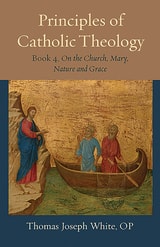
cover of Principles of Catholic Theology, Book 4: On the Church, Mary, Nature and Grace

Principles of Catholic Theology, Book 4

On the Church, Mary, Nature and Grace

Thomas Joseph White

Catholic University of America Press, 2023
In the Nicene Creed Christians profess belief in the Church, "one, holy, catholic, and apostolic." The Church is also called the mystical body of Christ and the bride of Christ. What is the Church and how can we understand her mystery in light of the mystery of Christ? Principles of Catholic Theology, Book 4 explores Catholic ecclesiology and the theology of the Virgin Mary, as an exemplar of the Church's life. It also considers the people of Israel in light of the Church and Christ. The second half of the book considers human nature in light of the grace of Christ, and ecclesial humanity, so as to consider thematic and universal relations of grace to human nature. Major controversies are addressed such as the natural desire to see God and the Thomistic understanding of election and predestination. Effectively this volume seeks to receive and interpret the teaching of the Second Vatican Council Constitution on the Church, Lumen Gentium, within the Thomistic theological tradition and in light of that tradition. Principles of Catholic Theology, Book 4 is a continuation of Fr. Thomas Joseph White's collection of essays, extending over a range of fundamental topics in Catholic dogmatic theology.
[more]
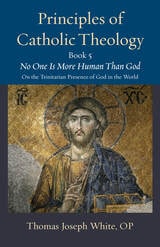
cover of Principles of Catholic Theology, Book 5: No One is More Human Than God: On the Trinitarian Presence of God in the World

Principles of Catholic Theology, Book 5

No One is More Human Than God: On the Trinitarian Presence of God in the World

Thomas Joseph White

Catholic University of America Press, 2026
This work explores a Christian understanding of God’s presence in the world. As the Creator of all that exists, the Creator-Trinity is mysteriously present to all things, and truly but imperfectly knowable as such. In addition to this creative presence, however, there is also the manifestation of God’s presence as a gift of grace. By supernatural faith, the trinitarian life of God is made known to us as an object of the Christian mystical life. This life is centered especially upon God’s unique presence by way of Incarnation, human life, death, and resurrection, in the person of Jesus of Nazareth. This work ex­plores these notions in comparison with other religious traditions, in a Cath­olic as well as ecumenical perspective. Original considerations are offered re­garding the nature of scriptural inspiration, the Church as the mystical body of Christ, and the sacraments as instrumental expressions of the Incarnation, all with a view to the notion of mystical experience, and union with God. Principles of Catholic Theology, Book 5 is a continuation of Fr. Thomas Joseph White’s collection of essays, extending over a range of fundamental topics in Catholic dogmatic theology.
[more]
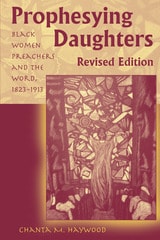
cover of Prophesying Daughters: Black Women Preachers and the Word, 1823-1913

Prophesying Daughters

Black Women Preachers and the Word, 1823-1913

Chanta M. Haywood

University of Missouri Press, 2003

In nineteenth-century America, many black women left their homes, their husbands, and their children to spread the Word of God. Descendants of slaves or former “slave girls” themselves, they traveled all over the country, even abroad, preaching to audiences composed of various races, denominations, sexes, and classes, offering their own interpretations of the Bible. When they were denied the pulpit because of their sex, they preached in tents, bush clearings, meeting halls, private homes, and other spaces. They dealt with domestic ideologies that positioned them as subservient in the home, and with racist ideologies that positioned them as naturally inferior to whites. They also faced legalities restricting blacks socially and physically and the socioeconomic reality of often being part of a large body of unskilled laborers.

Jarena Lee, Julia Foote, Maria Stewart, and Frances Gaudet were four women preachers who endured such hardships because of their religious convictions. Often quoting from the scripture, they insisted that they were indeed prophesying daughters whom God called upon to preach. Significantly, many of these women preachers wrote autobiographies in which they present images of assertive, progressive, pious women—steadfast and unmovable in their religious beliefs and bold in voicing their concerns about the moral standing of their race and society at large.

Chanta M. Haywood examines these autobiographies to provide new insight into the nature of prophesying, offering an alternative approach to literature with strong religious imagery. She analyzes how these four women employed rhetorical and political devices in their narratives, using religious discourse to deconstruct race, class, and gender issues of the nineteenth century.

By exploring how religious beliefs become an avenue for creating alternative ideologies, Prophesying Daughters will appeal to students and scholars of African American literature, women’s studies, and religious studies.
[more]
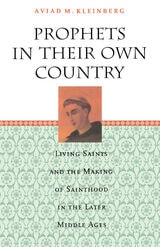
cover of Prophets in Their Own Country: Living Saints and the Making of Sainthood in the Later Middle Ages

Prophets in Their Own Country

Living Saints and the Making of Sainthood in the Later Middle Ages

Aviad M. Kleinberg

University of Chicago Press, 1992

In this original study of the making of saintly reputations, Aviad M. Kleinberg shows how sainthood, though frequently seen as a personal trait, is actually the product of negotiations between particular individuals and their communities. Employing the methods of history, anthropology, and textual criticism, Kleinberg examines the mechanics of sainthood in daily interactions between putative saints and their audiences. This book will interest historians, anthropologists, sociologists, medievalists, and those interested in the study of religion.

"[A] fascinating and sometimes iconoclastic view of saints in the medieval period." —Sandra R. O'Neal, Theological Studies

"[An] important new book. . . . [And] an excellent piece of scholarship." —Diane L. Mockridge, Method & Theory in the Study of Religion

"[Kleinberg's] style is clear and accessible and his observations insightful; the book is a pleasure to read." —Veronica Lawrence, Theological Book Review

"Original and interesting. . . . [Kleinberg] has made a major contribution." —Anne L. Clark, American Historical Review

"Kleinberg's concern is not just with perceptions of sanctity, but, refreshingly, with what actually happened: and he is especially good on the conflict of the two. . . . [This] is not just a book but a way of thought, and one that promises interesting conversations at all levels from the church porch to the tutorial and the academic conference." —Helen Cooper, Times Literary Supplement
[more]
cover of Proportionalism and the Natural Law Tradition

Proportionalism and the Natural Law Tradition

Christopher Kaczor

Catholic University of America Press, 2002

Consequentialism and Catholic ethics seem to be natural enemies. The Catholic prohibition against intentionally killing the innocent, lying, committing adultery, and so on contradicts the very essence of consequentialism that no act may be assessed as good or evil independently of its consequences. However in the 1960s within the Catholic tradition itself, there arose a method in ethics called proportionalism which practically, if not theoretically, affirmed that which consequentialists have long affirmed and Catholic ethicists had so long denied, namely one may do evil that good may come. According to proportionalists, so long as the good effects are proportioned to the bad effects of the act, the act is licit even if evil is used as a means to achieve the good.


In this book, Christopher Kaczor argues against the plausibility of proportionalism and its first proponents, namely Peter Knauer, Joseph Fuchs, Bruno Schüller, Louis Janssens, and Richard McCormick. Examining the genealogy of the movement, he disputes a received history that depicts proportionalism as a recovery of Thomas Aquinas. Instead, contends Kaczor, proportionalism is best seen as the organic successor to the moral manuals of the pre-Vatican II era. Proportionalism arises not from Thomas but rather extends many of the tendencies and presuppositions of the manuals. In particular, it retains their marginalizing of the account of human action as a knowing-willing involving a number of stages not always consciously recognized yet carefully described by Thomas in Summa theologiae, Prima Secundae, 6-17. Kaczor shows that a great deal of the plausibility of proportionalism rests on a fragile foundation that is rapidly eroding, an education in the moral manuals.
[more]
cover of Protestant and Roman Catholic Ethics: Prospects for Rapprochement

Protestant and Roman Catholic Ethics

Prospects for Rapprochement

James M. Gustafson

University of Chicago Press, 1978
"If Catholic and Protestant ethicians were asked to name a single theologian who was qualified to write a comprehensive overview of the historical divergences of Catholic and Protestant positions on ethical questions, the bases for those divergences in fundamentally different philosophical and theological perspectives, and the possibilities for future convergences of the traditions, my guess is that James Gustafson would be the one. . . . This brilliant and tightly argued book . . . will be the most important book on moral theology to appear this year."—John Coleman, National Catholic Reporter
[more]
cover of Pulpits of the Lost Cause: The Faith and Politics of Former Confederate Chaplains during Reconstruction

Pulpits of the Lost Cause

The Faith and Politics of Former Confederate Chaplains during Reconstruction

Steve Longenecker

University of Alabama Press, 2023

A comparison of the faith and politics of former Confederate chaplains with intriguing insights about the evolution of their postwar beliefs and the Lost Cause

Pulpits of the Lost Cause: The Faith and Politics of Former Confederate Chaplains during Reconstruction is the first in-depth study of former chaplains that juxtaposes their religion and politics, thereby revealing important insights about the Lost Cause movement. Steve Longenecker demonstrates that while some former chaplains vigorously defended the Lost Cause and were predictably conservative in the pulpit, embracing orthodoxy and resisting religious innovation, others were unexpectedly progressive and advocated on behalf of evolution, theological liberalism, and modern biblical criticism.

Former Confederate chaplains embodied both the distinctive white, Southern, regional identity and the variation within it. Most were theologically conservative and Lost Cause racists. But as with the larger South, variation abounded. The Lost Cause, which Longenecker interprets as a broad popular movement with numerous versions, meant different things to different chaplains. It ranged from diehard-ism to tempered sectional forgiveness to full reconciliation to a harmless once-a-year Decoration Day ritual.

This volume probes the careers of ten former chaplains, including their childhoods, wartime experiences, Lost Cause personas, and theologies, making use of manuscripts and published sermons as well as newspapers, diaries, memoirs, denominational periodicals, letters, and the books they themselves produced. In theology, many former chaplains were predictably conservative, while others were unexpectedly broad-minded and advocated evolution, theological liberalism, and modern Biblical criticism. One former chaplain became a social-climbing Harvard progressive. Another wrote innovative, liberal theology read by European scholars. Yet another espoused racial equality, at least in theory if not full practice. Additionally, former chaplains often exhibited the fundamental human trait of compartmentalization, most notably by extolling the past as they celebrated the Lost Cause while simultaneously looking to the future as religious progressives or New South boosters. The stereotypical preacher of the Lost Cause—a gray-clad Bible thumper—existed sufficiently to create the image but hardly enough to be universally accurate.
 

[more]
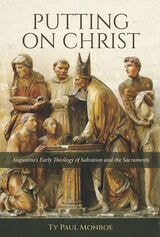
cover of Putting on Christ: Augustine's Early Theology of Salvation and the Sacraments

Putting on Christ

Augustine's Early Theology of Salvation and the Sacraments

Ty Paul Monroe

Catholic University of America Press, 2022

Putting on Christ aims to situate Augustine’s early soteriology and sacramental theology within the context of his personal history and intellectual development. Beginning with an extended analysis of the theology of salvation and sacramental efficacy contained within Augustine’s Confessions (ca. 400), the study then traces the maturation of his views on these matters, beginning with his earliest extant works, the Cassicacum dialogues (ca. 386). The journey entails treating Augustine’s earliest discussions of Christ’s person and his saving work, as well as the believer’s subjective experience of conversion and salvation. As Augustine’s corpus shifts from philosophical dialogues to explicitly apologetic and scriptural-exegetical works, so too does his soteriological lexicon expand to include concepts and terms that will later become his stock-in-trade, such as the virtue of humilitas. And as his roles in the North African Church come to include participation in the presbyterate and the episcopacy, so too does his engagement expand to a wider set of polemical contexts, both anti-Manichaean and anti-Donatist. Putting on Christ tracks these and many other aspects of Augustine’s maturing thought, showing where lines of both continuity and development lie and aiming to uncover their reasons. In doing so, it reveals Augustine to be a thinker and a teacher who continued to hone his understanding of salvation, the very heartbeat of Christian life and thought, as well as its relation to various other aspects of the Christian theological worldview, from Christology and anthropology to sacramental theology and ecclesiology.
[more]
cover of Puzzles: A Seminar on the ‘Benefit of Christ’

Puzzles

A Seminar on the ‘Benefit of Christ’

Carlo Ginzburg and Adriano Prosperi

Seagull Books, 2025

A seminar, a sixteenth-century heretical text, and the art of slow reading—this is historical research as you’ve never seen it before.

Patience Games: A Seminar on the 'Benefit of Christ' invites readers into the unpredictable world of scholarly discovery, where interpretation is not a straight path but a labyrinth of dialogue revision. At the heart of this book is a seminar held forty years ago at the University of Bologna, where students wrestled with The Beneficio di Cristo, the incendiary sixteenth-century text that questioned Church authority and championed salvation through grace alone. This is not a neatly packaged historical study, however—it is an unfiltered look at the errors and insights that emerge in the collective process of reading and debating a text.

Through shifting hypotheses and the sheer unpredictability of research, Patience Games dismantles the illusion of scholarship as a sterile pursuit, revealing instead a messy, deeply human endeavor. Blending sharp analysis with wit and self-irony, the book makes a compelling case for the continued importance of slow reading—even in an age where knowledge is just a click away.
[more]