Results by title
91 books match the query 'Citizen participation' and 7 start with p
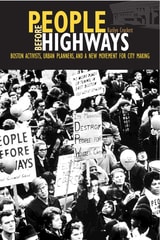
People before Highways
Boston Activists, Urban Planners, and a New Movement for City MakingKarilyn Crockett
University of Massachusetts Press, 2018
In 1948, inspired by changes to federal law, Massachusetts government officials started hatching a plan to build multiple highways circling and cutting through the heart of Boston, making steady progress through the 1950s. But when officials began to hold public hearings in 1960, as it became clear what this plan would entail—including a disproportionate impact on poor communities of color—the people pushed back. Activists, many with experience in the civil rights and antiwar protests, began to organize.
Linking archival research, ethnographic fieldwork, and oral history, Karilyn Crockett in People before Highways offers ground-level analysis of the social, political, and environmental significance of a local anti-highway protest and its lasting national implications. The story of how an unlikely multiracial coalition of urban and suburban residents, planners, and activists emerged to stop an interstate highway is one full of suspenseful twists and surprises, including for the actors themselves. And yet, the victory and its aftermath are undeniable: federally funded mass transit expansion, a linear central city park, and a highway-less urban corridor that serves as a daily reminder of the power and efficacy of citizen-led city making.
Pipeline Populism
Grassroots Environmentalism in the Twenty-First CenturyKai Bosworth
University of Minnesota Press, 2022
How contemporary environmental struggles and resistance to pipeline development became populist struggles
Stunning Indigenous resistance to the Keystone XL and the Dakota Access pipelines has made global headlines in recent years. Less remarked on are the crucial populist movements that have also played a vital role in pipeline resistance. Kai Bosworth explores the influence of populism on environmentalist politics, which sought to bring together Indigenous water protectors and environmental activists along with farmers and ranchers in opposition to pipeline construction.
Here Bosworth argues that populism is shaped by the “affective infrastructures” emerging from shifts in regional economies, democratic public-review processes, and scientific controversies. With this lens, he investigates how these movements wax and wane, moving toward or away from other forms of environmental and political ideologies in the Upper Midwest. This lens also lets Bosworth place populist social movements in the critical geographical contexts of racial inequality, nationalist sentiments, ongoing settler colonialism, and global empire—crucial topics when grappling with the tensions embedded in our era’s immense environmental struggles.
Pipeline Populism reveals the complex role populism has played in shifting interpretations of environmental movements, democratic ideals, scientific expertise, and international geopolitics. Its rich data about these grassroots resistance struggles include intimate portraits of the emotional spaces where opposition is first formed. Probing the very limits of populism, Pipeline Populism presents essential work for an era defined by a wave of people-powered movements around the world.

Policing Contingencies
Peter K. Manning
University of Chicago Press, 2003
Manning begins by developing a model of policing as drama—a way of communicating various messages to the public in an effort to enforce moral boundaries. Unexpected outcomes, or contingencies, continually rewrite the plot of this drama, requiring officers to adjust accordingly. New information technologies, media scrutiny and representations, and community policing also play important roles, and Manning studies these influences in detail. He concludes that their impacts have been quite limited, because the basic structure of policing—officer assessments based on encounters during routine patrols—has remained unchanged. For policing to really change, Manning argues, its focus will need to shift to prevention.
Written with precision and judiciously argued, Policing Contingencies will be of value to scholars of sociology, criminology, information technology, and cultural theory.
Power Moves
Transportation, Politics, and Development in HoustonBy Kyle Shelton
University of Texas Press, 2017
Since World War II, Houston has become a burgeoning, internationally connected metropolis—and a sprawling, car-dependent city. In 1950, it possessed only one highway, the Gulf Freeway, which ran between Houston and Galveston. Today, Houston and Harris County have more than 1,200 miles of highways, and a third major loop is under construction nearly thirty miles out from the historic core. Highways have driven every aspect of Houston’s postwar development, from the physical layout of the city to the political process that has transformed both the transportation network and the balance of power between governing elites and ordinary citizens.
Power Moves examines debates around the planning, construction, and use of highway and public transportation systems in Houston. Kyle Shelton shows how Houstonians helped shape the city’s growth by attending city council meetings, writing letters to the highway commission, and protesting the destruction of homes to make way for freeways, which happened in both affluent and low-income neighborhoods. He demonstrates that these assertions of what he terms “infrastructural citizenship” opened up the transportation decision-making process to meaningful input from the public and gave many previously marginalized citizens a more powerful voice in civic affairs. Power Moves also reveals the long-lasting results of choosing highway and auto-based infrastructure over other transit options and the resulting challenges that Houstonians currently face as they grapple with how best to move forward from the consequences and opportunities created by past choices.
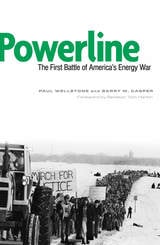
Powerline
The First Battle of America’s Energy WarPaul Wellstone
University of Minnesota Press, 2003
The inspiring story of a grassroots rebellion
Powerline describes the opposition of rural Minnesotans to the building of a high voltage powerline across 430 miles of farmland from central North Dakota to the Twin Cities suburbs. Convinced that the safety of their families and the health of their land was disregarded in favor of the gluttonous energy consumption of cities, the farmer-led revolt began as questioning and escalated to rampant civil disobedience, peaking in 1978 when nearly half of Minnesota’s state highway patrol was engaged in stopping sabotage of the project.
After construction was completed, the powerline proved difficult to defend and unprecedented guerrilla warfare brought many towers to the ground (due to “bolt weevils”). Through pulse-quickening personal interviews and big-picture analysis, Powerline lays bare the latent and unexpected power of the people of rural America—and resonates strongly with today’s energy debates.
Private Life, Public Action
How Housing Politics Mobilized Citizens in MoscowAnna Zhelnina
Temple University Press, 2026
Private Life, Public Action traces how residents impacted by the relocation plan became activists despite having little to no experience organizing or even forming political affiliations and opinions. Author Anna Zhelnina details the ways in which neighbors engaged in collective action, as well as the individual and structural changes these interactions caused.
Zhelnina develops the concept of “housing strategies” to explain how residents’ debates with their neighbors about housing were shaped by their private life strategies. She applies her findings about housing in Moscow to ongoing questions about political mobilization, demonstrating how public engagement is shaped by historical and social contexts.
Examining the intersection of housing, politics, and citizenship in contemporary Russia, Private Life, Public Action offers a new way to look at urban change.
In the series Politics, History, and Social Change
Public Policy and Community
Activism and Governance in TexasEdited by Robert H. Wilson
University of Texas Press, 1997
The decentralization of public policy from the federal government to state and local governments offers increased opportunities for ordinary citizens to participate directly in public policymaking. Yet these opportunities may not be equally shared. Due to a variety of factors, low-income citizens have long been denied a meaningful role in the public life and governance of our country.
By contrast, the essays in this volume explore how low-income citizens have successfully affected public policy. The book is built around six case studies, all from Texas, that cover education finance and reform, local infrastructure provision, environmental protection, and indigent health care.
This research illuminates several issues of national importance, including how communities gain standing and recognition for themselves and their issues, how policy agendas are defined, how communities mobilize technical and institutional resources, and how they form coalitions and alliances to accomplish their goals.