Results by title
172 books match the query 'Citizenship' and 7 start with p
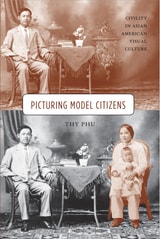
Picturing Model Citizens
Civility in Asian American Visual CultureThy Phu
Temple University Press, 2012
At the heart of the model minority myth—often associated with Asian Americans—is the concept of civility. In this groundbreaking book, Picturing Model Citizens, Thy Phu exposes the complex links between civility and citizenship, and argues that civility plays a crucial role in constructing Asian American citizenship.
Featuring works by Arnold Genthe, Carl Iwasaki, Toyo Miyatake, Nick Ut, and others, Picturing Model Citizens traces the trope of civility from the nineteenth to the twenty-first centuries. Through an examination of photographs of Chinese immigrants, Japanese internment camps, the Hiroshima Maidens project, napalm victims, and the SARS epidemic, Phu explores civility's unexpected appearance in images that draw on discourses of intimacy, cultivation, apology, and hygiene. She reveals how Asian American visual culture illustrates not only cultural ideas of civility, but also contests the contradictions of state-defined citizenship.
Poets Beyond the Barricade
Rhetoric, Citizenship, and Dissent after 1960Dale M. Smith
University of Alabama Press, 2012
Postnational Self
Belonging And IdentityUlf Hedetoft
University of Minnesota Press, 2002
A timely look at how our globalized era has reconfigured experiences of belonging.
What happens to a sense of belonging when national and regional governments, religious organizations, community groups, political parties, and corporations become unstable and incoherent, as they have in these nationalist and postnationalist times? From a richly interdisciplinary perspective, the authors examine notions of citizenship and cultural hybridization, migration and other forms of mobility, displacements and ethnic cleansing, and the nature of national belonging in a world turning ever more fluid, aided by transnational flows of capital, information, people, and ideas.
Contributors: Seyla Benhabib, Yale; John A. Hall, McGill U; Ulf Hannerz, Stockholm U; Jeffrey Herf, U of Maryland; Michael Herzfeld, Harvard; Richard Jenkins, U of Sheffield, UK; Mark Juergensmeyer, U of California, Santa Barbara; Riva Kastoryano, Center for International Studies and Research (CERI), Paris; Michèle Lamont, Princeton; Benjamin Lee, Rice U; Orvar Löfgren, U of Lund, Sweden; Philip Schlesinger, U of Stirling, Scotland; Yasemin Nuhõglu Soysal, U of Essex, UK; Ray Taras, Tulane U; James Tully, U of Victoria, British Columbia.
Precarity and Belonging
Labor, Migration, and NoncitizenshipCatherine S. Ramírez
Rutgers University Press, 2021
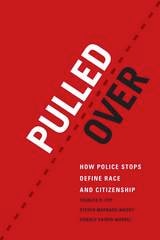
Pulled Over
How Police Stops Define Race and CitizenshipCharles R. Epp, Steven Maynard-Moody, and Donald P. Haider-Markel
University of Chicago Press, 2014
Pulled Over deftly traces the strange history of the investigatory police stop, from its discredited beginning as “aggressive patrolling” to its current status as accepted institutional practice. Drawing on the richest study of police stops to date, the authors show that who is stopped and how they are treated convey powerful messages about citizenship and racial disparity in the United States. For African Americans, for instance, the experience of investigatory stops erodes the perceived legitimacy of police stops and of the police generally, leading to decreased trust in the police and less willingness to solicit police assistance or to self-censor in terms of clothing or where they drive. This holds true even when police are courteous and respectful throughout the encounters and follow seemingly colorblind institutional protocols. With a growing push in recent years to use local police in immigration efforts, Hispanics stand poised to share African Americans’ long experience of investigative stops.
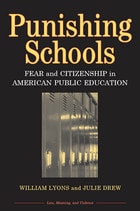
Punishing Schools
Fear and Citizenship in American Public EducationWilliam Lyons and Julie Drew
University of Michigan Press, 2006
In a society increasingly dominated by zero-tolerance thinking, Punishing Schools argues that our educational system has become both the subject of legislative punishment and an instrument for the punishment of children. William Lyons and Julie Drew analyze the connections between state sanctions against our schools (the diversion of funding to charter schools, imposition of unfunded mandates, and enforcement of dubious forms of teacher accountability) and the schools' own infliction of punitive measures on their students-a vicious cycle that creates fear and encourages the development of passive and dependent citizens.
"Public schools in the United States are no longer viewed as a public good. On the contrary, they are increasingly modeled after prisons, and students similarly have come to mirror the suspicions and fears attributed to prisoners. Punishing Schools is one of the most insightful, thoughtful, and liberating books I have read on what it means to understand, critically engage, and transform the present status and state of schools from objects of fear and disdain to institutions that value young people, teachers, and administrators as part of a broader vision of social justice, freedom, and equality. William Lyons and Julie Drew have done their homework and provide all the necessary elements for understanding and defending schools as public spheres that are foundational to a democracy. This book should be required reading for every student, teacher, parent, and concerned citizen in the United States. In the end, this book is not just about saving schools, it is also about saving democracy and offering young people a future that matters."
--Henry Giroux, McMaster University
"This is an important book . . . a distinctive contribution. The authors move back and forth convincingly between the micropolitics of school discipline and the 'politics writ large' of the liberal left and the utopian right. The result is an expansive, idealistic, and well-grounded book in the spirit of the very best of social control literature."
--Stuart Scheingold, Professor Emeritus, Political Science, University of Washington
William Lyons is Director of Center for Conflict Management and Associate Professor of Political Science, University of Akron.
Julie Drew is Associate Professor of English, University of Akron.
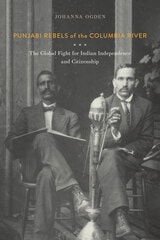
Punjabi Rebels of the Columbia River
The Global Fight for Indian Independence and CitizenshipJohanna Ogden
Oregon State University Press, 2024
Oregon is commonly perceived to have little, let alone notable, South Asian history. Yet in the early 1900s Oregon was at the center of two entwined quests for Indian independence and civic belonging that rocked the world.
Punjabi Rebels of the Columbia River traces the stories of the radical Indian independence organization known as Ghadar and Bhagat Singh Thind’s era-defining US Supreme Court citizenship case. Ghadar sought the overthrow of India’s British colonizers while Thind utilized sanctioned legal channels to do so. Despite widely differing strategies, both the movement and the man were targeted, often in coordination, by the highest levels of the US and British governments. The empires’ united message: India would not be an independent country and Indians could not be citizens. In the decades that followed, it was a verdict Indians refused to abide.
Johanna Ogden’s detailed history of migrants’ experience expands the time frame, geographic boundaries, and knowledge of the conditions and contributions of Indians in North America. It is the story of a people’s awakening amid a rich community of international workers in an age of nationalist uprisings. To understand why one of the smallest western Indian settlements became a resistance center, Punjabi Rebels mines the colonial underpinnings of labor, race, and place-making and their regional and global connections, rendering a history of whiteness and labor as much as of Indian-ness and migration. The first work to rejoin the lived experience of Thind and Ghadar activists, Punjabi Rebels complicates our understanding not just of the global fight for Indian political rights but of multi-racial democracy.