Results by title
129 books match the query 'City and town life' and 5 start with p
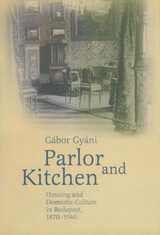
Parlor and Kitchen
Housing and Domestic Culture in Budapest, 1870-1940Gábor Gyáni
Central European University Press, 2002
Besides Berlin, Budapest was the fastest-growing capital city in Europe at the end of the nineteenth century. Parlor and Kitchen, the work of a microhistorian and historical anthropologist, describes the development of private spaces in this newly emerged metropolis.
Author Gábor Gyáni has chosen two distinct groups of contemporary society: the upper middle class and the working class, to present their homes, domestic culture and attitudes. At the same time the book offers a panoramic view of the everyday life of the entire society, on social segregation and mobility. Behind the visual details the author reveals a great deal about the value systems of the groups of society investigated.
Reconstructing minute details as well as case studies, the author has relied on archival sources, private documents, and statistical data. The text is accompanied by contemporary photographs, maps and blueprints.
This enlightening and interesting volume will be of interest not only to historians, anthropologists and sociologists, but also to the general reader with an interest in urban history.
Gábor Gyáni is founder and editor of the quarterly Budapest Review of Books. He is President of the Hungarian-American Historians' Committee and Secretary of the Urban History Workshop of the Hungarian Academy of Sciences.
A student of the late professor Péter Hanák, Gyáni is active in research into the urban and social history of modern Hungary and the theory and methodology of history writing.
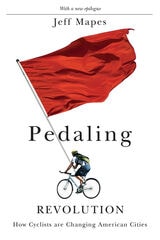
Pedaling Revolution
How Cyclists Are Changing American CitiesJeff Mapes
Oregon State University Press, 2009
In a world of increasing traffic congestion, a grassroots movement is carving out a niche for bicycles on city streets. Pedaling Revolution explores the growing bike culture that is changing the look and feel of cities, suburbs, and small towns across North America.
From traffic-dodging bike messengers to tattooed teenagers on battered bikes, from riders in spandex to well-dressed executives, ordinary citizens are becoming transportation revolutionaries. Jeff Mapes traces the growth of bicycle advocacy and explores the environmental, safety, and health aspects of bicycling. He rides with bicycle advocates who are taming the streets of New York City, joins the street circus that is Critical Mass in San Francisco, and gets inspired by the every-day folk pedaling in Amsterdam, the nirvana of American bike activists. Chapters focused on big cities, college towns, and America’s most successful bike city, Portland, show how cyclists, with the encouragement of local officials, are claiming a share of the valuable streetscape.
“A growing number of Americans, mounted on their bicycles like some new kind of urban cowboy, are mixing it up with swift, two-ton motor vehicles as they create a new society on the streets. They’re finding physical fitness, low-cost transportation, environmental purity—and, still all too often, Wild West risks of sudden death or injury.” —from the introduction
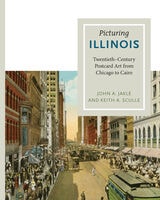
Picturing Illinois
Twentieth-Century Postcard Art from Chicago to CairoJohn A. Jakle and Keith A. Sculle
University of Illinois Press, 2012
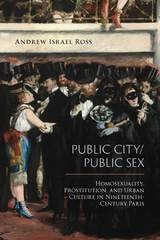
Public City/Public Sex
Homosexuality, Prostitution, and Urban Culture in Nineteenth-Century ParisAndrew Israel Ross
Temple University Press, 2019
In the 1800s, urban development efforts modernized Paris and encouraged the creation of brothels, boulevards, cafés, dancehalls, and even public urinals. However, complaints also arose regarding an apparent increase in public sexual activity, and the appearance of “individuals of both sexes with depraved morals” in these spaces. Andrew Israel Ross’s illuminating study, Public City/Public Sex, chronicles the tension between the embourgeoisement and democratization of urban culture in nineteenth-century Paris and the commercialization and commodification of a public sexual culture, the emergence of new sex districts, as well as the development of gay and lesbian subcultures.
Public City/Public Sex examines how the notion that male sexual desire required suitable outlets shaped urban policing and development. Ross traces the struggle to control sex in public and argues that it was the very effort to police the city that created new opportunities for women who sold sex and men who sought sex with other men. Placing public sex at the center of urban history, Ross shows how those who used public spaces played a central role in defining the way the city was understood.
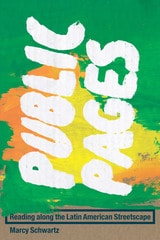
Public Pages
Reading Along the Latin American StreetscapeBy Marcy Schwartz
University of Texas Press, 2018
Public reading programs are flourishing in many Latin American cities in the new millennium. They defy the conception of reading as solitary and private by literally taking literature to the streets to create new communities of readers. From institutional and official to informal and spontaneous, the reading programs all use public space, distribute creative writing to a mass public, foster collective rather than individual reading, and provide access to literature in unconventional arenas.
The first international study of contemporary print culture in the Americas, Public Pages reveals how recent cultural policy and collective literary reading intervene in public space to promote social integration in cities in Colombia, Argentina, Brazil, Mexico, and Chile. Marcy Schwartz looks at broad institutional programs such as UNESCO World Book Capital campaigns and the distribution of free books on public transportation, as well as local initiatives that produce handmade books out of recycled materials (known as cartoneras) and display banned books at former military detention centers. She maps the connection between literary reading and the development of cultural citizenship in Latin America, with municipalities, cultural centers, and groups of ordinary citizens harnessing reading as an activity both social and literary. Along with other strategies for reclaiming democracy after decades of authoritarian regimes and political violence, as well as responding to neoliberal economic policies, these acts of reading collectively in public settings invite civic participation and affirm local belonging.