Results by title
90 books match the query 'Civil' and 4 start with p
Politics Across the Hudson
The Tappan Zee MegaprojectPhilip Mark Plotch
Rutgers University Press, 2015
Winner of the 2015 American Planning Association New York Metro Chapter Journalism Award
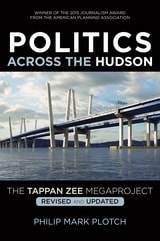
The State of New York built one of the world’s longest, widest, and most expensive bridges—the new Tappan Zee Bridge—stretching more than three miles across the Hudson River, approximately thirteen miles north of New York City. In Politics Across the Hudson, urban planner Philip Plotch offers a behind-the-scenes look at three decades of contentious planning and politics centered around this bridge, recently renamed for Governor Mario M. Cuomo, the state's governor from 1983 to 1994. He reveals valuable lessons for those trying to tackle complex public policies while also confirming our worst fears about government dysfunction.
The State of New York built one of the world’s longest, widest, and most expensive bridges—the new Tappan Zee Bridge—stretching more than three miles across the Hudson River, approximately thirteen miles north of New York City. In Politics Across the Hudson, urban planner Philip Plotch offers a behind-the-scenes look at three decades of contentious planning and politics centered around this bridge, recently renamed for Governor Mario M. Cuomo, the state's governor from 1983 to 1994. He reveals valuable lessons for those trying to tackle complex public policies while also confirming our worst fears about government dysfunction.
Drawing on his extensive experience planning megaprojects, interviews with more than a hundred key figures—including governors, agency heads, engineers, civic advocates, and business leaders—and extraordinary access to internal government records, Plotch tells a compelling story of high-stakes battles between powerful players in the public, private, and civic sectors. He reveals how state officials abandoned viable options, squandered hundreds of millions of dollars, forfeited more than three billion dollars in federal funds, and missed out on important opportunities. Faced with the public’s unrealistic expectations, no one could identify a practical solution to a vexing problem, a dilemma that led three governors to study various alternatives rather than disappoint key constituencies.
This revised and updated edition includes a new epilogue and more photographs, and continues where Robert Caro’s The Power Broker left off and illuminates the power struggles involved in building New York’s first major new bridge since the Robert Moses era. Plotch describes how one governor, Andrew Cuomo, shrewdly overcame the seemingly insurmountable obstacles of onerous environmental regulations, vehement community opposition, insufficient funding, interagency battles, and overly optimistic expectations...
[more]
Politics Across the Hudson
The Tappan Zee MegaprojectPhilip Mark Plotch
Rutgers University Press, 2015
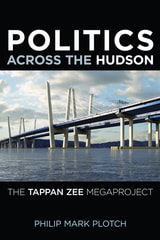
The State of New York is now building one of the world’s longest, widest, and most expensive bridges—the new Tappan Zee Bridge—stretching more than three miles across the Hudson River, approximately thirteen miles north of New York City. In Politics Across the Hudson, urban planner Philip Plotch offers a behind-the-scenes look at three decades of contentious planning and politics centered around this bridge, recently renamed for Governor Mario M. Cuomo, the state's governor from 1983 to 1994. He reveals valuable lessons for those trying to tackle complex public policies while also confirming our worst fears about government dysfunction.
Drawing on his extensive experience planning megaprojects, interviews with more than a hundred key figures—including governors, agency heads, engineers, civic advocates, and business leaders—and extraordinary access to internal government records, Plotch tells a compelling story of high-stakes battles between powerful players in the public, private, and civic sectors. He reveals how state officials abandoned viable options, squandered hundreds of millions of dollars, forfeited more than three billion dollars in federal funds, and missed out on important opportunities. Faced with the public’s unrealistic expectations, no one could identify a practical solution to a vexing problem, a dilemma that led three governors to study various alternatives rather than disappoint key constituencies.
Politics Across the Hudson continues where Robert Caro’s The Power Broker left off and illuminates the power struggles involved in building New York’s first major new bridge since the Robert Moses era. Plotch describes how one governor, Andrew Cuomo, shrewdly overcame the seemingly insurmountable obstacles of onerous environmental regulations, vehement community opposition, insufficient funding, interagency battles, and overly optimistic expectations.
[more]
Port Newark and the Origins of Container Shipping
Angus Kress Gillespie
Rutgers University Press, 2023
Container shipping is a vital part of the global economy. Goods from all around the world, from vegetables to automobiles, are placed in large metal containers which are transported across the ocean in ships, then loaded onto tractor-trailers and railroad flatbeds. But when and where did this world-changing invention get started?
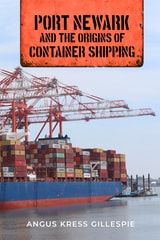
This fascinating study traces the birth of containerization to Port Newark, New Jersey, in 1956 when trucker Malcom McLean thought of a brilliant new way to transport cargo. It tells the story of how Port Newark grew rapidly as McLean’s idea was backed by both New York banks and the US military, who used containerization to ship supplies to troops in Vietnam. Angus Gillespie takes us behind the scenes of today’s active container shipping operations in Port Newark, talking to the pilots who guide the ships into port, the Coast Guard personnel who help manage the massive shipping traffic, the crews who unload the containers, and even the chaplains who counsel and support the mariners. Port Newark shines a spotlight on the unsung men and women who help this complex global shipping operation run smoothly.
Since McLean's innovation, Port Newark has expanded with the addition of the nearby Elizabeth Marine Terminal. This New Jersey complex now makes up the busiest seaport on the East Coast of the United States. Some have even called it “America’s Front Door.” The book tells the story of the rapid growth of worldwide containerization, and how Port Newark has adapted to bigger ships with deeper channels and a raised bridge. In the end, there is speculation of the future of this port with ever-increasing automation, artificial intelligence, and automation.
[more]
Propulsion Systems for Hybrid Vehicles
John M. Miller
The Institution of Engineering and Technology, 2010
Worldwide, the automotive industry is being challenged to make dramatic improvements in vehicle fuel economy. In Europe there are CO2 emissions penalties prorated by the degree to which vehicles exceed mandated CO2 levels. In the United States, vehicle fuel economy targets set by Congress in 2007 for 20 per cent fuel economy improvement by 2020 are now being accelerated by the Obama administration to 35.5 mpg by 2016 for a passenger car. Taking effect in 2012, the new rules set more aggressive fuel economy measures that will require significant gains in engine and driveline efficiency, better performance cabin climate control and the introduction of electric hybridization. This 2nd Edition of Propulsion Systems for Hybrid Vehicles addresses the electrification innovations that will be required, ranging from low end brake energy recuperators, idle-stop systems and mild hybrids on to strong hybrids of the power split architecture in both single mode and two mode and introducing new topics in plug-in hybrid and battery electrics. Important topics of the 1st Edition are retained and expanded and some outdated material has been replaced with new information.
[more]