138 books match the query 'Civil War' and 8 start with p
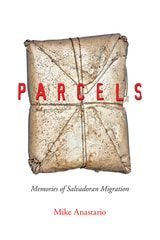
cover of Parcels: Memories of Salvadoran Migration

Parcels

Memories of Salvadoran Migration

Mike Anastario

Rutgers University Press, 2019
In light of new proposals to control undocumented migrants in the United States, Parcels prioritizes rural Salvadoran remembering in an effort to combat the collective amnesia that supports the logic of these historically myopic strategies. Mike Anastario investigates the social memories of individuals from a town he refers to as “El Norteño,” a rural municipality in El Salvador that was heavily impacted by the Salvadoran Civil War, which in turn fueled a mass exodus to the United States. By working with two viajeros (travelers) who exchanged encomiendas (parcels containing food, medicine, documents, photographs and letters) between those in the U.S. and El Salvador, Anastario tells the story behind parcels and illuminates their larger cultural and structural significance. This narrative approach elucidates key arguments concerning the ways in which social memory permits and is shaped by structural violence, particularly the U.S. actions and policies that have resulted in the emotional and physical distress of so many Salvadorans. The book uses analyses of testimonies, statistics, memories of migration, the war and, of course, the many parcels sent over the border to create an innovative and necessary account of post-Civil War El Salvador. 
[more]
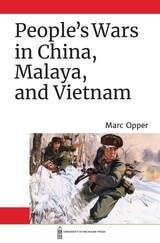
cover of People's Wars in China, Malaya, and Vietnam

People's Wars in China, Malaya, and Vietnam

Marc Opper

University of Michigan Press, 2020

People’s Wars in China, Malaya, and Vietnam explains why some insurgencies collapse after a military defeat while under other circumstances insurgents are able to maintain influence, rebuild strength, and ultimately defeat the government. The author argues that ultimate victory in civil wars rests on the size of the coalition of social groups established by each side during the conflict. When insurgents establish broad social coalitions (relative to the incumbent), their movement will persist even when military defeats lead to loss of control of territory because they enjoy the support of the civilian population and civilians will not defect to the incumbent. By contrast, when insurgents establish narrow coalitions, civilian compliance is solely a product of coercion. Where insurgents implement such governing strategies, battlefield defeats translate into political defeats and bring about a collapse of the insurgency because civilians defect to the incumbent. The empirical chapters of the book consist of six case studies of the most consequential insurgencies of the 20th century including that led by the Chinese Communist Party from 1927 to 1949, the Malayan Emergency (1948–1960), and the Vietnam War (1960–1975). People’s Wars breaks new ground in systematically analyzing and comparing these three canonical cases of insurgency. The case studies of China and Malaya make use of Chinese-language archival sources, many of which have never before been used and provide an unprecedented level of detail into the workings of successful and unsuccessful insurgencies. The book adopts an interdisciplinary approach and will be of interest to both political scientists and historians.
[more]
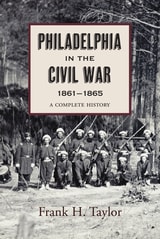
cover of Philadelphia in the Civil War, 1861–1865

Philadelphia in the Civil War, 1861–1865

Frank H. Taylor

Westholme Publishing, 2014

A Treasure Trove of Primary Source Material Chronicling the Role of a Pivotal City in America’s Most Important Conflict
The city of Philadelphia played a major role in the Civil War as a manufacturing base, naval port, arsenal, financial and transportation center, and supplier of thousands of troops for the Union cause. Philadelphia provided the most uniforms for the Union army, built warships, was the site of the two largest military hospitals in the North, and recruited more than fifty infantry and cavalry regiments. Philadelphia was the closest free-state metropolitan area to the Confederacy and in fact had close contact with the South before the war. However, once the war began, Philadelphians embraced the Union cause.
            First published one hundred years ago, Philadelphia in the Civil War presents the complete story of the city during America’s greatest conflict. Richly illustrated with rare images, the book describes every detail of the region’s response to the war, ranging from accounts of each of the military units that served, medicine and medical staffs, and the city’s defense measures to lists of information, such as regiments losing fifty or more men, officers who gained the rank of general, recruiting stations, and famous songs.
[more]
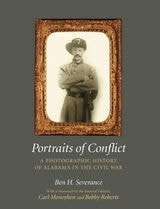
cover of Portraits of Conflict: A Photographic History of Alabama in the Civil War

Portraits of Conflict

A Photographic History of Alabama in the Civil War

Ben H. Severance

University of Arkansas Press, 2012

Portraits of Conflict: A Photographic History of Alabama in the Civil War is the tenth volume in this acclaimed series showing the human side of the country's great national conflict. Over 230 photographs of soldiers and civilians from Alabama, many never seen before, are accompanied by their personal stories and woven into the larger narrative of the war both on the battlefield and the home front. Alabama is unusual among the Rebel states in that, while its people saw little fighting inside its boundaries, nearly one hundred thousand Alabamians served with Confederate units throughout the South. This volume chronicles their experiences in almost every battle east of the Mississippi River--especially at Sharpsburg, Chancellorsville, and Gettysburg under the legendary Robert E. Lee; at Murfreesboro and Chickamauga as part of the ill-fated Army of Tennessee; and at the famous siege of Vicksburg. Ultimately Union soldiers did invade the state, and Alabamians defended their homeland against enemy cavalry raiders at Selma and against Federal warships in the fight for Mobile Bay. The volume also includes accounts of some of Alabama's leading politicians as well as several of its more ordinary citizens. This new volume contains the same quality of photography and storytelling that has attracted Civil War enthusiasts since the first volume was published in 1987, making it another welcome addition to the series Civil War History called "a sensibly priced, beautifully produced photographic history."
[more]
cover of Portraits of Conflict: A Photographic History of Louisiana in the Civil War

Portraits of Conflict

A Photographic History of Louisiana in the Civil War

Carl H. Moneyhon

University of Arkansas Press, 1990
[more]
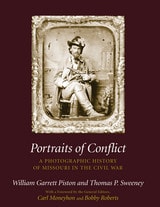
cover of Portraits of Conflict: A Photographic History of Missouri in the Civil War

Portraits of Conflict

A Photographic History of Missouri in the Civil War

William Garrett Piston

University of Arkansas Press, 2009
A deeply divided border state, heir to the “Bleeding Kansas” era, Missouri became the third most fought-over state in the war, following Virginia and Tennessee. Rich in resources and manpower, critical politically to both the Union and the Confederacy, it was the scene of conventional battles, river warfare, and cavalry raids. It saw the first combat by organized units of Native Americans and African Americans. It was also marked by guerrilla warfare of unparalleled viciousness. This volume, the ninth in the series, includes hundreds of photographs, many of them never before published. The authors provide text and commentary, organizing the photographs into chapters covering the origins of the war, its conventional and guerrilla phases, the war on the rivers, medicine (Sweeny’s medical knowledge adds a great deal to this chapter and expands our knowledge of its practice in the west), the experiences of Missourians who served out of state, and the process of reunion in the postwar years.
[more]
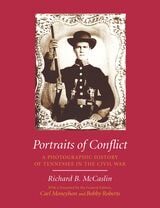
cover of Portraits of Conflict: Tennessee: A Photographic History of Tennessee in the Civil War

Portraits of Conflict

Tennessee: A Photographic History of Tennessee in the Civil War

Richard B. McCaslin

University of Arkansas Press, 2007
It’s one thing to understand that over twenty-thousand Confederate and Union soldiers died at the Battle of Murfreesboro. It’s quite another to study an ambrotype portrait of twenty-year-old private Frank B. Crosthwait, dressed in his Sunday best, looking somberly at the camera. In a tragically short time, he’ll be found on the battlefield, mortally wounded, still clutching the knotted pieces of handkerchief he used in a hopeless attempt to stop the bleeding from his injuries. Private Crosthwait’s image is one of more than 250 portraits—many never before published—to be found in the much anticipated Portraits of Conflict: A Photographic History of Tennessee in the Civil War. The eighth in the distinguished Portraits of Conflict series, this volume joins the personal and the public to provide a uniquely rich portrayal of Tennesseans—in uniforms both blue and gray—who fought and lost their lives in the Civil War. Here is the story of a widow working as a Union spy to support herself and her children. Of a father emerging from his house to find his Confederate soldier son dying at his feet. Of a nine-year-old boy who attached himself to a Union regiment after his mother died. Their stories and faces, joined with personal remembrances from recovered letters and diaries and ample historical information on secession, famous battles, surrender, and Reconstruction, make this new Portraits of Conflict a Civil War treasure.
[more]
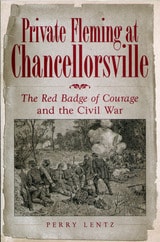
cover of Private Fleming at Chancellorsville: The Red Badge of Courage and the Civil War

Private Fleming at Chancellorsville

The Red Badge of Courage and the Civil War

Perry Lentz

University of Missouri Press, 2006

Famous for its insight into a young, inexperienced soldier’s psychology, Stephen Crane’s The Red Badge of Courage has long been assumed to have been based on little more than magazine articles and veterans’ reminiscences. It also has been subject to various misreadings, including ones unduly influenced by fictional responses to the wars of the twentieth century. Perry Lentz now draws on more than three decades of teaching the novel and his own experience as a historical novelist to plumb the historical realities that actually shaped Crane’s work and to confront these misreadings.
Taking a new look at a classic work that many may feel they already know, Lentz shows how this apparently impressionistic novel is actually a faithful reflection of Civil War combat based on thorough knowledge about combat in general and the battle of Chancellorsville in particular. Anchoring the novel’s action firmly in the Civil War, Lentz challenges the long-standing assumption that Crane did little research for the novel, arguing that he made extensive use of contemporary sources to fashion an accurate depiction of Chancellorsville.
Rich with information about infantry combat in the Civil War, from uniforms and weaponry to formations and battlefield tactics, Lentz’s study invites readers to follow the exploits of Private Henry Fleming of the 304th New York Volunteer Infantry Regiment as he and his fellow soldiers participate in this legendary battle. Lentz shows how Crane evokes a set of traditional responses from his reader and how close reading expands those responses. He examines Private Fleming’s adventures behind the lines of battle in terms of the historical situations in which they are set, then explains how Crane repeatedly entices readers into imposing their initial expectations and final evaluations upon the experiences of this particular soldier.
Lentz also investigates why the novel’s portrayal of its hero’s experiences on the second day of battle is sometimes ignored and always undervalued. By focusing on events both as they actually unfolded at Chancellorsville and as Crane depicted Fleming and his comrades experiencing them, he shows how these soldiers judge themselves, how others judge them, and how a reader can achieve a more sophisticated understanding of these judgments. Lentz’s work reclaims a place for this novel in the American canon and enhances our understanding of Crane, of a legendary battle, and of war literature in general.
[more]