Results by title
121 books match the query 'Comic books, strips, etc' and 5 start with p
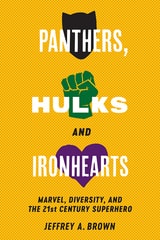
Panthers, Hulks and Ironhearts
Marvel, Diversity and the 21st Century SuperheroJeffrey A. Brown
Rutgers University Press, 2021
Panthers, Hulks, and Ironhearts offers the first comprehensive study of how Marvel has reimagined what a superhero might look like in the twenty-first century. It examines how they have revitalized older characters like Black Panther and Luke Cage, while creating new ones like Latina superhero Miss America. Furthermore, it considers the mixed fan responses to Marvel’s recasting of certain “legacy heroes,” including a Pakistani-American Ms. Marvel, a Korean-American Hulk, and a whole rainbow of multiverse Spidermen.
If the superhero comic is a quintessentially American creation, then how might the increasing diversification of Marvel’s superhero lineup reveal a fundamental shift in our understanding of American identity? This timely study answers those questions and considers what Marvel’s comics, TV series, and films might teach us about stereotyping, Orientalism, repatriation, whitewashing, and identification.

Perfect Copies
Reproduction and the Contemporary ComicShiamin Kwa
Rutgers University Press, 2023
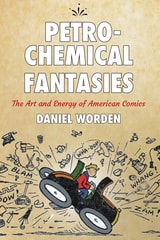
Petrochemical Fantasies
The Art and Energy of American ComicsDaniel Worden
The Ohio State University Press, 2024
Finalist, Comics Studies Society Charles Hatfield Book Prize 2025
Nominee, Eisner Award for Best Academic/Scholarly Work 2025
In Petrochemical Fantasies, Daniel Worden reveals the entwined history of comics and fossil fuels in the United States. From the 1840s to the present, comics have depicted the power, pollution, and rapid expansion of energy systems—especially the explosive growth of coal and oil. In the 1930s, some of the first comic books were the gas station giveaways Gulf Funny Weekly and Standard Oil Comics. And in recent years, comics have become one of the major sites for visualizing life after oil, a striking reversal of the medium’s early boosterism.
Surveying the work of acclaimed artists such as Nell Brinkley, George Herriman, Jack Kirby, Winsor McCay, and R. F. Outcault and recovering little-known works, Worden advances a new history of American comics in the Anthropocene. From late nineteenth- and early twentieth-century editorial cartoons and superhero comics that visualize our modern energy culture to contemporary comics grappling with climate crises, Petrochemical Fantasies places comics, environmental humanities, and energy studies in conversation with each other to unearth the crucial but overlooked history of comics’ place in US energy culture.
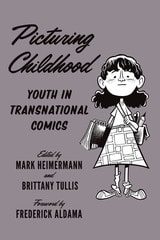
Picturing Childhood
Youth in Transnational ComicsEdited by Mark Heimermann and Brittany Tullis, Foreword by Frederick Aldama
University of Texas Press, 2017
Comics and childhood have had a richly intertwined history for nearly a century. From Richard Outcault’s Yellow Kid, Winsor McCay’s Little Nemo, and Harold Gray’s Little Orphan Annie to Hergé’s Tintin (Belgium), José Escobar’s Zipi and Zape (Spain), and Wilhelm Busch’s Max and Moritz (Germany), iconic child characters have given both kids and adults not only hours of entertainment but also an important vehicle for exploring children’s lives and the sometimes challenging realities that surround them.
Bringing together comic studies and childhood studies, this pioneering collection of essays provides the first wide-ranging account of how children and childhood, as well as the larger cultural forces behind their representations, have been depicted in comics from the 1930s to the present. The authors address issues such as how comics reflect a spectrum of cultural values concerning children, sometimes even resisting dominant cultural constructions of childhood; how sensitive social issues, such as racial discrimination or the construction and enforcement of gender roles, can be explored in comics through the use of child characters; and the ways in which comics use children as metaphors for other issues or concerns. Specific topics discussed in the book include diversity and inclusiveness in Little Audrey comics of the 1950s and 1960s, the fetishization of adolescent girls in Japanese manga, the use of children to build national unity in Finnish wartime comics, and how the animal/child hybrids in Sweet Tooth act as a metaphor for commodification.
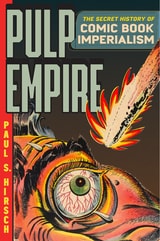
Pulp Empire
The Secret History of Comic Book ImperialismPaul S. Hirsch
University of Chicago Press, 2021
In the 1940s and ’50s, comic books were some of the most popular—and most unfiltered—entertainment in the United States. Publishers sold hundreds of millions of copies a year of violent, racist, and luridly sexual comics to Americans of all ages until a 1954 Senate investigation led to a censorship code that nearly destroyed the industry. But this was far from the first time the US government actively involved itself with comics—it was simply the most dramatic manifestation of a long, strange relationship between high-level policy makers and a medium that even artists and writers often dismissed as a creative sewer. In Pulp Empire, Paul S. Hirsch uncovers the gripping untold story of how the US government both attacked and appropriated comic books to help wage World War II and the Cold War, promote official—and clandestine—foreign policy and deflect global critiques of American racism.
As Hirsch details, during World War II—and the concurrent golden age of comic books—government agencies worked directly with comic book publishers to stoke hatred for the Axis powers while simultaneously attempting to dispel racial tensions at home. Later, as the Cold War defense industry ballooned—and as comic book sales reached historic heights—the government again turned to the medium, this time trying to win hearts and minds in the decolonizing world through cartoon propaganda.
Hirsch’s groundbreaking research weaves together a wealth of previously classified material, including secret wartime records, official legislative documents, and caches of personal papers. His book explores the uneasy contradiction of how comics were both vital expressions of American freedom and unsettling glimpses into the national id—scourged and repressed on the one hand and deployed as official propaganda on the other. Pulp Empire is a riveting illumination of underexplored chapters in the histories of comic books, foreign policy, and race.