Results by title
126 books match the query 'Communism' and 4 start with p
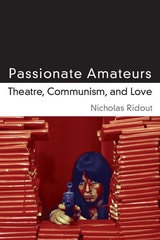
Passionate Amateurs
Theatre, Communism, and LoveNicholas Ridout
University of Michigan Press, 2015
Passionate Amateurs tells a new story about modern theater: the story of a romantic attachment to theater’s potential to produce surprising experiences of human community. It begins with one of the first great plays of modern European theater—Chekhov’s Uncle Vanya in Moscow—and then crosses the 20th and 21st centuries to look at how its story plays out in Weimar Republic Berlin, in the Paris of the 1960s, and in a spectrum of contemporary performance in Europe and the United States. This is a work of historical materialist theater scholarship, which combines a materialism grounded in a socialist tradition of cultural studies with some of the insights developed in recent years by theorists of affect, and addresses some fundamental questions about the social function and political potential of theater within modern capitalism. Passionate Amateurs argues that theater in modern capitalism can help us think afresh about notions of work, time, and freedom. Its title concept is a theoretical and historical figure, someone whose work in theater is undertaken within capitalism, but motivated by a love that desires something different. In addition to its theoretical originality, it offers a significant new reading of a major Chekhov play, the most sustained scholarly engagement to date with Benjamin’s “Program for a Proletarian Children’s Theatre,” the first major consideration of Godard’s La chinoise as a “theatrical” work, and the first chapter-length discussion of the work of The Nature Theatre of Oklahoma, an American company rapidly gaining a profile in the European theater scene.
Passionate Amateurs contributes to the development of theater and performance studies in a way that moves beyond debates over the differences between theater and performance in order to tell a powerful, historically grounded story about what theater and performance are for in the modern world.
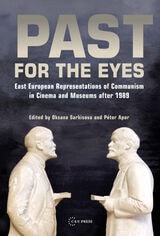
Past for the Eyes
East European Representations of Communism in Cinema and Museums After 1989Oksana Sarkisova
Central European University Press, 2008
Post-Communism
An IntroductionLeslie Holmes
Duke University Press, 1997
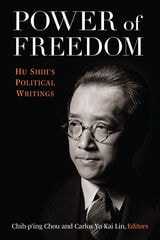
Power of Freedom
Hu Shih's Political WritingsChih-p'ing Chou and Carlos Yu-Kai Lin, Editors
University of Michigan Press, 2022
For decades—and today to a certain extent—Hu Shih’s political writings were considered sensitive and even dangerous. As a strident critic of the Chinese Communist Party’s oligarchical practices, he was targeted by the CCP in a concerted national campaign to smear his reputation, cast aspersions on his writings, and generally destroy any possible influence he might have in China. This volume brings together a collection of Hu Shih’s most important, mostly unpublished, English-language speeches, interviews, and commentaries on international politics, China-U.S. relations, and the International Communist Movement. Taken together, these works provide an insider’s perspective on Sino-American relations and the development of the International Communist Movement over the course of the 20th century.