Results by title
198 books match the query 'Community' and 9 start with p
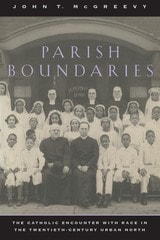
Parish Boundaries
The Catholic Encounter with Race in the Twentieth-Century Urban NorthJohn T. McGreevy
University of Chicago Press, 1996
"Parish Boundaries can take its place in the front ranks of the literature of urban race relations."—Jonathan Dorfman, Washington Post Book Review
"A prodigiously researched, gracefully written book distinguished especially by its seamless treatment of social and intellectual history."—Robert Orsi, American Historical Review
"Parish Boundaries will fascinate historians and anyone interested in the historic connection between parish and race."—Ed Marciniak, Chicago Tribune
"The history that remains to be written will rest on the firm foundation of Mr. McGreevy's remarkable book."—Richard Wightman Fox, New York Times Book Review
Paths toward the Nation
Islam, Community, and Early Nationalist Mobilization in Eritrea, 1941–1961Joseph L. Venosa
Ohio University Press, 2014

Peruvians in Paterson
Building Businesses and CommunityGianncarlo Muschi
Rutgers University Press, 2027
Peruvians were among the first Latinos to arrive in Paterson and other cities in New Jersey during the post-WW II period. Over successive generations, they established a prosperous ethnic enclave that contributed to Paterson’s socioeconomic renewal. Yet their migration experience has remained relatively unexamined by scholars. This book examines the role of entrepreneurship and informality in the emergence and evolution of the Peruvian community of Paterson. It highlights the historical significance of the establishment of small businesses and social organizations as important cultural elements that validated their physical presence in the area. By uncovering the diverse strategies that Peruvians utilized for building a community, Muschi contends that their culture of informality and resourcefulness paved the way for their economic advancement and the consolidation of the Peruvian community. This book also shows that the informal economic practices introduced by Peruvians altered the social and economic landscape of Paterson and contributed to the revitalization of the local economy. Through the examination of oral histories, archival material from local newspapers, and memoirs declassified by the Peruvian consulate, the author challenges the oversimplified portrayal of Latinos as blue- collar workers with few opportunities for socioeconomic advancement. Peruvians in Paterson demonstrates that Latino migrants achieve wealth and ethnic empowerment in the process of adjustment and community building, suggesting new lines for future research.
Political Landscapes
Forests, Conservation, and Community in MexicoChristopher R. Boyer
Duke University Press, 2015
Post-Weird
Fragmentation, Community, and the Decline of the MainstreamCalum Lister Matheson
Rutgers University Press, 2026
An ambitious look at rhetoric and psychosis that explores how communities form when society collapses
American society seems to have fractured. Common touchpoints of authority have receded in recent decades and beliefs that were once taboo are now openly shared, from neo-Nazism to occultism to conspiracy thinking. In this book, Calum Lister Matheson goes beyond the fraying of contemporary American culture to ask how splinter communities form in our current media environment, what keeps them together, and what they build from the ruins of shared language.
In his stirring exploration of how people communicate when old forms of authority and meaning collapse, Matheson examines far-flung groups that have departed the mainstream—Sandy Hook deniers, Appalachian serpent handlers, pro-anorexia bloggers, incels, transvestigators, pseudoscientific reactionaries, and more—and finds unexpected similarities among their many differences. Key among their parallels is the insistence that the symbols shared by each community represent a hidden truth that cannot be questioned or interpreted but is revealed through signs—words, images, videos, and texts. By documenting American fringe cultures, extremism, and the social functions of language, this book rethinks concepts like irony, psychosis, propriety, and what it means to be normal in weird times.

Power, Community and the State
The Political Anthropology of Organisation in MexicoMonique Nuijten
Pluto Press, 2003
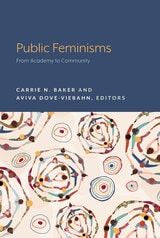
Public Feminisms
From Academy to CommunityEdited by Carrie N. Baker and Aviva Dove-Viebahn
Lever Press, 2023
The field of feminist studies grew from the U.S. women’s movements of the 1960s and 1970s and has continued to be deeply connected to ongoing movements for social justice. As educational institutions are increasingly seeing public scholarship and community engagement as relevant and fruitful complements to traditional academic work, feminist scholars have much to offer in demonstrating different ways to inform and interact with various communities. In Public Feminisms: From Academy to Community edited by Carrie N. Baker and Aviva Dove-Viebahn, a diverse range of feminist scholar-activists write about the dynamic and varied methods they use to reach beyond the traditional academic classroom and scholarly journals to share their work with the public.
Part one explores how feminist scholars engage broader audiences through art, media, and public programming, including essays on a public discussion series teaching intersectional feminist analysis of popular films, and a podcast from Latina scholars discussing issues of reproductive justice, social justice, motherhood, sexuality, race, and gender. Part two focuses on activism and public education, including essays on “Take Back the Night,” and archiving the women’s march protests. Part three turns to public writing and scholarship, including an essay on elevating the perspectives and voices of underrepresented creatives in the film and television industry. Part four explores feminist pedagogies for community engagement and for teaching public feminisms.
Accessible and engaging to a broad range of readers, the essays in this volume are a rich resource for scholars and students interested in infusing their academic knowledge into the public sphere. With this timely book, the editors offer an opportunity to reflect on the meaning and importance of community engagement and highlight some of the important public-facing work feminist scholars are doing today. Faculty, graduate, and undergraduate students, as well as administrators hoping to increase their schools’ connections to the community, will find this volume indispensable.
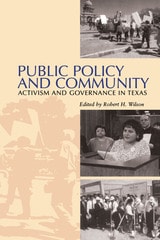
Public Policy and Community
Activism and Governance in TexasEdited by Robert H. Wilson
University of Texas Press, 1997
The decentralization of public policy from the federal government to state and local governments offers increased opportunities for ordinary citizens to participate directly in public policymaking. Yet these opportunities may not be equally shared. Due to a variety of factors, low-income citizens have long been denied a meaningful role in the public life and governance of our country.
By contrast, the essays in this volume explore how low-income citizens have successfully affected public policy. The book is built around six case studies, all from Texas, that cover education finance and reform, local infrastructure provision, environmental protection, and indigent health care.
This research illuminates several issues of national importance, including how communities gain standing and recognition for themselves and their issues, how policy agendas are defined, how communities mobilize technical and institutional resources, and how they form coalitions and alliances to accomplish their goals.
Public and Private in Thought and Practice
Perspectives on a Grand DichotomyEdited by Jeff Weintraub and Krishan Kumar
University of Chicago Press, 1997
In contexts ranging from friendship, the family, and personal life to nationalism, democratic citizenship, the role of women in social and political life, and the contrasts between western and (post-)Communist societies, this book brings out the ways the various uses of the public/private distinction are simultaneously distinct and interconnected. Public and Private in Thought and Practice will be of interest to students and scholars in disciplines including politics, law, philosophy, history, sociology, and women's studies.
Contributors include Jeff Weintraub, Allan Silver, Craig Calhoun, Daniela Gobetti, Jean L. Cohen, Jean Bethke Elshtain, Alan Wolfe, Krishan Kumar, David Brain, Karen Hansen, Marc Garcelon, and Oleg Kharkhordin.