80 books match the query 'Community development' and 5 start with p
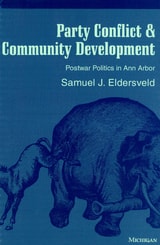
cover of Party Conflict & Community Development: Postwar Politics in Ann Arbor

Party Conflict & Community Development

Postwar Politics in Ann Arbor

Samuel J. Eldersveld

University of Michigan Press, 1995
Through an in-depth study of Ann Arbor politics, Party Conflict and Community Development addresses fundamental questions of the relationship between partisan politics and municipal government. Since a large majority of middle-sized American cities operate with nonpartisan government, Ann Arbor's fiercely competitive, two-party system provides an essential counterpoint to other urban studies. Moreover, political activity at this local level gives unique insight into the relative strength and performance of American political parties. Samuel J. Eldersveld examines in detail how this increasingly competitive system has led to innovative policy change. Finally, he offers comparisons to other American and European cities.
[more]
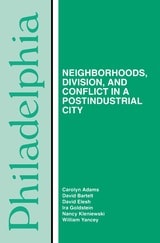
cover of Philadelphia: Neighborhoods, Division, and Conflict in a Post-Industrial City

Philadelphia

Neighborhoods, Division, and Conflict in a Post-Industrial City

Carolyn Adams

Temple University Press, 1993
[more]
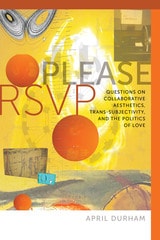
cover of Please RSVP: Questions on Collaborative Aesthetics, Trans-Subjectivity, and the Politics of Love

Please RSVP

Questions on Collaborative Aesthetics, Trans-Subjectivity, and the Politics of Love

April Durham

Dartmouth College Press, 2019
It’s no secret that working with others, rather than alone, on a creative project can often yield the most unexpected results, a new and surprising sum greater than the whole of its parts. Please RSVP presents a bold new theory of just how powerful collaboration can be in the making of art. April Durham argues that collaborative activity has the potential to broaden and expand an individual participant’s static identity through what she calls “trans-subjectivity.” She offers a fine-grained analysis of the ways in which personal subjectivity becomes porous and malleable during the process of shared creative labor. Durham’s concept of the trans-subjective offers a new way to come to terms with the networks, either digital or otherwise, that have developed over the twentieth- and twenty-first centuries, providing a bold new frame for topics like the experience of time, community, language, and ethics. This is a crucial and eye-opening book for contemporary artists and art historians alike.
[more]
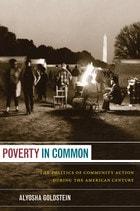
cover of Poverty in Common: The Politics of Community Action during the American Century

Poverty in Common

The Politics of Community Action during the American Century

Alyosha Goldstein

Duke University Press, 2012
After the Second World War, the idea that local community action was indispensable for the alleviation of poverty was broadly embraced by US policymakers, social scientists, international development specialists, and grassroots activists. Governmental efforts to mobilize community action in the name of democracy served as a volatile condition of possibility for poor people and dispossessed groups negotiating the tension between calls for self-help and demands for self-determination in the era of the Cold War and global decolonization. In Poverty in Common, Alyosha Goldstein suggests new ways to think about the relationship among liberalism, government, and inequality in the United States. He does so by analyzing historical dynamics including Progressive-era reform as a precursor to community development during the Cold War, the ways that the language of "underdevelopment" articulated ideas about poverty and foreignness, the use of poverty as a crucible of interest group politics, and radical groups' critical reframing of community action in anticolonial terms. During the mid-twentieth century, approaches to poverty in the United States were linked to the racialized and gendered negotiation of boundaries—between the foreign and the domestic, empire and nation, violence and order, and dependency and autonomy.
[more]
cover of Practicing Community: Class Culture and Power in an Urban Neighborhood

Practicing Community

Class Culture and Power in an Urban Neighborhood

By Rhoda H. Halperin

University of Texas Press, 1998

Cincinnati's East End river community has been home to generations of working-class people. This racially mixed community has roots that reach back as far as seven generations. But the community is vulnerable. Developers bulldoze "raggedy" but affordable housing to build upscale condos, even as East Enders fight to preserve the community by participating in urban development planning controlled by powerful outsiders.

This book portrays how East Enders practice the preservation of community. Drawing on more than six years of anthropological research and advocacy in the East End, Rhoda Halperin argues for redefining community not merely as a place, but as a set of culturally embedded and class-marked practices that give priority to caring for children and the elderly, procuring livelihood, and providing support for family, friends, and neighbors. These practices create the structures of community within the larger urban power structure.

Halperin uses different genres to weave the voices of East Enders throughout the book. Poems and narratives offer poignant insights into the daily struggles against impersonal market forces that work against the struggle for livelihood. This firsthand account questions commonly held assumptions about working-class people. In a fresh way, it reveals the cultural construction of marginality, from the viewpoints of both "real East Enders" and the urban power structure.

[more]