Results by title
108 books match the query 'Comparative Religion' and 3 start with p

Popular Religion in America
Symbolic Change and the Modernization Process in Historical PerspectivePeter W. Williams
University of Illinois Press, 1989
"Williams provides a thought-provoking overview of popular religion in America that will intrigue specialist and student alike. . . . He has both answered many questions and raised important new ones on the nature and development of American popular religion." --Journal for the Scientific Study of Religion
"Pioneering. . . . I for one am glad he combined scholarship and chutzpah for this modestly immodest first word." --Catholic Historical Review
[more]
Powers of Distinction
On Religion and ModernityNancy Levene
University of Chicago Press, 2017
In this major new work, philosopher of religion Nancy Levene examines the elemental character of religion and modernity. Deep in their operating systems, she argues, are dualisms of opposition and identity that cannot be reconciled with the forms of life they ostensibly support. These dualisms are dead ends, but they conceal a richer position—another kind of dualism constitutive of mutual relation. This dualism is difficult to distinguish and its concept of relation difficult to commit to. It risks contention and even violence. But it is also the indispensable support for modernity’s most innovative ideals: democracy, criticism, and interpretation.
In readings from Abraham to the present, Levene recovers this richer dualism in its difference from the alternatives—other dualisms, nondualism, multiplication. From Abraham we get the biblical call to give up tribal belonging for a promised land of covenantal relation. Yet modernity, inclusive of this call, is also the principle that critiques the promise when it divides self from other, us from them.
Drawing on a long tradition of thinkers and scholars even as she breaks new ground, Levene offers here nothing less than a new way of understanding modernity as an ethical claim about our world, a philosophy of the powers of distinction to include rather than to divide.
[more]
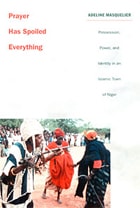
Prayer Has Spoiled Everything
Possession, Power, and Identity in an Islamic Town of NigerAdeline Masquelier
Duke University Press, 2001
Bori, in the Mawri society of Niger, are mischievous and invisible beings that populate the bush. Bori is also the practice of taming these wild forces in the context of possession ceremonies. In Prayer Has Spoiled Everything Adeline Masquelier offers an account of how this phenomenon intervenes—sometimes subtly, sometimes dramatically—in human lives, providing a constantly renewed source of meaning for Mawri peasants confronted with cultural contradictions and socio-economic marginalization.
To explore the role of bori possession in local definitions of history, power, and identity, Masquelier spent a total of two years in Niger, focusing on the diverse ways in which spirit mediums share, transform, and contest a rapidly changing reality, threatened by Muslim hegemony and financial hardship. She explains how the spread of Islam has provoked irreversible change in the area and how prayer—a conspicuous element of daily life that has become virtually synonymous with Islamic practice in this region of west Africa—has thus become equated with the loss of tradition. By focusing on some of the creative and complex ways that bori at once competes with and borrows from Islam, Masquelier reveals how possession nonetheless remains deeply embedded in Mawri culture, representing more than simple resistance to Islam, patriarchy, or the state. Despite a widening gap between former ways of life and the contradictions of the present, it maintains its place as a feature of daily life in which villagers participate with varying degrees of enthusiasm and approval.
Specialists in African studies, in the anthropology of religion, and in the historical transformations of colonial and postcolonial societies will welcome this study.
[more]