Results by title
77 books match the query 'Congress' and 4 start with p
Parties and Leaders in the Postreform House
David W. Rohde
University of Chicago Press, 1991
Since the Second World War, congressional parties have been characterized as declining in strength and influence. Research has generally attributed this decline to policy conflicts within parties, to growing electoral independence of members, and to the impact of the congressional reforms of the 1970s. Yet the 1980s witnessed a strong resurgence of parties and party leadership—especially in the House of Representatives.
Offering a concise and compelling explanation of the causes of this resurgence, David W. Rohde argues that a realignment of electoral forces led to a reduction of sectional divisions within the parties—particularly between the northern and southern Democrats—and to increased divergence between the parties on many important issues. He challenges previous findings by asserting that congressional reform contributed to, rather than restrained, the increase of partisanship. Among the Democrats, reforms siphoned power away from conservative and autocratic committee chairs and put control of those committees in the hands of Democratic committee caucuses, strengthening party leaders and making both party and committee leaders responsible to rank-and-file Democrats. Electoral changes increased the homogeneity of House Democrats while institutional reforms reduced the influence of dissident members on a consensus in the majority party. Rohde's accessible analysis provides a detailed discussion of the goals of the congressional reformers, the increased consensus among Democrats and its reinforcement by their caucus, the Democratic leadership's use of expanded powers to shape the legislative agenda, and the responses of House Republicans. He also addresses the changes in the relationship between the House majority and the president during the Carter and Reagan administrations and analyzes the legislative consequences of the partisan resurgence.
A readable, systematic synthesis of the many complex factors that fueled the recent resurgence of partisanship, Parties and Leaders in the Postreform House is ideal for course use.
[more]
Paul Wellstone
The Life of a Passionate ProgressiveBill Lofy
University of Michigan Press, 2005
"Paul Wellstone, we miss you. Few politicians, especially these days, are as willing to stand up and speak the truth as Wellstone was. In this era of flaccid rhetoric and pre-approved sound bites, he had the rare ability to ignite a fire in his audiences. Bill Lofy's excellent biography rekindles that fire and reminds us just how much politicians of Wellstone's honesty, character, and spine are needed---now more than ever. This book should inspire a new generation of voters and political leaders alike."
---Arianna Huffington, columnist and editor of HuffingtonPost.com
"This book captures the vibrant spirit of my friend Paul Wellstone---the fierce commitment to justice that defined his life, and that shapes his enduring legacy."
---U.S. Senator Russ Feingold
"Paul Wellstone was a great leader because he fused progressive idealism with a stubbornly pragmatic politics. Bill Lofy's book captures that dual commitment in his story of Wellstone's life, and also shows us the extraordinary human appeal that Wellstone emanated in his relationships with people in all walks of life. This book is an engaging read that also tells us a lot about the political practice to which we should aspire."
---Frances Fox Piven, author of The War at Home
"This vividly written book captures the life and personal qualities of the late Senator Paul Wellstone. In so doing it provides an illuminating gloss on Max Weber's seminal exposition of the political vocation. It is a jewel of a book."
-Fred Greenstein, Princeton University
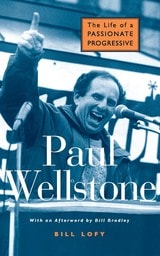
Bill Lofy's fast-paced and readable biography tells the inspirational story of one of the most compelling figures in the history of American politics---Senator Paul Wellstone.
Yet Lofy's book is more than just the chronicle of Wellstone's life and political career; it's also an indispensable guide to what ails political life today. Readers politically inclined or not will find in its pages a handbook to the uncertain and often treacherous business of politics and a stirring example for living a courageous and honest life---whether as public servant or private individual.
[more]
Philip Hart
the conscience of the SenateMichael O'Brien
Michigan State University Press, 1995
Never a fiery orator nor a seeker of headlines, Phil Hart earned after eighteen years in congress the title of "The Conscience of the Senate" from colleauges on both sides of the aisle. Author and sponsor of critical legislation, particulalry in the areas of civil rights, antitrust enforcement, and consumer and and environmental protection, Hart took great pride in the fact that he was a leader in the Senate fight for the Voting Rights Act of 1965. He was intelligent and committed, idealistic and courageous, honest and humble, taking stands on contraversial issues. A role model for many, an inspiration for others, the extent of his influence was demonstrated in the fall of 1976 as he was retiring from the Senate and dying of cancer. In a tribute to his distinguished career, Senator Edward Kennedy suggested that the new Senate building be named after Hart. A bill sponsored by 85 senators passed, and the new structure became the Phil A. Hart Senate Office Building. "Naming it for Phil Hart was a nice gesture," wrote columnist Mary McGrory, "and if they could build his qualities...into the walls, we would have a Senate that would astound the world with its civility and enlightenment."
[more]
Power Shifts
Congress and Presidential RepresentationJohn A. Dearborn
University of Chicago Press, 2021
That the president uniquely represents the national interest is a political truism, yet this idea has been transformational, shaping the efforts of Congress to remake the presidency and testing the adaptability of American constitutional government.
The emergence of the modern presidency in the first half of the twentieth century transformed the American government. But surprisingly, presidents were not the primary driving force of this change—Congress was. Through a series of statutes, lawmakers endorsed presidential leadership in the legislative process and augmented the chief executive’s organizational capacities.
But why did Congress grant presidents this power? In Power Shifts, John A. Dearborn shows that legislators acted on the idea that the president was the best representative of the national interest. Congress subordinated its own claims to stand as the nation’s primary representative institution and designed reforms that assumed the president was the superior steward of all the people. In the process, Congress recast the nation’s chief executive as its chief representative.
As Dearborn demonstrates, the full extent to which Congress’s reforms rested on the idea of presidential representation was revealed when that notion’s validity was thrown into doubt. In the 1970s, Congress sought to restore its place in a rebalanced system, but legislators also found that their earlier success at institutional reinvention constrained their efforts to reclaim authority. Chronicling the evolving relationship between the presidency and Congress across a range of policy areas, Power Shifts exposes a fundamental dilemma in an otherwise proud tradition of constitutional adaptation.
[more]