Results by title
66 books match the query 'Constitutions' and 4 start with p
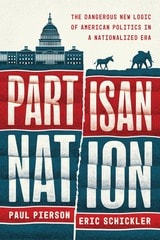
Partisan Nation
The Dangerous New Logic of American Politics in a Nationalized EraPaul Pierson and Eric Schickler
University of Chicago Press, 2024
A provocative exploration of how America’s democratic crisis is rooted in a dangerous mismatch between our Constitution and today’s nationalized, partisan politics.
The ground beneath American political institutions has moved, with national politics subsuming and transforming the local. As a result, American democracy is in trouble.
In this paradigm-shifting book, political scientists Paul Pierson and Eric Schickler bring a sharp new perspective to today’s challenges. Attentive to the different coalitions, interests, and incentives that define the Democratic and Republican parties, they show how contemporary polarization emerged in a rapidly nationalizing country and how it differs from polarization in past eras. In earlier periods, three key features of the political landscape—state parties, interest groups, and media—varied locally and reinforced the nation’s stark regional diversity. But this began to change in the 1960s as the two parties assumed clearer ideological identities and the power of the national government expanded, raising the stakes of conflict. Together with technological and economic change, these developments have reconfigured state parties, interest groups, and media in self-reinforcing ways. The result is that today’s polarization is self-perpetuating—and intensifying.
Partisan Nation offers a powerful caution. As a result of this polarization, America’s political system is distinctly and acutely vulnerable to an authoritarian movement emerging in the contemporary Republican Party, which has both the motive and the means to exploit America’s unusual Constitutional design. Combining the precision and acuity characteristic of their earlier work, Pierson and Schickler explain what these developments mean for American governance and democracy.

Populist Seduction in Latin America
Carlos de la Torre
Ohio University Press, 2010
Is Latin America experiencing a resurgence of leftwing governments, or are we seeing a rebirth of national-radical populism? Are the governments of Hugo Chávez, Evo Morales, and Rafael Correa becoming institutionalized as these leaders claim novel models of participatory and direct democracy? Or are they reenacting older traditions that have favored plebiscitary acclamation and clientelist distribution of resources to loyal followers? Are we seeing authentic forms of expression of the popular will by leaders who have empowered those previously disenfranchised? Or are these governments as charismatic, authoritarian, and messianic as their populist predecessors?
This new and expanded edition of Populist Seduction in Latin America explores the ambiguous relationships between democracy and populism and brings de la Torre’s earlier work up to date, comparing classical nationalist, populist regimes of the 1940s, such as those of Juan Perón and José María Velasco Ibarra, with their contemporary neoliberal and radical successors. De la Torre explores their similarities and differences, focusing on their discourses and uses of political symbols and myths.
Presidential Accountability in Wartime
President Bush, the Treatment of Detainees, and the Laws of WarStuart Streichler
University of Michigan Press, 2023
The American presidency has long tested the capacity of the system of checks and balances to constrain executive power, especially in times of war. While scholars have examined presidents starting military conflicts without congressional authorization or infringing on civil liberties in the name of national security, Stuart Streichler focuses on the conduct of hostilities. Using the treatment of war-on-terror detainees under President George W. Bush as a case study, he integrates international humanitarian law into a constitutional analysis of the repercussions of presidential war powers for human rights around the world.
Putting President Bush’s actions in a wider context, Presidential Accountability in Wartime begins with a historical survey of the laws of war, with particular emphasis on the 1949 Geneva Conventions and the Nuremberg Tribunal. Streichler then reconstructs the decision-making process that led to the president’s approval of interrogation methods that violated Geneva’s mandate to treat wartime captives humanely. While taking note of various accountability options—from within the executive branch to the International Criminal Court—the book illustrates the challenge in holding presidents personally responsible for violating the laws of war through an in-depth analysis of the actions taken by Congress, the Supreme Court, and the public in response. In doing so, this book not only raises questions about whether international humanitarian law can moderate wartime presidential behavior but also about the character of the presidency and the American constitutional system of government.
Presidents, Populism, and the Crisis of Democracy
William G. Howell and Terry M. Moe
University of Chicago Press, 2020
The most visible cause is Donald Trump, who has used his presidency to attack the nation’s institutions and violate its democratic norms. Yet Trump is but a symptom of causes that run much deeper: social forces like globalization, automation, and immigration that for decades have generated economic harms and cultural anxieties that our government has been wholly ineffective at addressing. Millions of Americans have grown angry and disaffected, and populist appeals have found a receptive audience. These are the drivers of Trump’s dangerous presidency. And after he leaves office, they will still be there for other populists to weaponize.
What can be done to safeguard American democracy? The disruptive forces of modernity cannot be stopped. The solution lies, instead, in having a government that can deal with them—which calls for aggressive new policies, but also for institutional reforms that enhance its capacity for effective action.
The path to progress is filled with political obstacles, including an increasingly populist, anti-government Republican Party. It is hard to be optimistic. But if the challenge is to be met, we need reforms of the presidency itself—reforms that harness the promise of presidential power for effective government, but firmly protect against the fear that it may be put to anti-democratic ends.