Results by title
341 books match the query 'Cooking' and 12 start with p
P.E.O. Cookbook
Souvenir EditionDavid E. Schoonover
University of Iowa Press, 1992
Pacific Northwest Cheese
A HistoryTami Parr
Oregon State University Press, 2013
For years, farmers in the Pacific Northwest made and sold cheese to support themselves, but over time the craft of cheesemaking became a profitable industry and production was consolidated into larger companies and cooperatives. Eventually, few individual cheesemakers were left in the region. In the late sixties and early seventies, influenced by the counterculture and back-to-the-land movements, the number of small farms and cheesemakers began to grow, initiating an artisan cheese renaissance that continues today.
Along with documenting the history of cheese in the region, Parr reveals some of the Pacific Northwest’s untold cheese stories: the fresh cheese made on the Oregon Trail, the region’s thriving blue cheese and regional swiss cheese makers, and the rise of goat’s milk and goat’s milk cheese (not the modern phenomenon many assume it to be).

Penny Loafers & Bobby Pins
Tales and Tips from Growing Up in the ’50s and ’60sSusan Sanvidge
Wisconsin Historical Society Press, 2010
“In the fifties, sleek Mixmasters were replacing rusty eggbeaters, and new pressure-cookers blew their tops in kitchens all over town. There were kids everywhere, and new ‘ranch-style’ houses filled vacant lots. . . . Turquoise Studebakers and dusty-rose Chevy BelAirs with flamboyant fins and lots of chrome replaced dark pre-war cars. Cameras took color snapshots instead of black-and-white. We wore red canvas tennis shoes and lemon yellow shorts, and bright blue popsicles melted down our chins.” —from the Introduction
Pizza City, USA
101 Reasons Why Chicago Is America's Greatest Pizza TownSteve Dolinsky, Foreword by Grant Achatz
Northwestern University Press, 2018
There are few things that Chicagoans feel more passionately about than pizza. Most have strong opinions about whether thin crust or deep-dish takes the crown, which ingredients are essential, and who makes the best pie in town.
And in Chicago, there are as many destinations for pizza as there are individual preferences. Each of the city's seventy-seven neighborhoods is home to numerous go-to spots, featuring many styles and specialties. With so many pizzerias, it would seem impossible to determine the best of the best.
Enter renowned Chicago-based food journalist Steve Dolinsky! In Pizza City, USA: 101 Reasons Why Chicago Is America's Greatest Pizza Town, Dolinsky embarks on a pizza quest, methodically testing more than a hundred different pizzas in Chicagoland. Zestfully written and thoroughly researched, Pizza City, USA is a hunger–inducing testament to Dolinsky's passion for great, unpretentious food.
This user-friendly guide is smartly organized by location, and by the varieties served by the city's proud pizzaioli–including thin, artisan, Neapolitan, deep-dish and pan, stuffed, Sicilian, Roman, and Detroit-style, as well as by-the-slice. Pizza City also includes Dolinsky's "Top 5 Pizzas" in several categories, a glossary of Chicago pizza terms, and maps and photos to steer devoted foodies and newcomers alike.
Plain but Wholesome
Foodways of the Mormon PioneersBrock Cheney
University of Utah Press, 2012
Plain But Wholesome presents a groundbreaking foray into Mormon history. Brock Cheney explores the foodways of Mormon pioneers from their trek west through the arrival of the railroad and reveals new perspectives on the fasci-nating Mormon settlement era. Relying on original diaries, newspaper accounts, and recipe books from the 1850s, Cheney draws a vivid portrait of what Mormon pioneers ate and drank. Although other authors have sketched the subject before, this portrait is the first effort that might be described as scholarly, though the lively prose will interest a broad general audience.
Presented here are the first explicit descriptions of the menus, food processes, and recipes of the Mormon pioneers. While many have supposed that earlier pioneer foodways continued to be handed down through Mormon families, Cheney has confirmed traditions going back generations and covering more than a century. The book also exposes myths and clichés about pioneer piety and hardships, as Cheney examines such pioneer extravagances as fresh “oysters on the half shell” and pioneer trends of alcohol consumption.
A perfect gift for the history buff or Dutch oven chef, Plain But Wholesome will also prove its place among scholars and historians. With its rollicking blend of historical source material and modern interpretation, this book will entertain and educate novice and expert alike.
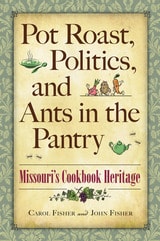
Pot Roast, Politics, and Ants in the Pantry
Missouri's Cookbook HeritageCarol Fisher & John Fisher
University of Missouri Press, 2008
When is a cookbook more than just a cookbook? When it’s a gateway to our culinary heritage. For well over a hundred years, Missouri’s cookbooks have helped readers serve up tasty dishes to the state’s tables, but these publications also document the evolution of our kitchens and households.
Pot Roast,Politics, and Ants in the Pantry, a treasure trove of anecdotes and nuggets of historical information about cookery in the Show-Me State, draws from more than 150 publications to reveal Missouri’s cookbook heritage and to deliver a generous sampling of recipes. Carol Fisher and John Fisher look back to manuscript cookbooks from 1821 St. Louis, then progress through the years and around Missouri before arriving at today’s online recipes. Along the way, they dish out servings of kitchen medicine, household hints, and cookbook literature gleaned from the state’s cache of culinary gems.
From handwritten family recipe collections and mimeographed publications to glossy color editions, the texts the Fishers have obtained from libraries and historical societies as well as their own extensive cookbook collection include such curiosities as the Julia Clark Household Memoranda Book from the William Clark papers, an 1880 production by the Ladies of St. Louis called My Mother’s Cookbook, Mary Foote Henderson’s Practical Cooking and Dinner Giving, and Albert E. Brumley’s All-Day Singin’ and Dinner on the Ground. They tell how various ethnic communities raised money by creating cookbooks, how the state’s Beef Council and Pork Association put recipes on the Internet, and how restaurants like the Blue Owl in Kimmswick and Stephenson’s Apple Farm Restaurant near Kansas City enhanced their reputations with their own cookbooks. Festival cookbooks, company cookbooks, even cookbooks tied to world events—they’re all here in one delightful book.
In this vastly entertaining review, readers will learn where to find recipes for dandelion wine, mock turtle soup (requiring a large calf’s head split open by the butcher), and vinegar pie—as well as the curative properties of potato water, tips for raising chickens in the basement, and even “how to cook a husband.” An extensive bibliography includes information to help readers track down the books discussed and also those on their own wish lists.
Pot Roast, Politics, and Ants in the Pantry: Missouri’s Cookbook Heritage shows how, instead of being just collections of recipes, cookbooks provide history lessons, document changing food ways, and demonstrate the cultural diversity of the state. From Julia Clark’s simple frontier recipes for puddings and preserves to Irma Rombauer’s encyclopedic Joy of Cooking—originally self-published in Missouri—Carol Fisher and John Fisher have laid out a smorgasbord of reading pleasure for cookbook collectors, nostalgia buffs, and gourmands alike.
Practice of Everyday Life
Volume 2: Living and CookingMichel De Certeau
University of Minnesota Press, 1998
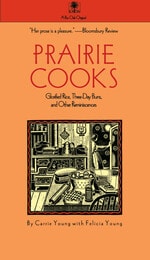
Prairie Cooks
Glorified Rice Three-Day BunsCarrie Young
University of Iowa Press, 1993
Growing up in a Norwegian American community imbued with the customs and foods of the Old Country, Carrie Young recalls how her mother and her neighbors skillfully blended Scandinavian with what they always called the American style of cooking. Young recounts how her mother, Carrine Gafkjen—after homesteading as a single woman in 1904—cooked for a large threshing crew during harvest season. Living and cooking around the clock in a cook car the size of a Pullman kitchen, she delighted the crew with her soda pancakes and her sour cream doughnuts, her fattigman (Poor Man's Cookies) and her fabulous North Dakota Lemon Meringue Pie.
During holidays lutefisk and lefse reigned supreme, but when the Glorified Rice fad swept the country in the thirties women broke new ground with inventive variations. And the short-lived but intensely experienced Three-Day Bun Era (when the buns became so ethereal they were in danger of floating off the plate) kept the Ladies Aid luncheons competitive. Whatever the times, in good years or bad, there was always the solace ofKaffe Tid, the forenoon and afternoon coffee time, when the table was set with smor og brod (butter and bread) and something sweet, like a Whipped Cream Cake or Devil's Food Cake with Rhubarb Sauce.
This book will appeal to those who feel nostalgia for a parent's or grandparent's cooking, to those who have a longing for the heartier fare of times past. The author's daughter, Felicia Young, who has "cooked Scandinavian since she was old enough to hold a lefse stick," has compiled and tested the seventy-two recipes accompanying this joyful memoir.
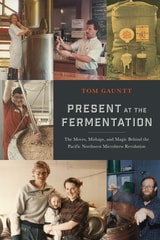
Present at the Fermentation
The Moves, Mishaps, and Magic Behind the Pacific Northwest Microbrew RevolutionTom Gauntt
Oregon State University Press, 2027
From ale romantics to hopheads, the Pacific Northwest is a haven for beer lovers. Considered a mecca for beer enthusiasts, the Northwest earned its reputation from a group of emerging brewers in the 1980s who established a demand for craft beer throughout and beyond the region. Brewing guru Fred Eckhardt, the Grateful Dead–loving McMenamin brothers, the effervescent Art Larrance, the determined Widmer brothers, and entrepreneurial pub owner Don Younger were among the open-minded, vibrant crew who founded a microbrewery industry that became a model for a new era.
“For those intimately involved or those who merely had a barstool view of the microbrewing revolution, the first decade of the movement was an intoxicating passage from anonymity to celebrity,” writes Tom Gauntt in the introduction. Present at the Fermentation celebrates the rich history of beermaking and those who transformed the business in the Pacific Northwest. Through press coverage of the time, interviews, oral histories, and personal memory, Gauntt offers an engaging history of one of Oregon’s signature industries.
With more than 9,700 craft brewers now operating in the US, there remains a passion for craft brewing and pride in creating the perfect ale in this evolving market. So, pour a pint and learn how Pacific Northwest microbreweries persevered through risk, hard work, foibles, and a lot of luck to create award-winning beer, connect with their communities, and build thriving businesses.
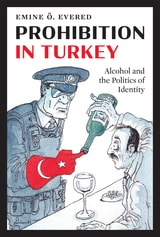
Prohibition in Turkey
Alcohol and the Politics of IdentityEmine Ö. Evered
University of Texas Press, 2024
A social history of alcohol, identity, secularism, and modernization from the late Ottoman and early Turkish republican eras to the present day.
Prohibition in Turkey investigates the history of alcohol, its consumption, and its proscription as a means to better understand events and agendas of the late Ottoman and early Turkish republican eras. Through a comprehensive examination of archival, literary, popular culture, media, and other sources, it unveils a traditionally overlooked—and even excluded—aspect of human history in a region that many do not associate with intoxicants, inebriation, addiction, and vigorous wet-dry debates.
Historian Emine Ö. Evered’s account uniquely chronicles how the Turko-Islamic Ottoman Empire developed strategies for managing its heterogeneous communities and their varied rights to produce, market, and consume alcohol, or to simply abstain. The first author to reveal this experience’s connections with American Prohibition, she demonstrates how—amid modernization, sectarianism, and imperial decline—drinking practices reflected, shifted, and even prompted many of the changes that were underway and that hastened the empire’s collapse. Ultimately, Evered’s book reveals how Turkey’s alcohol question never went away but repeatedly returns in the present, in matters of popular memory, public space, and political contestation.
Project 258
Making Dinner at Fish & GameBy Zakary Pelaccio and Peter Barrett
University of Texas Press, 2017
Fish & Game restaurant in Hudson, New York, is a leader in the local foods movement. Its core approach—engaging intimately with nature both wild and domestic, building relationships with farmers, and exploring the joys of fermentation—is one of interest to anyone, anywhere, who yearns to cook and eat better food. Established in 2013, Fish & Game, with its chef/owner Zakary Pelaccio and his co-chefs and partners Kevin Pomplun and Jori Jayne Emde, is already receiving national accolades and honors, including the 2016 James Beard Award for Best Chef: Northeast; 2015 James Beard Award finalist for Outstanding Restaurant Design; 2015 & 2016 Wine Enthusiast: America’s 100 Best Wine Restaurants; and 2014 James Beard Award semifinalist for Best New Restaurant.
Project 258: Making Dinner at Fish & Game presents an enticing selection of seasonal recipes, profiles of key producers who supply the restaurant, and a fascinating, beautifully illustrated look at the processes—both intellectual and culinary—behind the food at Fish & Game. Taking no shortcuts, Pelaccio and his staff handcraft many staple ingredients, including fish sauce, vinegars, maple syrup, and prosciutto. He explains how the methods and techniques practiced at Fish & Game can be applied to the food that grows wherever you live. If you ever wonder “what does this place taste like?,” let Project 258 be your guide and inspiration for locally based food sourcing and eating.
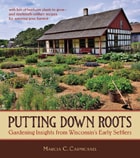
Putting Down Roots
Gardening Insights from Wisconsin’s Early SettlersMarcia C. Carmichael
Wisconsin Historical Society Press, 2013