69 books match the query 'Country life' and 6 start with p
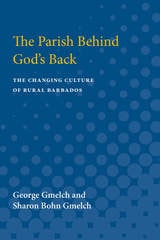
cover of Parish behind God's Back: The Changing Culture of Rural Barbados

Parish behind God's Back

The Changing Culture of Rural Barbados

George Gmelch and Sharon Bohn Gmelch

University of Michigan Press, 1997
One of the first things any visitor to Barbados notices is Barbadian youths wearing baseball caps and T-shirts sporting the logos of North American teams; and these days, one is more likely to find an American sitcom on television than a Caribbean program. The Parish behind God's Back describes the social fabric and everyday life of one rural parish on the island, St. Lucy, including its many links to the outside world. It is a contemporary ethnography of the local that takes into account the enormous influence of global factors such as tourism, television, foreign travel, and return migrants. Written with students in mind, the book contains several unique features. Each chapter blends descriptions of Barbadian culture with comparisons to North America; throughout, the authors include tales of not only their own fieldwork experiences but those of their undergraduate students; and personal narratives are emphasized to engage interest in individuals. This highly readable and thought-provoking account should appeal to general readers with an interest in the Caribbean as well as to students of anthropology. George Gmelch is Professor and Chair, Department of Anthropology, Union College. Sharon Bohn Gmelch is Professor of Anthropology and Director of Women's Studies, Union College.
[more]
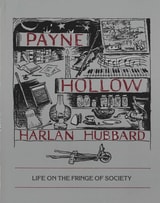
cover of Payne Hollow: Life on the Fringe of Society

Payne Hollow

Life on the Fringe of Society

Harlan Hubbard

Ohio University Press, 1997

Originally published in 1974, this second edition was published by Gnomon Press in 1997.Payne Hollow is a reflective and poetic memoir that details the simple, self-sufficient life Harlan Hubbard and his wife, Anna, led along the banks of the Ohio River in the 1950s–80s. After living on a shantyboat for eight years, the Hubbards crafted a custom home and studio at Payne Hollow, in Trimble County, Kentucky, where they lived off the land and embraced a lifestyle focused on nature, art, and solitude. The book, illustrated with Harlan’s own ink drawings, captures the couple’s philosophy of living in harmony with the natural world, free from the distractions and demands of modern society. Hubbard eloquently describes in words and images their daily routines, the changing seasons, and the deep satisfaction he and Anna found in their way of life. Through his writing, Hubbard rejoices in the return to simplicity and creates an appreciation for the living world, making Payne Hollow not just a memoir, but a model for building a deliberate, mindful life in tune with nature.
[more]
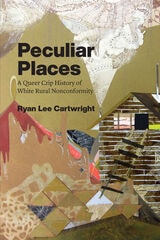
cover of Peculiar Places: A Queer Crip History of White Rural Nonconformity

Peculiar Places

A Queer Crip History of White Rural Nonconformity

Ryan Lee Cartwright

University of Chicago Press, 2021

The queer recluse, the shambling farmer, the clannish hill folk—white rural populations have long disturbed the American imagination, alternately revered as moral, healthy, and hardworking, and feared as antisocial or socially uncouth. In Peculiar Places, Ryan Lee Cartwright examines the deep archive of these contrary formations, mapping racialized queer and disability histories of white social nonconformity across the rural twentieth-century United States.

Sensationalized accounts of white rural communities’ aberrant sexualities, racial intermingling, gender transgressions, and anomalous bodies and minds, which proliferated from the turn of the century, created a national view of the perversity of white rural poverty for the American public. Cartwright contends that these accounts, extracted and estranged from their own ambivalent forum of community gossip, must be read in kind: through a racialized, materialist queercrip optic of the deeply familiar and mundane. Taking in popular science, documentary photography, news media, documentaries, and horror films, Peculiar Places orients itself at the intersections of disability studies, queer studies, and gender studies to illuminate a racialized landscape both profoundly ordinary and familiar.
 
[more]
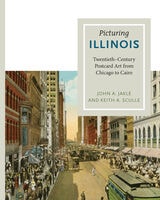
cover of Picturing Illinois: Twentieth-Century Postcard Art from Chicago to Cairo

Picturing Illinois

Twentieth-Century Postcard Art from Chicago to Cairo

John A. Jakle and Keith A. Sculle

University of Illinois Press, 2012
The American picture postcard debuted around the start of the twentieth century, creating an enthusiasm for sending and collecting postcard art that continued for decades. As a form of popular culture, scenic postcards strongly influenced how Americans conceptualized both faraway and nearby places through portrayals of landscapes, buildings, and historic sites. In this gloriously illustrated history of the picture postcard in Illinois, John A. Jakle and Keith A. Sculle study a rich and diverse set of images that chronicle what Illinoisans considered attractive, intriguing, and memorable. They also discuss how messages written on postcards reveal the sender's personal interpretation of local geography and scenery.
 
The most popularly depicted destination was Chicago, America's great boomtown.Its portraits are especially varied, showing off its high-rise architecture, its teeming avenues, and the vitality of its marketplaces and even slaughterhouses. Postcards featuring downstate locales, however, elaborated and reinforced stereotypes that divided the state, portraying the rest of Illinois as the counterpoint to Chicago's urban bustle. Scores of cards from Springfield, Peoria, Bloomington-Normal, Urbana-Champaign, Quincy, and Vandalia emphasize wide-open prairies, modest civic edifices, and folksy charm. The sense of dichotomy between Chicago and the rest of Illinois was, of course, a substantial fallacy, since the city's very prosperity depended upon the entire state's fertile farmlands, natural resources, and small industries.
 
Jakle and Sculle follow this dialogue between urban Chicago and rural downstate as it is illustrated on two hundred vintage postcards, observing both their common conventions and their variety. They also discuss the advances in printing technology in the early 1900s that made mass appeal possible. Providing rich historical and geographical context, Picturing Illinois: Twentieth-Century Postcard Art from Chicago to Cairo illustrates the picture postcard's significance in American popular culture and the unique ways in which Illinoisans pictured their world.
[more]
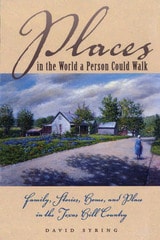
cover of Places in the World a Person Could Walk: Family, Stories, Home, and Place in the Texas Hill Country

Places in the World a Person Could Walk

Family, Stories, Home, and Place in the Texas Hill Country

By David Syring

University of Texas Press, 2000

Spring-fed creeks. Old stone houses. Cedar brakes and bleached limestone. The Hill Country holds powerful sway over the imagination of Texans. So many of us dream of having our own little place in the limestone hills. The Hill Country feels just like home, even if you've never lived there.

This beautifully written book explores what the Hill Country has meant as a homeplace to the author, his family, and longtime residents of the area, as well as to newcomers. David Syring listens to the stories that his aunts, uncles, and cousins tell about life in the Hill Country and grapples with their meaning for his own search for a place to belong. He also collects short stories focused around Honey Creek Church to consider how places become containers for memory. And he draws upon several years of living in Fredericksburg to talk about the problems and opportunities created by heritage tourism and the development of the town as a "home" for German Americans. These interconnected stories illuminate what it means to belong to a place and why the Texas Hill Country has become the spiritual, if not actual, home of many people.
[more]
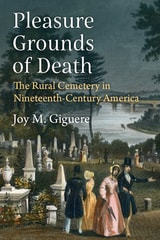
cover of Pleasure Grounds of Death: The Rural Cemetery in Nineteenth-Century America

Pleasure Grounds of Death

The Rural Cemetery in Nineteenth-Century America

Joy M. Giguere

University of Michigan Press, 2024

Rural cemeteries—named for their expansive, picturesque landscape design rather than location—were established during the middle decades of the nineteenth century in the United States. An instant cultural phenomenon, Mount Auburn Cemetery in Cambridge, Massachusetts, was the nation’s first such burial ground to combine the functions of the public park and the cemetery, becoming a popular place to picnic and go for strolls even for people who didn’t have graves to visit. It sparked a nationwide movement in which communities sought to establish their own cities of the dead. 

Pleasure Grounds of Death considers the history of the rural cemetery in the United States throughout the duration of the nineteenth century as not only a critical cultural institution embedded in the formation of community and national identities, but also as major sites of contest over matters of burial reform, taste and respectability, and public behavior; issues concerning race, class, and gender; conflicts over the burial of the Civil War dead and formation of postwar memory; and what constituted the most appropriate ways to structure the landscape of the dead in a modern and progressive society. As cultural landscapes that served the needs of the living as well as the dead, rural cemeteries offer a mirror for the transformations and conflicts taking place throughout the nineteenth century in American society.
[more]