56 books match the query 'Crafts & Hobbies' and 6 start with p

cover of Patchwork: Iowa Quilts and Quilters

Patchwork

Iowa Quilts and Quilters

Jacqueline Andre Schmeal

University of Iowa Press, 2003
Frugal, thrifty, enduring, colorful, comforting, warm. These words capture both the spirit of Iowa quilters through the centuries and the fabrics they stitched together. In Patchwork, Jacqueline Schmeal celebrates the lives of Iowa quilters and the enduring beauty of historic Iowa quilts.
Drawing on written records by and interviews with contemporary quilters, many of whom were born in the early years of the twentieth century, Schmeal presents the life histories of these hard-working yet inspired artists. Sisters Elsie Ball and Mary Ball Jay of Fairfield—charging one and a quarter cents per yard of thread—kept meticulous records of each of the 135 quilts they stitched between 1935 and 1970. Ivan Johnson plowed his fields by day and quilted vivid designs by night. Cloth scraps were so precious to Barbara Chupp, an Amish quilter, that she became known for her mosaic piecing. Members of the Sunshine Circle, organized in 1912 in a Quaker church in Earlham, still quilt together today. Mennonite quilter Sara Miller became famous nationwide for her fabric store, Kalona Kountry Kreations. Their stories—of impoverished childhoods, hardscrabble work, and strong families—are enhanced by over seventy color photographs of an unbelievably rich collection of historic quilts ranging from the early 1800s to the 1950s.
Offering both a glimpse into the daily lives of twentieth-century quiltmakers and an amazing treasury of Iowa's historic quilts, Patchwork is a loving tribute to the creative spirit that links modern-day quilters to the patterns and traditions of their predecessors.
[more]
cover of Pattern and Loom: A Practical Study of the Development of Weaving Techniques in China, Western Asia and Europe

Pattern and Loom

A Practical Study of the Development of Weaving Techniques in China, Western Asia and Europe

John Becker

National University of Singapore Press, 2014
When John Becker's Pattern and Loom was posthumously published in 1987, the work was hailed as an important work that revealed much new knowledge on the development of weaving techniques across the centuries from China through to Europe. The key to the book's almost forensic investigation of its subject was the author himself, a Danish damask weaver with a lifetime's practical experience in his craft and an intimate knowledge of weaving techniques that allowed him to decipher, experiment and interpret original techniques from small remnants of surviving material. Long out of print, the work has been tidied and reset by Becker's collaborator on the original work, the sinologist Don Wagner.
[more]
cover of Peasants, Warriors, and Wives: Popular Imagery in the Reformation

Peasants, Warriors, and Wives

Popular Imagery in the Reformation

Keith Moxey

University of Chicago Press, 2004
In Peasants, Warriors, and Wives, Keith Moxey examines woodcut images from the German Reformation that have often been ignored as a crude and inferior form of artistic production. In this richly illustrated study, Moxey argues that while they may not satisfy received notions of "art," they nevertheless constitute an important dimension of the visual culture of the period. Far from being manifestations of universal public opinion, as a cursory acquaintance with their subject matter might suggest, such prints were the means by which the reformed attitudes of the middle and upper classes were disseminated to a broad popular audience.
[more]
cover of Perfumed: The Story of Fragrance in the Ancient Mediterranean

Perfumed

The Story of Fragrance in the Ancient Mediterranean

Annette Giesecke

J. Paul Getty Trust, The, 0

A heady look at the fascinating world of perfumes, incense, and other aromatics in the ancient Mediterranean and their vibrant and sometimes violent history.

Perfumed invites you to breathe deeply and inhale the incense burning on the altars of the Greeks, perfumes sprinkled on spectators in Roman amphitheaters or wafting from the robes of Persian kings, and unguents filling Egyptian tombs. Though we don’t know who first burned a fragrant branch to perfume their dwelling or rubbed an aromatic petal against their skin, evidence demonstrates that such practices were ubiquitous by the Bronze Age.

  • Opens with a richly illustrated overview of aromatics in Mesopotamia, Persia, Egypt, Greece, and Roman Italy.
  • Explores the role fragrance played in all aspects of daily life and details major ingredients, including balsam, frankincense, rose, myrrh, saffron, and more.
  • Features vivid passages from ancient sources, including perfume recipes and intriguing anecdotes such as the historian Herodotus’s account of winged serpents guarding frankincense trees in Arabia or Pliny the Elder’s claim that the emperor Nero burned a year’s harvest of frankincense for his wife’s funeral (after likely murdering her).
  • Contains over 80 images drawn from a diverse range of ancient sources and archaeological evidence.

Experience the ancient world through its most evocative sense. Best-selling author Annette Giesecke’s Perfumed is essential reading for anyone with an interest in plants, perfumes, and other aromatics, as well as the rich, interrelated cultures of the Mediterranean.
[more]
cover of Pottery Analysis: A Sourcebook

Pottery Analysis

A Sourcebook

Prudence M. Rice

University of Chicago Press, 1987
Pottery Analysis is a rich and comprehensive sourcebook that draws together diverse approaches to the study of pottery—archaeological, ethnographic, stylistic, functional, and physicochemical. Using pottery as a starting point for insights into people and culture, Prudence M. Rice examines in detail the methods for studying the fired clay vessels used worldwide from prehistoric times to present.
[more]
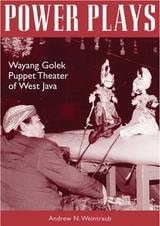
cover of Power Plays: Wayang Golek Puppet Theater of West Java

Power Plays

Wayang Golek Puppet Theater of West Java

Andrew N. Weintraub

Ohio University Press, 2004

Based on ethnographic fieldwork spanning twenty years, Power Plays is the first scholarly book in English on wayang golek, the Sundanese rod-puppet theater of West Java. It is a detailed and lively account of the ways in which performers of this major Asian theatrical form have engaged with political discourses in Indonesia. Wayang golek has shaped, as well, the technological and commercial conditions of art and performance in a modernizing society.

Using interviews with performers, musical transcriptions, translations of narrative and song texts, and archival materials, author Andrew N. Weintraub analyzes the shifting and flexible nature of a set of performance practices called Padalangan, the art of the puppeteer. He focuses on “superstar” performers and the musical troupes that dominated wayang golek during the New Order political regime of former president Suharto (1966-98) and the ensuing three years of the post-Suharto period. Studies of actual performances illuminate stylistic and formal elements and situate wayang golek as a social process in Sundanese culture and society. Power Plays includes an interactive multimedia CD-ROM of wayang golek.

Power Plays shows how meanings about identity, citizenship, and community are produced through theater, music, language, and discourse. While based in ethnographic theory and methods, this book is at the center of a new synthesis emerging among ethnomusicology, anthropology, and cultural studies. Its cross-disciplinary approach will inspire researchers studying similar struggles over cultural authority and popular representation in culture and the performing arts.
[more]